


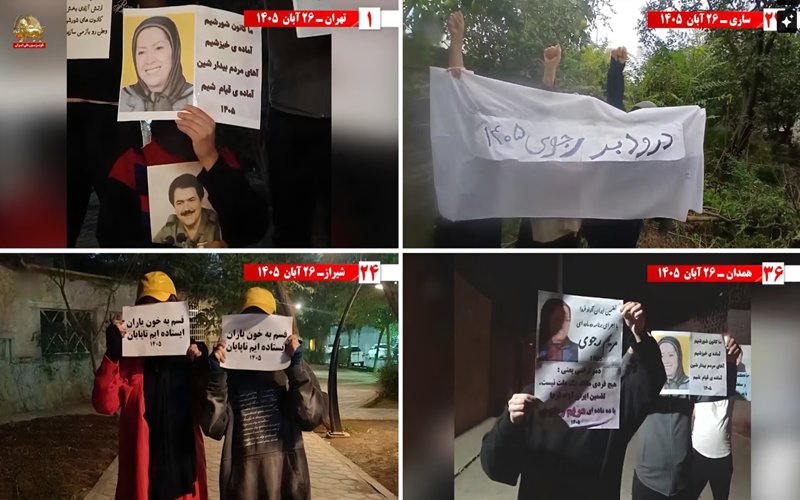

The sixth series of the November Uprising Campaign featured coordinated revolutionary activities, graffiti, and public displays in cities across Iran, honoring the uprising’s martyrs and reaffirming the demand for a democratic republic with neither monarchy nor clerical dictatorship.
The activities included collective public actions, slogans, graffiti, and photo campaigns in Tehran, Tabriz, Karaj, Mashhad, Shiraz, Isfahan, Shahin Shahr, Rasht, Gilan-e Gharb, Qazvin, Zanjan, Bushehr, Sari, Hamedan, Ramhormoz, Gorgan, and Zahedan.
The campaign’s messages emphasized the continuation of the struggle against both the clerical dictatorship and the former monarchy, the pursuit of a democratic republic, and the commitment to carry forward the sacrifices of those killed in successive uprisings.
One of the campaign’s central messages declared that the Iranian people had risen four times in eight years—in 2017, 2019, 2022, and 2025—and that another uprising was approaching.
Tehran: Rejecting both clerical and monarchical rule
In Tehran, Resistance Units organized several collective activities emphasizing the need to end clerical rule and the principle of hereditary monarchy.
Their slogans included:
- “The rule of the mullahs and the sovereignty of the cleric must end.”
- “With Maryam, toward liberation; with love for freedom and Maryam Rajavi’s Ten-Point Plan.”
- “A free Iran tomorrow is guaranteed through the implementation of Maryam Rajavi’s Ten-Point Plan.”
- “We are Resistance Units, ready to rise. Wake up, people! Let us prepare for an uprising.”
- “Democracy means that no individual owns a nation.”
- “Swearing by the blood of our comrades, we stand in the field for our homeland. We want neither a Mullah nor a sultan.”
Another message described the Ten-Point Plan as the path toward Iran’s liberation and declared readiness to continue the struggle until that goal was achieved.
Other activities stressed the Resistance Units’ determination to sustain their efforts, declaring that they would neither bend nor grow weary. One message invoked the blood of the uprising’s victims and the tears of bereaved mothers, pledging to establish a democratic republic in Iran.
Tabriz and Karaj: The November uprising’s legacy continues
In Tabriz, campaign materials featured messages attributed to Massoud and Maryam Rajavi commemorating the November uprising.
One message from Massoud Rajavi stated that the response of Iran’s children on the anniversary of the uprising should be maximum offensive action and a hundredfold struggle.
A message attributed to Maryam Rajavi emphasized that the November uprising demonstrated the continuity of rebellious youth movements.
Other slogans included “Death to Khamenei, hail to Rajavi.”
In Karaj, messages similarly honored the uprising’s martyrs, declaring that their blood continued to boil and ignite resistance. Another reiterated that the November 2019 uprising had demonstrated the continuing determination of rebellious young people to rise against the regime.
Mashhad: November 2019 as a lesson for future uprisings
In Mashhad, Resistance Units highlighted the political significance and lessons of the November 2019 uprising.
Their messages included statements attributed to Massoud Rajavi and Maryam Rajavi, recalling how the uprising brought the regime to the brink of overthrow and emphasizing the importance of its experiences as a guide for future resistance.
The campaign also featured the slogan:
“Death to Khamenei, hail to Rajavi.”
Shiraz and Isfahan: Honoring the martyrs and continuing their struggle
In Shiraz, collective activities connected the November 2019 uprising with the demand for justice for victims of the 1988 massacre of political prisoners.
One slogan declared:
“From 1988 to November, we seek justice for the blood of our comrades.”
Another stated:
“Swearing by the blood of our comrades, we stand firm until the end.”
In Isfahan, Resistance Units repeated the pledge to remain steadfast until freedom. One message compared fallen martyrs to towering cypress trees, declaring that their sacrifice had strengthened the determination of those continuing their path.
Other slogans called for the implementation of Maryam Rajavi’s Ten-Point Plan as the guarantee of a free Iran.
In nearby Shahin Shahr, activists declared their commitment to the People’s Mojahedin Organization of Iran (PMOI/MEK) and their opposition to religious reaction and dictatorship.
Rasht: Calls for freedom and an end to religious fascism
In Rasht, Resistance Units emphasized the role of organized resistance in achieving freedom and justice.
Their slogans included:
- “The Liberation Army is our path to freedom. Freedom and justice are once again coming into view.”
- “We are Iran’s children, leading the struggle in the field. With the Liberation Army, Iran will become a garden.”
- “We must fight until we tear apart the religious fascism, and the rule of the mullahs and the sovereignty of the cleric must end.”
These messages presented the struggle against the ruling system as a continuing national effort rather than an isolated protest movement.
Activities in other cities
The November Uprising Campaign also reached several other cities and towns.
In Gilan-e Gharb, activists displayed the message that the November uprising had demonstrated that resistance was the only path to liberation.
In Qazvin, a message attributed to Maryam Rajavi described the November uprising as having delivered devastating blows to the regime.
In Zanjan, a slogan attributed to Massoud Rajavi recalled that the blood of the martyrs, particularly those killed in November, continued to fuel resistance.
In Bushehr, activists connected the struggle for justice for the victims of the 1988 massacre and the November uprising. Another message called on freedom-seekers to rise up and rebel against oppression.
In Sari, campaign participants displayed the slogan “Hail to Rajavi.”
In Hamedan, a message again called for an end to clerical rule and the sovereignty of the mullahs.
Graffiti and photo campaigns reinforce the anti-dictatorship message
Alongside collective activities, Resistance Units carried out graffiti campaigns in several cities.
In Ramhormoz, wall slogans declared:
- “An awakened Iran rejects both the Shah and the Sheikh.”
- “After all these years of crimes, death to the rule of the supreme leader.”
In Tehran, graffiti featured the slogan “Death to Khamenei, hail to Rajavi,” while in Gorgan, activists displayed “Death to Khamenei.”
Additional graffiti and photo campaigns carrying the slogan “Hail to Rajavi” were reported in Isfahan, Gorgan, and Zahedan.
The November uprising’s unfinished demand for freedom
The 50 activities across Iran form part of the sixth series of the November Uprising Campaign, which seeks to keep alive the memory and political message of the nationwide protests of November 2019.
The campaign connects the sacrifices of the November martyrs with the subsequent uprisings of 2022 and 2025, emphasizing that popular opposition to the ruling system has continued despite executions, arrests, and widespread repression.
A recurring message throughout the activities was the rejection of both forms of dictatorship that have shaped Iran’s modern political history: the monarchy and the clerical regime.
The Resistance Units reaffirmed their commitment to a democratic republic, the Ten-Point Plan presented by Maryam Rajavi, and the continuation of organized resistance until the establishment of a free Iran.