


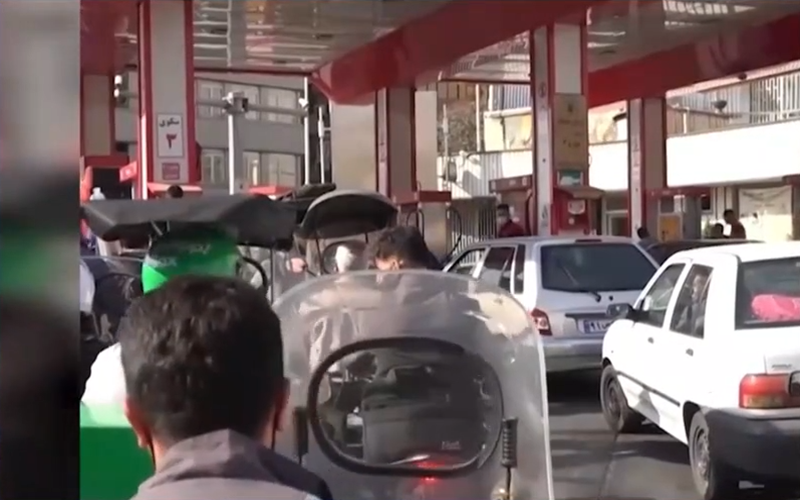

The regime has doubled the price of gasoline beyond the subsidized quota as consumption reaches record levels, imports become increasingly costly, and memories of the November 2019 uprising remain a powerful warning.
Iran’s regime has doubled the price of gasoline for high-volume consumers, raising the third-tier rate from 50,000 to 100,000 rials per liter as the country faces a widening fuel deficit, record consumption, and mounting economic pressures.
The new measure, implemented on September 7, applies to gasoline consumed beyond the existing monthly quota of 110 liters. The first 60 liters remain priced at 15,000 rials per liter, while the next 50 liters cost 30,000 rials. Only consumption beyond those subsidized quotas is now subject to the 100,000-rial rate. The government says the additional revenue will be directed toward supporting households.
But the measure is far more than a routine adjustment of fuel prices. It exposes the growing contradiction at the heart of the regime’s energy policy: Iran possesses some of the world’s largest oil and gas reserves, yet its limited refining capacity, inefficient vehicle fleet, subsidized prices, and rapidly rising consumption have forced it to import gasoline at enormous cost.
A gradual gasoline shock
The latest increase is the culmination of a process that has unfolded gradually.
For years, motorists were able to purchase 60 liters of gasoline per month at 15,000 rials per liter and an additional 100 liters at 30,000 rials. In December 2025, the regime introduced a third pricing tier, initially charging 50,000 rials per liter for consumption beyond the quota. During 2026, the second-tier quota was reduced first from 100 to 70 liters and then to 50 liters.
Now the third-tier price has been doubled again.
The incremental approach is significant. A sudden and across-the-board increase would immediately affect millions of households and could provoke a powerful social reaction. Instead, the regime has progressively narrowed the subsidized quota while increasing the price of fuel outside it.
Reuters reported that the latest increase had previously been delayed because of concerns that it could trigger protests similar to those that erupted after the November 2019 gasoline-price increase.
The concern is understandable. Gasoline is not merely an economic commodity in Iran. Changes in its price have repeatedly carried political consequences.
A fuel deficit despite record production
The regime’s immediate problem is that gasoline consumption has outpaced domestic supply.
Gasoline consumption reached a record approximately 145 million liters per day in August, according to the head of Iran’s state oil distribution company. Domestic production capacity was about 122 million liters per day, leaving a substantial gap that has to be covered through imports. The latest price increase reportedly affects around 15 percent of consumers.
Other recent estimates put current production at approximately 121 million liters per day against consumption of around 135 million liters, while Iranian officials have acknowledged a daily shortage of roughly 10 million liters.
The numbers vary according to the period and whether production capacity, actual refinery output, or blended gasoline is being counted. But the underlying problem is consistent: Iran is consuming substantially more gasoline than its domestic system can reliably supply.
The resulting dependence on imports is becoming increasingly expensive. President Masoud Pezeshkian has said the regime spent approximately $6 billion importing gasoline during the Iranian year ending March 20, 2026.
That is particularly damaging at a time when the regime is struggling with declining revenues, limited access to foreign currency, and severe economic pressure.
A subsidy system the regime can no longer easily sustain
The difference between the domestic selling price and the cost of obtaining gasoline reveals the scale of the problem.
The government continues to sell the first 110 liters at heavily subsidized prices, while imported gasoline can cost vastly more. Iranian officials have put the cost of imported gasoline at around 700,000 rials per liter, far above even the new 100,000-rial third-tier price.
The result is a system in which the regime can spend enormous amounts to secure gasoline abroad and then sell much of it domestically for a fraction of that cost.
Yet the new increase is unlikely to solve the fiscal problem by itself.
An analysis published on September 8 estimated that, under current consumption patterns, the higher third-tier price could generate less than $500 million in additional annual revenue. That would cover only a fraction of the country’s recent gasoline-import costs. The estimate is a scenario rather than an official government forecast, but it illustrates the limited financial impact of the measure relative to the scale of the deficit.
The regime is therefore trying to accomplish two things simultaneously: raise revenue and discourage consumption.
Higher gasoline prices will reach beyond the gas station
The government insists that the measure primarily targets heavy users. But the economic consequences will not necessarily stop with those purchasing more than 110 liters a month.
Transportation is an essential input into almost every part of the economy. Freight, taxis, delivery services, agricultural transport, and other businesses depend directly on fuel. When their fuel costs rise, the additional expense can be transferred to passengers and consumers through higher fares and prices.
This creates an indirect inflationary effect even for households that remain within the subsidized gasoline quota.
Iran is already experiencing severe inflation. Current reporting puts annual inflation at roughly 67 percent, while other estimates place it substantially higher depending on the measure and period. Food prices have also been rising sharply.
In such an environment, even a targeted fuel-price increase can have a broader impact by increasing transportation and distribution costs.
The 2019 warning
The regime’s greatest concern, however, may not be the immediate economic effect. It is the political reaction.
On November 15, 2019, the regime abruptly announced a major increase in gasoline prices. The decision immediately triggered protests that spread across the country. What began as anger over fuel prices rapidly developed into broader demonstrations against the regime, its repression, corruption, and economic policies.
The authorities responded with a brutal crackdown. Human Rights Watch described the protests as lasting about a week and transforming into a broader expression of popular discontent. The regime also imposed a near-total internet shutdown from November 15 to 19.
The death toll remains disputed, but international reporting has documented hundreds of protesters killed. AP, citing the 2019 precedent, now notes that the earlier gasoline-price increase reportedly resulted in more than 300 deaths during the subsequent crackdown.
That experience explains the regime’s cautious approach today.
Rather than imposing a single massive increase, it has moved step by step: reducing quotas, introducing new pricing tiers, testing higher prices, and then retreating when the political risks become too great.
The regime is trapped between two crises
The gasoline crisis therefore illustrates a much larger structural problem.
If the regime keeps gasoline prices artificially low, consumption continues to rise, subsidies grow, smuggling remains attractive, and the need for costly imports increases.
If it raises prices sharply, transportation costs and inflation rise, household purchasing power falls further, and the possibility of renewed protests increases.
The latest 100,000-rial price is an attempt to navigate between those two dangers.
But the underlying imbalance remains. Iran’s gasoline consumption has reached record levels, domestic production cannot fully meet demand, and the regime has already spent billions of dollars importing fuel. At the same time, inflation and declining purchasing power have left much of the population increasingly vulnerable to even modest additional price increases.
The long queues appearing at gasoline stations are therefore more than a temporary supply problem. They are a visible sign of a deeper economic crisis.
For the regime, gasoline has become a dilemma with no easy solution: the more urgently it needs to raise prices and cut consumption, the more it risks provoking the very social explosion it has spent years trying to prevent.