


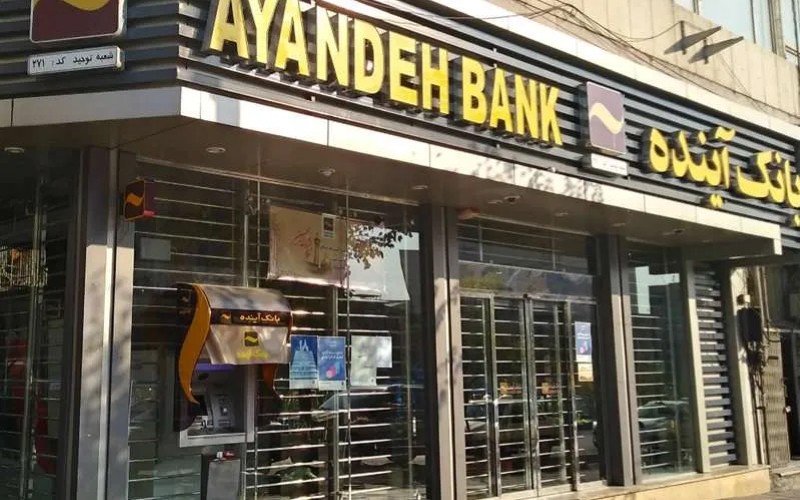

Explosive financial disclosures reveal years of political protection, hidden ownership, and reckless management that turned Bank Ayandeh into the most loss-making bank in Iran.
A new wave of revelations surrounding Bank Ayandeh has exposed one of the most severe corruption scandals in Iran’s banking system, highlighting years of political protection, hidden ownership structures, and deliberate mismanagement that ultimately pushed the bank to the brink of collapse.
Despite repeated warnings from experts and the regime Parliament’s Research Center since 2018, decisive action was blocked by influential networks benefiting from the bank’s operations.
Officials now confirm that the cost of delaying intervention between 2023 and 2025 added an additional 380 trillion tomans to the crisis. Babak Negahdari, head of the regime’s Parliament Research Center, stated that his institution had issued early warnings years ago, but these were consistently ignored.
Economic analysts argue that the deterioration accelerated dramatically after the bank came under the control of the Ministry of Economy during the Raisi administration. Prior to that transfer, Bank Ayandeh’s losses were below 120 trillion tomans. However, following decisions made by government-appointed managers, the scale of the crisis quadrupled.
By the time the Central Bank initiated its resolution process, it acknowledged catastrophic financial indicators: 540 trillion tomans in accumulated losses and 311 trillion tomans in overdrafts from the Central Bank. Independent experts place the numbers even higher.
Economist Mahmoud Jamsaz described the situation as unprecedented, noting that Bank Ayandeh had accumulated 465 trillion tomans in losses, owed 500 trillion tomans to the Central Bank, and carried 240 trillion tomans in commitments to depositors.
He stressed that the bank exploited concealed ownership networks and enjoyed ongoing support from powerful economic and political circles. Over twelve years, he said, Bank Ayandeh used the banking system as a tool for wealth extraction and influence, jeopardizing national financial stability.
Parliamentarians are now underscoring the scale of the corruption. According to the latest oversight reports, Bank Ayandeh’s accumulated losses reached 549 trillion tomans by September 2025—equal to more than half of all accumulated losses across the entire Iranian banking network, despite controlling only 1.7 percent of total banking assets.
The bank’s overdraft from the Central Bank also climbed to 350 trillion tomans, accounting for roughly 35 percent of all overdrafts in the system.
The disclosures paint a clear picture: Bank Ayandeh did not collapse due to market pressures or miscalculation.
It collapsed because it was shielded by powerful regime factions that enabled years of opaque ownership, political interference, and unchecked looting.
The consequences now threaten the country’s broader financial stability, while those responsible remain protected by the very institutions meant to enforce accountability.