


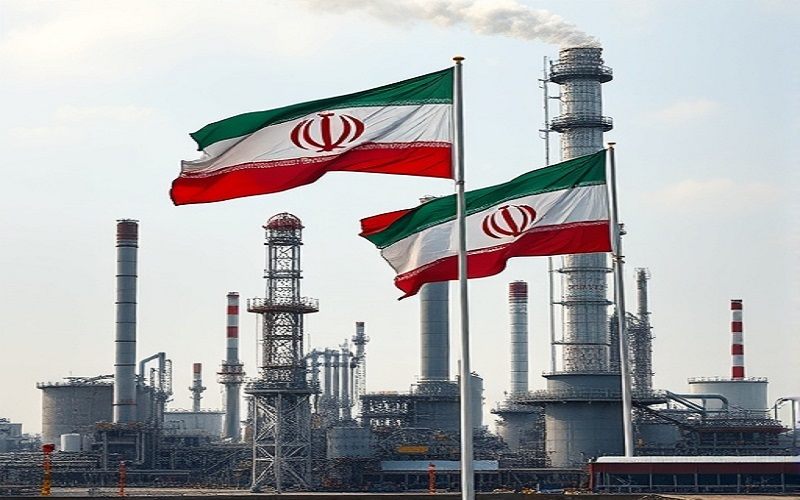

Each year, the Iranian regime transfers tens of billions of dollars from illegal and clandestine oil sales into bank accounts worldwide. This hidden financial stream has fueled numerous crises across the region and could soon trigger an even greater one.
As the Gaza conflict threatens to escalate, the Iranian regime may require additional funds—not only to procure weapons and sustain its economy but also to rearm militant groups such as Hamas, Hezbollah, and the Houthis.
Iran’s crude oil exports took a sharp dive six years ago when the Trump administration reimposed strict sanctions. However, under the Biden administration, Iran’s oil exports have surged, increasing 12-fold to reach 1.8 million barrels per day as of September 2023.
In 2023 alone, Iran is estimated to have generated between $35 and $50 billion from oil sales and an additional $15 to $20 billion from petrochemical exports. Given the sanctions, how does Iran manage to smuggle its oil and move the money across borders? How does the regime receive, transfer, and spend these billions?
The Oil Smuggling Network
According to The Economist, the Iranian regime has built a vast and covert financial network, stretching from oil platforms to the digital vaults of its central bank. China, as the largest buyer of Iran’s oil, is the primary beneficiary of this system. International banks and financial hubs are often unwittingly drawn into facilitating these operations, making them integral to the regime’s efforts to bypass sanctions.
Despite the stringent sanctions, Iran has managed to evade restrictions, thanks to weak enforcement, limited international resolve, and significant assistance from China.
Iran’s Unique Oil Sales Model
Unlike most oil-rich countries, which export their oil through large state-owned companies, Iran’s oil sales operate through a more complex structure. The National Iranian Oil Company controls production, while its Swiss-based subsidiary, Iran Oil Intertrade, manages international marketing. However, an increasing volume of oil is now allocated to ministries, religious institutions, and even pension funds, allowing them to sell oil independently.
With foreign currency reserves running low, the regime often uses crude oil in place of cash. For example, in last year’s budget, Iran’s armed forces were authorized to sell $4.9 billion worth of oil.
Various entities, including ministries and the Revolutionary Guards (IRGC), have developed their own sales channels. In some cases, the entire operation is outsourced to private cover companies, such as “Sahra Thunder,” which appears to be a private entity but is responsible for selling oil on behalf of the armed forces.
China’s Role in the Oil Market
China remains the destination for 95% of Iran’s crude oil exports. However, due to concerns over sanctions, China’s state-owned companies avoid direct purchases. Instead, Iranian intermediaries use shell companies to secure deals, supplying small, independent Chinese refineries authorized to process Iranian oil.
Once a buyer is found, contracts are signed between shell companies, with payments typically made in dollars, or less frequently in euros, UAE dirhams, or Japanese yen. The origin of the oil is often misrepresented as Iraqi, Malaysian, or Omani in official documents, with the true source disclosed in confidential letters.
To transport the oil, Iran relies on over 100 shell companies to secure tankers, most of which are aging vessels registered in Panama. After loading at Iranian export terminals, the oil is transferred multiple times between ships before arriving in China. Within 45 days, Iran’s shadow banking system springs into action to move the money.
Financial Networks and Laundering Operations
Iran’s economy is heavily dependent on China, which facilitates the smuggling of oil without officially becoming a party to these contracts. Iran’s major oil companies have set up large financial units that operate like banks, managing foreign transactions for the oil sector and other parts of the economy. These financial units create shell companies worldwide, whose primary purpose is to collect and transfer money.
According to a former high-ranking Iranian official, around 200 dual-national Iranians oversee these companies in Europe. Shell companies use their accounts with international banks to access the global financial system. Leaked documents from April 2023 reveal the existence of 218 bank accounts connected to 71 shell companies, managed by Amin, one of Iran’s largest exchanges. These accounts are spread across China, the UAE, and Europe.
Chinese banks, with their opaque practices, play a key role early in the process, allowing Iran to move petrodollars with minimal scrutiny. Later, these funds may flow through other financial hubs. For instance, as of May 2023, a branch of the Bank of Egypt in Dubai was reportedly providing services to 38 shell companies involved in Iran’s petrochemical export trade.
Some banks that knowingly cooperate with the regime’s money-laundering operations can earn up to 15% in commission from transactions. A portion of this laundered money is used to purchase essential imports, including weapons parts, while another portion funds militant groups such as Hamas, the Houthis, and Hezbollah.
Global Implications
Money is often hidden in inconspicuous locations, such as bank branches in Budapest or Aachen, while London serves as the sixth-largest base for Iranian institutions under U.S. sanctions. Iran’s vast and intricate money-laundering network poses a significant challenge for the West, a lucrative opportunity for China, and a growing threat to global stability.