Manipulated data on poverty, housing, and jobs paint a false picture of progress while deepening public mistrust.
In today’s Iran, statistics often act like a distorted mirror — reflecting an image far removed from reality. Nowhere is this clearer than in poverty data. Hamid Haj Esmaeili, a labor market expert, recently stated that the national relative poverty line has reached 55 million tomans. Yet the regime presents different numbers for “absolute poverty,” which bear little relation to real wages. Former labor minister Ahmad Meydari even claimed that a household earning 30 million tomans with its own home is not poor and should not receive subsidies.
Such contradictory figures make it impossible to determine how many Iranians actually live below the poverty line. Most workers and employees, earning less than 20 million tomans, simply disappear from official statistics. Field reports show that many families have cut meat and poultry from their diets, relying instead on bread and eggs. Still, Iran’s Statistical Center claims food inflation for the poorest households fell to 38.7% in May 2025 — a supposed “decline” that reflects not lower prices but people buying less. Purchasing power remains weak, rents are skyrocketing, and subsidies are scattered without proper targeting.
Contradictory Data Everywhere
The same confusion extends to Iran’s housing market. While the regime claims to have identified 500,000 vacant units, a parliament member puts the number at 2.7 million, and other reports range from 2.6 to 2.8 million. A study by Iran University of Science and Technology warns that self-reporting by owners, flaws in the housing registration system, and institutional conflicts have led to gross underreporting. After more than five years of promises, the regime’s “empty homes tax” has generated so little revenue that it could not even buy a single apartment.
The root cause lies in inflation and expectations of further price hikes, pushing people to invest in property rather than hoard it deliberately. In unemployment, too, the numbers tell a misleading story. The Statistical Center reported a 7.4% unemployment rate for summer 2025 — a 0.1% drop from the previous year — even though 171,000 fewer people were employed and economic participation declined. Many have simply given up looking for work. Unemployment among youth aged 15 to 24 remains at 19%, and 40.3% of the unemployed are university graduates, often forced into unrelated or informal jobs.
Services account for 53.1% of all employment, yet most of these jobs are low-paid and insecure. Underemployment stands at 7.6%, meaning people work fewer than 44 hours a week but want more. These “improved” jobless numbers reflect labor market exit, not real job creation.
Digital Illusions and Real Crises
Even in the energy sector, the regime presents crises as achievements. The “Bargh-e Man” (My Electricity) app, used by 67% of households, is advertised as a success in digital governance. In reality, citizens are forced to install it just to check when the next power outage will hit. Frequent blackouts have damaged businesses, endangered hospital patients, and disrupted daily life. Once again, manipulated data turns failure into supposed progress.
Hidden Costs of Statistical Poverty
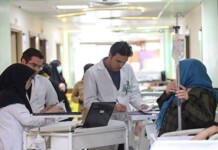
Iran’s “statistical poverty” not only produces false numbers but also cripples prevention, planning, and public trust. In the labor sector, the Social Security Organization reports that 40% of occupational incidents stem from chronic work-related illnesses rather than accidents. Every year, 5,000 to 7,000 workers suffer long-term health impacts, yet no comprehensive data exist. Stress affects over 65% of healthcare workers, 55% of teachers, and up to 60% of industrial workers suffer from musculoskeletal disorders. In mines and factories, hearing loss, respiratory issues, and skin diseases are common, but the Health Ministry focuses only on treatment, not prevention.
Workers on temporary contracts often hide their illnesses out of fear of dismissal, while bureaucracy discourages reporting. This lack of data — sometimes seemingly intentional — prevents the creation of preventive labor policies. According to the International Labour Organization, 2.4 million people worldwide die each year from occupational diseases, yet Iran offers no updated statistics.
The Cultural Data Void
The same vacuum exists in culture. In 2019, the Minister of Culture and Islamic Guidance admitted to a “statistical poverty” in cultural affairs and called for cooperation with the Statistical Center to define social and cultural indicators. Without such data, it’s impossible to measure how much people read, go to the cinema, or engage in cultural activities. This absence of information blinds policymakers and deepens societal divisions.
Ultimately, statistical poverty erodes trust. When citizens see one reality in prices, rent, and wages, but officials report another, disbelief grows. The social costs are immense: youth despair, migration, hidden malnutrition, and the normalization of crises.
Statistics should serve justice — not cover for failure. When hollow numbers replace reality, society is left in the dark, like an empty home that could have been a light for a family in need.