


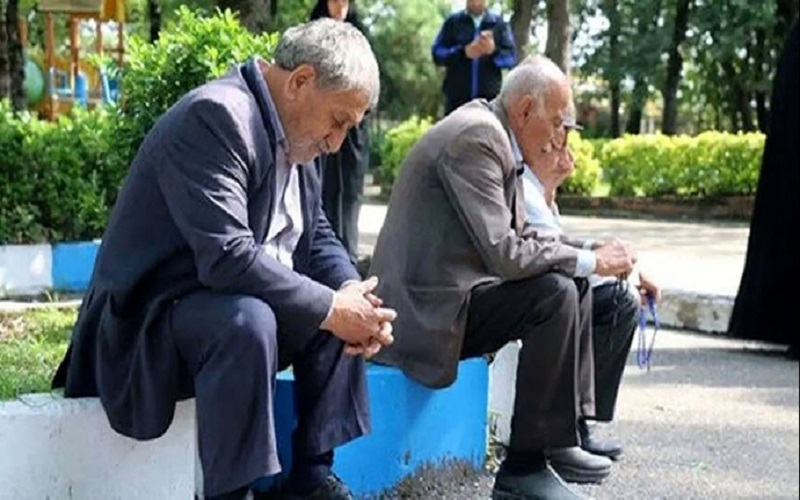

Iran’s pension funds are in crisis, with millions of retirees struggling to receive their pensions. Protests by retirees have become a regular occurrence, highlighting the deep-rooted economic and structural problems plaguing these funds.
The state-run news website Bahar News recently reported on the dire situation, revealing that in the past year alone, retirees held over 70 protest rallies—an average of six per month. Among them, telecommunications retirees led the demonstrations with at least 22 rallies, followed by social security and steel industry retirees, who held 17 and 11 protests, respectively.
The Scope of the Crisis
Currently, Iran has 17 pension funds covering approximately 28 million subscribers. However, several of these funds, including the National Pension Fund, the Armed Forces Social Security Organization, and the Steel Workers Pension Fund, are effectively bankrupt. They rely on state budget allocations to meet their obligations, revealing the extent of their financial insolvency.
Despite the severity of the crisis, Iranian officials avoid addressing the root causes of the funds’ financial collapse. Mohammad Reza Bahonar, a member of the regime’s Expediency Discernment Council, recently questioned the fate of the massive profits generated by state-affiliated companies. He specifically pointed to Mobarakeh Steel, Iran’s largest steel producer, which reportedly made a profit of hundreds of trillions of tomans in 2023.
However, Bahonar stopped short of acknowledging the real issue: the direct control of these corporations by the regime’s military and economic powerhouses, including the Islamic Revolutionary Guard Corps (IRGC). He revealed that the major shareholders of Mobarakeh Steel include:
- Sepah Bank (30%) – A financial institution historically tied to the IRGC and currently under state control, although it remains financially linked to Iran’s armed forces.
- Edalat Shares (40%) – A vast investment entity under the regime’s Privatization Organization, originally designed to distribute state-owned company shares among the public but ultimately serving as a political and economic tool for regime insiders.
- Iranian Mines & Mining Industries Development & Renovation (IMIDRO) (15%) – A subsidiary of the Ministry of Industry, Mine, and Trade responsible for overseeing the country’s mining and mineral industries.
A System Designed for Exploitation
A closer look at these entities reveals that Mobarakeh Steel, like many other state-controlled firms, is effectively owned by the government, the military, and other regime-linked institutions. The supposed privatization of key industries has merely transferred ownership to different branches of the state, ensuring that financial gains remain within the ruling elite’s control.
For example, Sepah Bank, which was previously owned by the IRGC, was formally placed under the supervision of the Central Bank to evade U.S. sanctions. Yet, it continues to operate as a financial arm of the regime’s military apparatus, with its primary financial backer being the Joint Staff of Iran’s armed forces.
Similarly, Edalat Shares, initially marketed as a wealth distribution initiative, has evolved into a massive investment conglomerate with tens of thousands of employees. Instead of empowering the public, it has concentrated financial power in the hands of regime insiders, enabling them to control major industrial sectors.
Meanwhile, IMIDRO, despite being a government body, serves as a conduit for the regime’s economic interests, overseeing Iran’s lucrative mining and metals industries while ensuring that key resources remain under state and military control.
The True Cost: Retirees Pay for Regime’s Corruption
The pension fund crisis is not merely a result of economic mismanagement but a symptom of a broader system of exploitation. The regime’s institutions siphon off the profits from industries like Mobarakeh Steel to fund their own operations, including the repression of protesters—many of whom are the very retirees demanding their rights.
In effect, the Iranian people, particularly retirees, are being robbed twice: first through the systematic looting of pension funds and state revenues, and second through the violent suppression of their protests when they demand what is rightfully theirs.
Until the stranglehold of military and government-controlled entities on the economy is broken, the pension crisis will only deepen, leaving millions of retirees in financial despair while the regime continues to enrich itself at their expense.