



How collapsing welfare, rising poverty, silent deaths, and vanishing livelihoods expose the structural decay of life under the Iranian regime.
In today’s Iran, the crisis is no longer an exception; it is the structure that governs daily life. Every indicator—economic, social, or psychological—points toward a society strained beyond its limits, where the cost of survival rises faster than incomes, and where the state’s deliberate neglect deepens despair in every province.
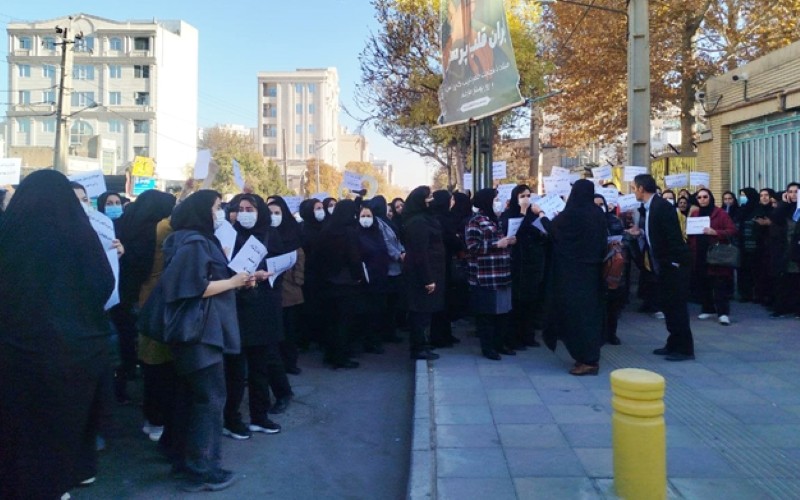
Nowhere is this breakdown clearer than in the lives of retirees, who contributed thirty percent of their wages for decades—one of the highest contribution rates by global standards—expecting security and dignity in old age.
Instead, they now face a supplementary insurance fee set at 720,000 tomans, with the regime’s Social Security Organization covering only a fraction of it. Almost half a million tomans are directly deducted from their already depleted monthly pensions, a process that transforms what should have been a lifelong investment into a fresh burden.
What retirees receive is not the security they paid for, but a shrinking income that forces many of them back under the weight of basic expenses. Any silence or justification by those tasked with defending their rights becomes a form of complicity in stripping away what little support remains.
The economic collapse extends far beyond retirees. A recent official report offers a bleak picture: every major welfare indicator has deteriorated since 2017, but none as dramatically as food security and housing. Absolute poverty has surged from thirty percent in 2017 to forty-four percent in 2024.
During the same period, calorie consumption has fallen every single year, signaling a quiet but widespread nutritional decline. For households that rent, income-based poverty has jumped from twenty-six percent to thirty-eight percent. Education spending has nearly vanished, dropping from 1.5 percent to just over half a percent of household expenditures.
Meanwhile, the number of children unable to attend school has climbed from 777,000 to 911,000—a staggering figure that reveals how the future itself is being eroded by today’s economic collapse.
Even regional suffering follows a consistent pattern. In the Zagros provinces—Ilam, Kermanshah, Lorestan, and Kohgiluyeh-and-Boyer-Ahmad—suicide rates have remained among the highest in the country for three decades.
These regions have never emerged from crisis, and their distance from the national average remains deeply significant. Researchers link the rise in suicides to a web of structural pressures: unemployment, entrenched poverty, stunted development, domestic violence, cultural tension between tradition and modernity, and persistent gender inequality.
The question that haunts these communities is not abstract: how do systemic pressures push people from frustration into hopelessness, and from hopelessness into the irreversible decision to end their own lives?
Economic degradation is also visible in everyday metaphors of value. With the price of a single Bahar Azadi gold coin reaching 123 million tomans, the symbolic weight of inflation becomes palpable.
To match this value using only 10,000-toman bills, one would need twelve thousand individual banknotes—a mountain of paper to equal a coin small enough to fit in a closed hand. The visual contrast captures the collapse of purchasing power more vividly than any spreadsheet ever could. Money still exists in physical form, but its meaning has quietly evaporated.
Food insecurity is another dimension of this unraveling. While markets show no shortage of red meat, the tables of ordinary families tell a different story. According to recent FAO data, meat consumption in Iran has fallen to 31.9 kilograms per person annually, far lower than Turkey’s 46.8 kilograms.
Specialists warn that without serious reform in livestock feed supply, distribution systems, and government policies, Iran’s agricultural and livestock sectors may face an even more severe crisis. The abundance seen in store windows has little relation to affordability for consumers whose incomes have collapsed.
Across these diverse crises—retiree impoverishment, rising absolute hunger, increasing suicides, vanishing purchasing power, and shrinking access to basic nutrition—a single thread runs through them all: a governing system that has neither the capacity nor the will to safeguard the dignity or survival of its own population.
Under the Iranian regime, the economy does not merely fluctuate; it erodes. Social conditions do not temporarily worsen; they structurally deteriorate. And each new statistic, each quiet tragedy, exposes how deeply the system’s failures have penetrated into the private lives of millions.
In this landscape, crisis is no longer a moment. It is the air the nation breathes.