


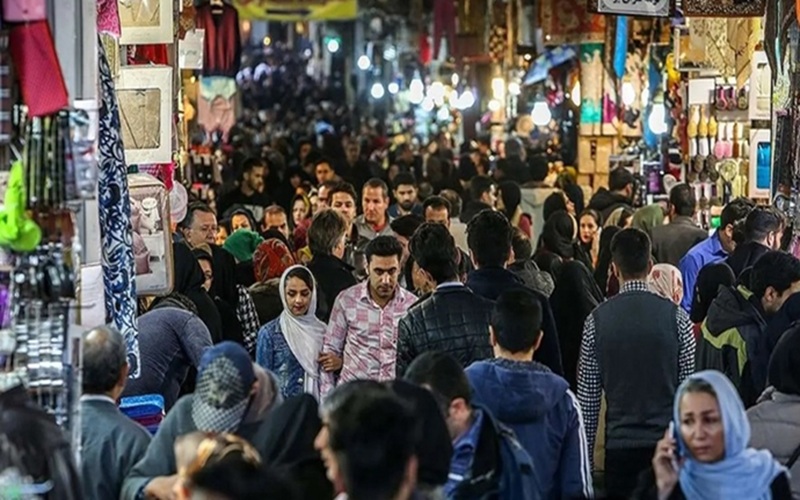

Four decades of inflation, currency devaluation, and political instability have transformed Iranian workers into the primary victims of a system that finances its survival through the impoverishment of its own people.
For decades, discussions about wages and inflation in Iran have been treated as technical debates among economists and policymakers. Yet the numbers tell a far more consequential story. The historical relationship between wages and inflation is not merely an economic indicator—it is a measure of the regime’s structural failure to provide even the most basic economic security for its citizens.
Every year, the regime’s Supreme Labor Council announces a new minimum wage increase amid extensive media coverage and official claims of support for workers. On paper, wages rise. In reality, workers become poorer. The widening gap between nominal wage growth and the actual cost of living has become one of the clearest indicators of Iran’s economic decline.
As the state-run newspaper Jahan-e Sanat recently observed in its analysis, minimum wage levels have evolved from a simple labor policy metric into a thermometer measuring the failure of economic governance. Despite annual wage negotiations and headline-grabbing increases, workers repeatedly confront the same question: why does the family table become smaller every year despite higher salaries?
The Triple Trap Destroying Purchasing Power
Understanding the scale of the crisis requires moving beyond official rhetoric and examining the forces shaping workers’ lives. Iranian laborers are trapped in what can be described as a “triple economic minefield”: chronic inflation, repeated currency devaluations, and persistent political and security instability.
These three factors reinforce one another. Inflation continuously erodes purchasing power. Currency depreciation increases the cost of imported goods and production inputs. Political tensions and military confrontations create uncertainty that discourages investment and accelerates capital flight.
The result has been a dramatic collapse in the real value of wages.
Historical data reveal that the dollar value of Iran’s minimum wage peaked at approximately $248 in 2009. By 2025, that figure had fallen to roughly $64. In practical terms, a full-time Iranian worker today earns barely one-quarter of the international purchasing power enjoyed by a minimum-wage worker less than two decades ago.
Behind these statistics lies a profound social reality. Millions of Iranian households have been forced to eliminate essential expenditures from their budgets. Protein consumption has declined. Healthcare has become increasingly inaccessible. Affordable housing remains out of reach for many families. Educational opportunities are narrowing. What economists call “real wage erosion” translates directly into lower living standards and expanding poverty.
From Wartime Hardship to Permanent Economic Crisis
The roots of the current crisis extend back to the 1980s. During the Iran-Iraq war, regime authorities effectively transferred part of the cost of conflict onto workers through wage suppression. Real wages declined while inflation remained elevated.
However, today’s crisis is arguably more severe than that experienced during the war years.
In the 1980s, rationing systems and a less import-dependent economy partially shielded households from currency fluctuations. Today, decades of economic mismanagement, the weakening of domestic production, and growing dependence on imports have made ordinary citizens far more vulnerable to exchange-rate shocks.
Even in periods without formal warfare, Iran increasingly functions like a wartime economy. Inflation expectations remain elevated, investment remains weak, and economic uncertainty has become permanent.
This reality exposes a fundamental flaw in the regime’s economic model. Rather than building sustainable productivity growth, policymakers have repeatedly relied on short-term financial injections, oil revenues, and monetary expansion to mask structural weaknesses.
The consequences became particularly evident during the oil-boom years under former President Mahmoud Ahmadinejad. While dollar-denominated wages temporarily increased due to massive oil revenues, the underlying foundations remained fragile. Once oil income declined and currency pressures intensified, wage gains evaporated. Workers ultimately paid the price for policies built on temporary windfalls rather than sustainable economic reform.
The Illusion of Wage Increases
In recent years, successive administrations have embraced a new strategy: large nominal wage increases that generate headlines but fail to improve living standards.
This approach allows officials to claim support for workers while avoiding the deeper structural reforms necessary to control inflation and stabilize the economy.
The problem is straightforward. When inflation exceeds 40 or 50 percent annually, wage increases lose their meaning almost immediately. By the time workers receive their higher salaries, prices have already adjusted upward.
The reported inflation rate of nearly 58 percent in 2026 effectively neutralized a 60 percent increase in nominal wages. What appears on paper as a significant raise becomes virtually meaningless in practice.
This pattern reveals a broader truth about the Iranian economy. Inflation has become a hidden tax imposed disproportionately on workers and low-income households. Those with access to hard assets, foreign currency, or political connections can often protect themselves. Wage earners cannot.
Workers Paying for Political Failure
The deterioration of wages cannot be separated from the political structure that produces it. Economic decline in Iran is not simply the result of poor policy choices; it reflects a governance model that prioritizes political survival over economic development.
As long as national resources are diverted toward ideological projects, military ambitions, and the preservation of political power, ordinary citizens will continue to absorb the costs. Inflation, currency collapse, and declining living standards are not accidental outcomes. They are the predictable consequences of a system that repeatedly shifts the burden of its failures onto society.
The erosion of real wages has produced visible social consequences. Labor force participation is weakening. Informal employment is expanding. Skilled workers are emigrating in growing numbers. Economic frustration is deepening across virtually every segment of society.
These trends point to more than an economic downturn. They indicate a crisis of governance. A state that cannot protect the purchasing power of its citizens, provide economic stability, or guarantee basic living standards faces a fundamental legitimacy problem.
The story of wages in Iran is therefore not merely a labor issue. It is a reflection of a broader national crisis. Behind every inflation statistic and every currency depreciation lies the same reality: millions of Iranians are being asked to pay the price for a system that has failed to deliver economic security, prosperity, or hope for the future.
As inflation continues to devour wages, the growing impoverishment of Iranian workers stands as one of the clearest indicators of the regime’s deepening structural bankruptcy.