


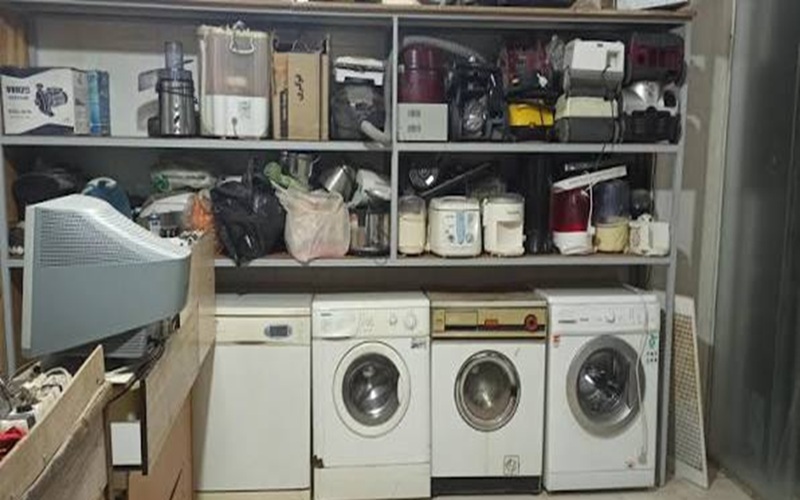

Soaring prices for spare parts and repair services are pushing Iranian households beyond the cost of replacing appliances—and increasingly beyond the cost of maintaining what they already own.
For millions of Iranian households, the economic crisis is no longer measured only by the price of food, housing, medicine, or household appliances. It is increasingly reflected in something more basic: the inability to repair the things they already own.
The soaring cost of spare parts and repair services has turned routine maintenance into a major financial burden. As household purchasing power continues to deteriorate, families are not only finding it increasingly difficult to buy new appliances; they are also struggling to keep existing ones functioning.
The result is a growing phenomenon that Iranian media have described as “repair poverty”—a situation in which broken appliances remain unrepaired because households simply cannot afford the cost.
Social media platforms are increasingly filled with videos showing people how to repair their own vacuum cleaners, juicers, and other household equipment. What might appear to be a trend toward do-it-yourself repairs is, in many cases, a reflection of economic necessity.
Living with broken appliances
The Iranian newspaper Shargh recently highlighted the phenomenon in a report titled “Repair Poverty: Living With Broken Appliances.” The newspaper attributed the problem primarily to the rising cost of spare parts and repair services.
The report cited the case of a bank employee named Ghazal, who said repairing her car’s air-conditioning system had reached approximately 200 million rials (20 million tomans).
“Several years ago, with this amount we could buy a car, and now we have to pay it for repairs,” she said.
Despite having a job, she could not afford the repair and was forced to rely on public transportation, waiting for cooler weather.
Her experience is increasingly representative of a broader economic reality. According to Shargh, many households have broken appliances that are never taken to repair shops because the cost is prohibitive. The problem extends far beyond irons, heaters, and microwave ovens. Washing machines, vacuum cleaners, cooking equipment, and even everyday items such as clothing, bags, and shoes are increasingly being used until they break and then simply abandoned.
This deterioration has another consequence that is often overlooked: the growing burden of unpaid household labor on women.
When washing machines, vacuum cleaners, cooking appliances, and other equipment stop working, household tasks become more labor-intensive. Families may wash clothes manually, perform household cleaning without mechanical assistance, or abandon appliances altogether. As a result, the economic crisis can translate directly into additional unpaid work, disproportionately affecting women.
Food costs come first
Economic sociologist Ali-Asghar Saeedi told Shargh that the phenomenon is closely connected to the growing share of household income consumed by food and other essential expenditures.
“When household income is insufficient for more immediate needs such as food, housing, medicine and education, repairs are postponed even when they are economically worthwhile in the long term,” he explained.
This is a crucial feature of Iran’s current economic crisis. Families are increasingly forced to prioritize immediate survival over maintenance and long-term household needs.
A broken refrigerator, washing machine, air conditioner, or vehicle may technically be repairable. But if the household must first pay for food, rent, medicine, or education, the repair becomes a lower priority.
The consequences can accumulate rapidly. A temporary repair may become permanent abandonment, while a household’s standard of living gradually declines.
The pressure on food budgets has intensified amid the removal of preferential foreign-exchange subsidies for some essential goods and the introduction of electronic food vouchers. Reports and available price data indicate that increases in the prices of goods covered by the voucher system have significantly outpaced the value of the assistance provided.
Repair shops replacing appliance stores
The deterioration of the household-appliance market is not new.
Last November, the Iranian newspaper Ham-Mihan reported that soaring appliance prices had severely damaged sales, while repair technicians were increasingly taking the place of retailers.
According to the report, appliance prices had risen by as much as 100 percent within a few months, with some specific brands increasing by even more.
As purchasing new appliances becomes increasingly inaccessible, consumers have little choice but to extend the lives of aging equipment. Repair technicians consequently become more important—not because households are becoming wealthier and more inclined to maintain their possessions, but because replacing them has become unaffordable.
At the same time, rising prices and weakened purchasing power have created opportunities for fraud. Iranian state television has reported an increase in deception in the appliance market, including an illegal workshop where old refrigerators were refurbished and subsequently sold as new.
Such practices further undermine consumers who are already struggling to distinguish between affordable, reliable products and increasingly expensive alternatives.
War cited as another explanation for inflation
The regime has also attributed the latest wave of price increases to the country’s wartime circumstances.
President Masoud Pezeshkian recently referred to what he described as a U.S. maritime blockade affecting Iranian ports, saying that restrictions had made it necessary to seek alternative routes for importing goods.
The U.S. Department of Defense has estimated that Iran lost approximately $4.8 billion in oil revenues during the first two weeks of the maritime blockade that began in the Iranian calendar month of Farvardin.
Regardless of the immediate impact of the conflict and restrictions on trade, however, the underlying vulnerability of Iranian households predates the current crisis. Years of inflation, currency depreciation, economic mismanagement, corruption, and declining purchasing power have progressively reduced families’ ability to absorb additional costs.
A shrinking standard of living
Saeedi also pointed to a more profound consequence: people may neither repair an item nor replace it. Instead, they simply lower their standard of living.
He gave examples of people avoiding rooms without cooling equipment, setting aside damaged clothing, continuing to drive vehicles with mechanical problems, or eliminating household appliances from their daily lives altogether.
This represents a significant shift in household consumption. Poverty is not only preventing people from purchasing new goods; it is gradually stripping away amenities and services that were once considered ordinary components of daily life.
The result is a form of economic impoverishment that extends beyond income statistics. Families are losing access to the practical conveniences that previously supported their daily lives, while broken appliances, damaged clothing, defective vehicles, and deferred repairs become visible signs of declining living standards.
Iran’s cost-of-living crisis has therefore reached an increasingly basic level. For many households, the question is no longer whether they can afford a new appliance. It is whether they can afford to keep the old one working.
As essential expenses consume an ever-greater share of household income, the Iranian regime’s economic failures are increasingly being reflected inside people’s homes—one unrepaired appliance at a time.