


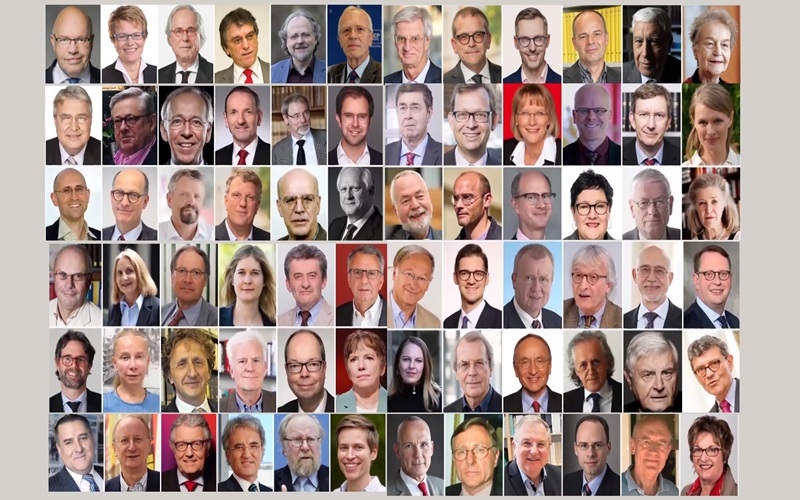

More than 70 prominent German figures reportedly urge the Friedrich Naumann Foundation to reconsider its decision to have the son of Iran’s former shah receive an award dedicated to the Iranian people, warning against political endorsement of a deeply divisive figure.
The decision by Germany’s Friedrich Naumann Foundation for Freedom to designate Reza Pahlavi as the recipient of its 2026 Freedom Prize on behalf of the Iranian people has triggered a public controversy over who has the right to represent Iran’s struggle for freedom. More than 70 prominent German figures have reportedly signed an open letter urging the foundation to reconsider the arrangement, arguing that honoring the Iranian people should not become a vehicle for granting political legitimacy to the son of the former shah.
The foundation announced on September 14 that the 2026 prize would honor the Iranian people for their struggle for freedom, civil rights, and democracy. The award ceremony is scheduled for November 7 at St. Paul’s Church in Frankfurt, with Reza Pahlavi designated to receive it in a fiduciary capacity until it can be presented to freely elected representatives of Iran. The foundation describes him as a prominent opposition figure and maintains that the country’s future political system should be decided by its people.
The open letter challenges the implications of that decision. Its central argument is that a prize dedicated to an entire people should not be entrusted to a politically divisive individual whose family history is inseparable from Iran’s former dictatorship. The signatories reportedly argue that the arrangement conflicts with democratic values and risks creating the impression that a German democratic institution has endorsed Pahlavi as the representative of a nation whose political future remains undecided.
Germany’s historical experience with the Pahlavi dictatorship
The signatories invoke a particularly significant chapter in German history to explain their concerns: the protests against Mohammad Reza Shah Pahlavi during his visit to West Berlin on June 2, 1967.
German and Iranian students demonstrated against the shah’s authoritarian rule and the repression imposed by his security apparatus, SAVAK. During the demonstrations, German student Benno Ohnesorg was shot and killed. His death became a defining event in West Germany’s postwar protest movement and remains closely associated with opposition to authoritarianism.
The letter reportedly argues that this history cannot be separated from the decision to give the shah’s son a prominent role in receiving an award for freedom. For the signatories, the issue is not merely the identity of an individual accepting a prize. It is the danger of overlooking the historical record of the dictatorship from which Pahlavi derives his dynastic identity.
Iran’s future cannot be reduced to a choice between the current theocratic dictatorship and a restoration of the monarchy. The struggle for democracy requires rejecting political arrangements that presume a particular individual or hereditary family has a privileged claim to power before the Iranian people have freely expressed their will.
Questions over democratic accountability and political intimidation
The open letter also reportedly raises concerns about Pahlavi’s conduct during a press conference in Berlin on April 23, 2026, at the Federal Press Conference. A German journalist, Pauline Jäckels of taz, questioned his democratic credentials and challenged his support for military attacks on Iran. His response prompted criticism, while subsequent reporting by German public broadcaster ARD described a wave of abusive messages directed at the journalist by Pahlavi supporters, including death threats and misogynistic insults.
The signatories regard intimidation directed at a journalist for asking politically relevant questions as a matter of particular concern for democratic institutions. Freedom of expression cannot be defended selectively: it must protect critical questioning of opposition figures as well as criticism of those in power.
The reported letter also points to displays of SAVAK-related symbols at gatherings of Pahlavi supporters, including in Germany. SAVAK remains associated with political surveillance, imprisonment, and torture under the former monarchy. Celebrating or glorifying such an apparatus raises serious questions about the democratic political culture being promoted in the name of Iran’s future.
Opposition to Iran’s current regime does not automatically establish a commitment to democracy. Nor does a family connection to the former monarchy confer a mandate to speak for millions of Iranians with different political views and aspirations.
The Iranian people are not the political property of any individual
The controversy exposes a fundamental contradiction in the presentation of the award. The foundation says the prize belongs to the Iranian people and is intended to recognize those who have risked their lives, endured imprisonment, and suffered persecution in pursuit of freedom. It specifically highlights women fighting for self-determination, students demanding academic freedom, journalists defending press freedom, and workers seeking dignity and fair conditions.
Yet the decision to have Pahlavi receive the award places a single, controversial political figure at the center of an honor intended to recognize a diverse national struggle.
The distinction matters. Iran’s democratic future must be determined by the Iranian people themselves, not through international ceremonies that risk elevating one political personality into a presumed national representative. No individual can acquire such a mandate simply through dynastic lineage, international visibility, or recognition by a foreign institution.
The Iranian people’s struggle also cannot be separated from their opposition to both forms of dictatorship. Rejecting the current regime does not require accepting the restoration of the monarchy. The principle of a free Iran rests on popular sovereignty, political pluralism, equal rights, and the right of citizens to choose their own representatives.
A freedom prize should honor the people who paid the price
The German signatories reportedly welcome the decision to dedicate the 2026 Freedom Prize to the Iranian people but call for the foundation to reconsider how the award will be presented. Their proposed alternative is to ensure that the honor is received in a genuinely inclusive manner by Iranian women and men who have directly participated in the struggle for freedom and personally paid a price for it.
Such an approach would keep the focus on the people the award is intended to honor rather than on the political ambitions or symbolic standing of a single individual.
The question facing the Friedrich Naumann Foundation is therefore larger than the selection of a representative for a ceremony. It concerns the meaning of democratic solidarity with a people struggling against dictatorship.
If the prize is truly intended to recognize Iran’s fight for freedom, its presentation should not be interpreted as a political endorsement of hereditary leadership or as a declaration that Reza Pahlavi speaks for the Iranian nation. The people who have resisted repression, endured imprisonment, faced execution, and continued to demand fundamental rights deserve recognition in their own right.
Iran’s future belongs neither to the ruling theocracy nor to the heirs of the former monarchy. It belongs to the Iranian people, who must be free to determine their country’s political future through a democratic process without imposed rulers or self-appointed representatives.