


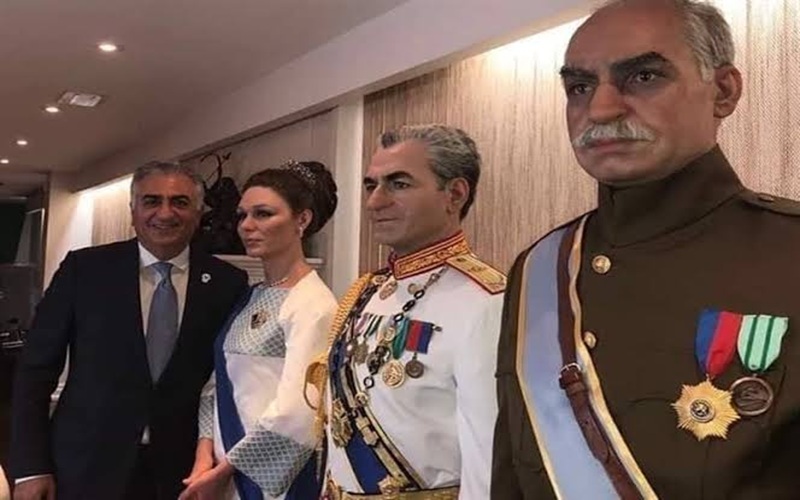

A 1953 U.S. diplomatic document and recent appeals by Reza Pahlavi expose a recurring pattern: seeking foreign backing rather than deriving political legitimacy from the Iranian people.
Political movements without genuine roots in society have historically sought survival through foreign patrons rather than through the consent of their own people. Iran’s modern history offers a particularly revealing example of this pattern in the Pahlavi monarchy and its contemporary advocates.
As the Iranian regime faces growing social discontent and the prospect of fundamental political change, efforts to revive the legacy of hereditary monarchy have become increasingly visible. Yet a closer look at the history of the Pahlavi dynasty raises a fundamental question: where did its political legitimacy come from?
A recently highlighted U.S. diplomatic document from May 21, 1953—just months before the overthrow of Prime Minister Mohammad Mosaddegh—provides a striking answer.
A revealing document from 1953
The document, identified as a U.S. State Department memorandum entitled “Memorandum for the Files,” records information conveyed to U.S. Ambassador Loy W. Henderson by people close to Shah Mohammad Reza Pahlavi.
The memorandum records the Shah’s concerns about Britain’s attitude toward him. According to the document, he reportedly said:
“The British threw out the Qajar dynasty; they brought in my father; they threw out my father; and they can throw me out or keep me as they see fit. If they desire that I should remain and that the Court should retain powers given it by the Constitution, I should be in- formed. Likewise, if the British wish me to go, I should know immediately so that I can quietly leave. Do the British wish to substitute another Shah for me or to abolish the monarchy? Are the British back of present efforts to take away my powers and deprive me of my prestige in Iran and abroad?”
The Shah went on to question whether Britain wanted him to remain on the throne, replace him with another monarch, or abolish the monarchy altogether.
The significance of the passage lies not simply in the Shah’s fear of foreign intervention. It reveals how he himself understood the vulnerability of his position. His words portray the fate of the monarchy as something that could be determined by foreign powers rather than by the Iranian people.
For readers unfamiliar with Iran’s modern history, the context is important.
The Qajar dynasty ruled Iran from the late eighteenth century until 1925. Reza Khan, an army commander who had risen to prominence following a military coup in 1921, became Shah in 1925 and founded the Pahlavi dynasty. His son, Mohammad Reza Pahlavi, succeeded him in 1941 after Reza Shah was forced to abdicate during World War II.
By the early 1950s, Mohammad Reza Shah’s position remained deeply dependent on the complicated balance of domestic and foreign power.
In 1951, Mohammad Mosaddegh became prime minister after the Iranian parliament nationalized the country’s oil industry. His government challenged the enormous influence that Britain had exercised over Iran’s oil resources.
In August 1953, Mosaddegh’s government was overthrown in a coup backed by the United States and Britain. Mohammad Reza Shah subsequently consolidated his authority, while political opposition was increasingly suppressed.
The 1953 episode remains one of the defining controversies of modern Iranian history. It also forms an important part of the debate over the political foundations of the Pahlavi monarchy.
From the Shah to his son
More than seven decades later, critics of the Pahlavi project argue that the same underlying political mentality remains visible among its contemporary advocates.
Reza Pahlavi, the son of Mohammad Reza Shah and the last monarch’s heir, has repeatedly presented himself as a potential political figure in a future Iran. His supporters portray him as a symbol of an alternative to the current regime.
But the question of political legitimacy cannot be separated from the manner in which power is expected to be obtained.
In a recent speech at a conference of the Israeli-American Council, Reza Pahlavi described the need for leadership in the United States, Israel, and an Iranian partner, presenting himself as that prospective Iranian partner:
“This requires leadership in the United States, Israel and an Iranian partner. Ladies and gentlemen, I am here to offer you that partnership and extend my hand to you as a partner in peace.”
For his critics, such statements are significant because they appear to place foreign political and military support at the center of a strategy for political transformation in Iran.
The issue is not whether foreign governments can influence Iran. They clearly can, and Iran’s modern history contains numerous examples of foreign intervention. The deeper question is whether a political alternative can claim democratic legitimacy while depending on external powers to help bring it to power.
Hereditary rule versus popular sovereignty
The Pahlavi system was a hereditary monarchy. Political authority passed from father to son, rather than being determined through a democratic process in which citizens freely choose their head of state.
That distinction matters particularly today, when Iranian society is confronting both the current regime’s authoritarianism and competing visions of what should replace it.
Rejecting the current regime does not automatically constitute support for a return to monarchy. Nor does opposition to the regime establish legitimacy for any particular individual or political faction.
For many Iranians involved in protests and resistance activities, the central demand is not the restoration of one political dynasty but the establishment of a system based on popular sovereignty, democratic institutions and equality before the law.
The slogan heard in Iranian protests—“No to monarchy, no to the supreme leader, democracy and equality”—reflects this rejection of hereditary and clerical forms of authoritarian rule alike.
Iran’s future cannot be decided abroad
The historical record surrounding the Pahlavi dynasty is therefore more than an argument about the past. It is part of a contemporary debate over who has the right to determine Iran’s political future.
The Iranian people have experienced both hereditary monarchy and the current theocratic dictatorship. The central lesson of that history is that replacing one form of authoritarian rule with another does not constitute democratic change.
The young generation confronting repression, imprisonment, executions and violence today is increasingly defining its struggle in terms of political agency: the right of Iranians themselves to determine their country’s future.
That principle also draws a clear line between democratic transition and externally engineered political projects.
Iran’s future cannot legitimately be decided in foreign capitals, through diplomatic bargains, military intervention or arrangements between foreign powers and self-appointed representatives. Nor can democratic legitimacy be inherited through a family name.
The historical record, including the words preserved in the 1953 U.S. diplomatic memorandum, demonstrates why the question of political legitimacy matters. The future of Iran should not depend on who can secure the strongest foreign patron. It should depend on the will of the Iranian people.
For those seeking fundamental change, the challenge is therefore not to resurrect a hereditary political order, but to establish a democratic and independent republic in which sovereignty belongs to the people and political power is obtained through their freely expressed will.
That is ultimately the dividing line between a genuine democratic alternative and another attempt to impose power from above.