


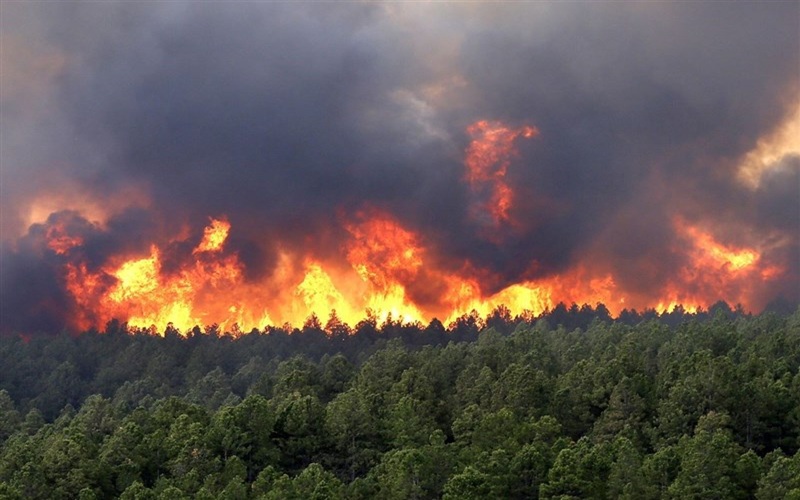

At least 32 wildfires have scorched forests, rangelands, and farmland in early August, raising alarms over climate change, resource mismanagement, and inadequate prevention measures.
In second half of July, Iran witnessed a surge in destructive wildfires, with at least 32 incidents reported across forests, grasslands, and farmland in 11 provinces. The situation escalated dramatically on August 5 and 6, when more than 15 fires broke out in Chaharmahal and Bakhtiari, Golestan, East Azerbaijan, Fars, Semnan, Gilan, and Kurdistan.
According to the Department of Environment and the Natural Resources and Watershed Management Organization, the primary trigger has been unprecedented summer heat, which has not only increased the likelihood of fires but also accelerated their spread across dry and highly flammable vegetation.
Major Hotspots and Damage
One of the worst-affected areas was the Helen Protected Area in Chaharmahal and Bakhtiari Province. In just 24 hours, over 100 hectares of oak forests were destroyed. This region carries historical significance, named after Helen Jeffreys Bakhtiar, an American nurse who, decades ago, worked alongside her Iranian physician husband to provide medical care to local communities.
Golestan Province also faced severe damage. On August 5, three separate fires broke out in Kordkuy’s forests. Officials said the blazes, contained within 24 hours, were caused by a combination of human negligence, unfavorable weather, and strong winds.
In East Azerbaijan, the Qaradagh forests of Jolfa County caught fire the same day. While the flames were extinguished within hours, the provincial Department of Natural Resources warned that prolonged high temperatures made further incidents likely.
The iconic Cloud Forest (Jangal-e Abr) in Semnan Province was also engulfed in flames, but was saved after a joint effort by the Red Crescent, environmental authorities, and local volunteers.
Recurring Fires in Derak Mountains
Another major incident occurred in the Derak mountain range near Shiraz, which has already seen multiple fires this year. The first blaze was reported on May 9 and attributed to high temperatures and dried vegetation. A second, more severe fire broke out on May 12 in hard-to-reach terrain. On July 23, another fire prompted a 22-hour battle by over 65 firefighters before it was brought under control.
These repeated incidents have sparked speculation about the presence of undisclosed military facilities in the area, though local authorities have denied any connection. On August 5, the southern slope of Derak was once again aflame. According to Fars Province’s Crisis Management Department, the fire was contained a day later with the help of over 100 firefighters and local residents, aided by helicopters. Fire Department Chief Hadi Eidipour insisted the blaze was not near any military site and was purely the result of environmental conditions. The cause of the repeated fires remains under investigation.
Wider Agricultural and Environmental Losses
Beyond forested areas, the August fires destroyed 20 hectares of farmland in Khoda Afarin (East Azerbaijan), 15 hectares of rangeland in Kurdistan’s Abdolrazagh Protected Area, parts of orchards and woodlands in Armand and Ardalan (Chaharmahal and Bakhtiari), 23 hectares of pastures in Bouein-Miandasht on the Isfahan–Lorestan border, and 20 hectares of rangeland in Shahrud’s Siakamar region.
Underlying Causes: More Than Just Heatwaves
While climate change and extreme temperatures play a critical role, environmental experts argue that decades of mismanagement have worsened the situation. Long-term drought and over-extraction of groundwater have left the soil dangerously dry, creating a tinderbox environment.
In a report published on August 1, the daily Etemad quoted environmental scientist Mohammad Darvish as saying Iran’s aquifers are so depleted that even if water withdrawals stopped immediately, they would not recover within human timescales. He estimated it could take up to 70,000 years for underground reserves to replenish.
Official data also reveal a troubling trend. Ali Abbasnejad, head of the Forests, Rangelands and Watershed Management Protection Unit, reported that forest fire incidents in June 2025 rose by 30% compared to the same month last year. In 95% of cases, human activity—whether intentional or accidental—was to blame. He noted that cooler weather and reduced public access to natural areas earlier in the year kept April and May numbers lower, with 90 forest fires and 300 rangeland fires recorded in those months.
Temperature records for early 2025 show above-average conditions: in Tehran, April highs ranged from 12°C to 17°C, and May from 11°C to 24°C. Similar increases were recorded in Mazandaran, Gilan, and Chaharmahal and Bakhtiari provinces, where average May temperatures reached into the mid-20s Celsius.
Prevention and Accountability
Critics say the official narrative—emphasizing weather patterns and public negligence—sidesteps the lack of effective fire prevention policies, poor environmental governance, and absence of long-term adaptation plans to counter climate change. The repeated focus on blaming individuals, they argue, helps shield authorities from scrutiny while doing little to address the structural drivers of Iran’s escalating wildfire crisis.