


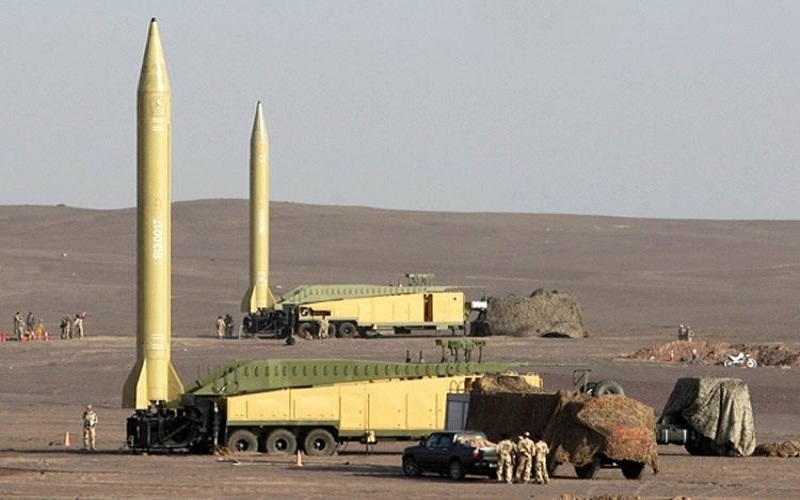

June 6, 2025 — The Iranian regime has reportedly placed a large order for materials used in ballistic missile production from Chinese suppliers, signaling renewed efforts to reestablish its regional military posture and strengthen its proxy network, according to a Thursday report in The Wall Street Journal.
Citing sources familiar with the transaction, the report states that Tehran has secured a shipment of ammonium perchlorate, a chemical compound used in the manufacture of solid-fuel missiles. The quantity ordered could potentially be used to produce up to 800 ballistic missiles. The material is expected to arrive in Iran in the coming months.
According to the Journal, the deal was finalized months ago — likely before U.S. President Donald Trump’s March announcement that he had proposed new nuclear talks with Iran’s Supreme Leader, Ayatollah Ali Khamenei.
The Iranian company behind the order, Pishgaman Tejarat Rafi Novin Co., reportedly made the purchase through Lion Commodities Holdings Ltd., a Hong Kong-based firm. Neither Pishgaman nor Lion Commodities responded to requests for comment.
Officials cited in the report believe a portion of the ammonium perchlorate may be diverted to pro-regime proxy forces, such as Yemen’s Houthi rebels. The Houthis, who are part of Iran’s so-called “Axis of Resistance,” have repeatedly launched ballistic missiles at Israel, including as recently as Thursday. However, much of the material is expected to remain in Iran to support the reconstruction of domestic missile production facilities.
This development comes as Iran is also reportedly working to revive its air defense systems, further indicating a broader military buildup.
A Chinese government spokesperson responded to the report by emphasizing Beijing’s adherence to international export controls:
“The Chinese side has always exercised strict control over dual-use items in accordance with China’s export control laws and regulations and its international obligations,” the spokesperson said.
This is not the first time Chinese-sourced missile materials have been linked to deadly consequences in Iran. An earlier shipment of ammonium perchlorate precursors — also reportedly from China — has been connected to a deadly explosion at a southern Iranian port, which dozens and injured hundreds. According to the Journal, that shipment contained enough material to produce around 260 short-range missiles and was allegedly mishandled by a unit of the Quds Force, a branch of the regime’s Islamic Revolutionary Guard Corps (IRGC).
The Iranian regime has long funneled arms and resources to a regional network of militias, including Lebanon’s Hezbollah, Gaza’s Hamas, Iraq-based separatist groups, and the Houthis in Yemen. In early April, despite the resumption of nuclear negotiations with the United States, Tehran reportedly transferred ballistic missiles to its Iraqi proxies — even as earlier reports suggested those groups were in the process of disarming.
On Saturday, after five rounds of nuclear talks, the United States presented a new proposal aimed at limiting Iran’s uranium enrichment program. The proposed agreement would reportedly place constraints on enrichment without fully halting it. Supreme Leader Khamenei rejected the proposal on Wednesday.
Despite its public claims of rejecting nuclear weapons, the regime has enriched uranium to 60% purity — well beyond the level required for civilian energy production and alarmingly close to weapons-grade material.