


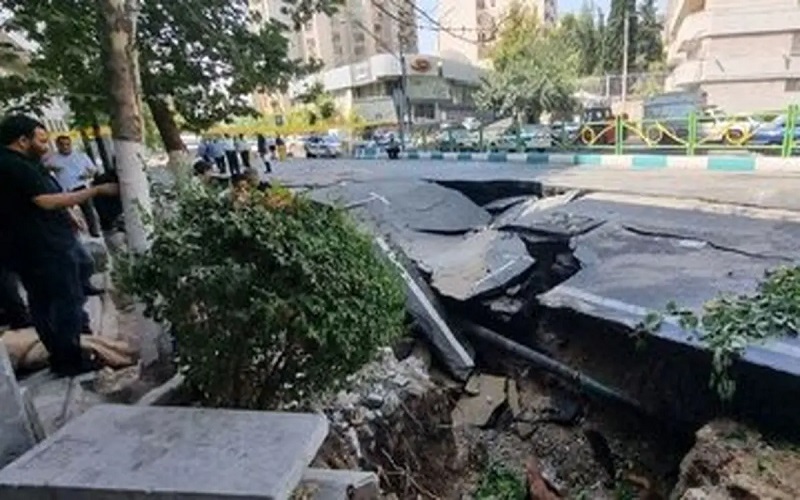

Land subsidence—once a distant environmental concern—has now engulfed over 90,000 square kilometers of Iran, posing one of the gravest environmental and humanitarian threats the country has ever faced. Yet, despite clear warnings from experts, the Iranian regime remains largely indifferent, allowing the crisis to spiral unchecked.
According to Seyyed Eskandar Saydaei, head of Iran’s national mapping organization, land subsidence has reached catastrophic levels. Speaking to the state-run IRNA news agency on May 7, 2025, he labeled the phenomenon a “national crisis,” noting that the affected area is equivalent to five major countries in size.
A Nationwide Phenomenon
Land subsidence, which began in the early 2000s, now affects major provinces including Tehran, Alborz, Qazvin, Khorasan Razavi, Kerman, Isfahan, and Fars. In some areas, the ground is sinking at rates of up to 35 centimeters per year—a stark contrast to the global standard of 3 to 5 centimeters.
Tehran, home to 20% of the country’s population, is among the hardest-hit. The capital is sinking between 8 and 12 centimeters annually, placing millions of lives and critical infrastructure in jeopardy. In Kerman Province, particularly in the Rafsanjan district—Iran’s pistachio heartland—rates have exceeded 35 centimeters per year, threatening both agricultural output and economic stability.
Infrastructure on the Brink
The consequences are already visible. As Saydaei warns, land subsidence is inflicting irreparable damage: roads, water and gas pipelines, buildings, aqueducts, and even schools are cracking and collapsing. Fertile soil is being destroyed, salinity in agricultural land is rising, and the risk of earthquakes is intensifying.
This is not just an environmental issue—it is a national security and economic threat that jeopardizes the well-being of millions of Iranians.
The Ground Beneath Iran Is Collapsing
At the core of this crisis lies a deepening groundwater emergency. With the over-extraction of groundwater becoming a normalized practice, Iran is losing an estimated 1.7 billion cubic meters of groundwater annually. Replenishing these aquifers, if even possible, could take centuries.
Land subsidence is a visible sign of aquifer compaction and long-term groundwater mismanagement. Currently, 3.5% of Iran’s land area is affected, including key infrastructure like airports and railways. In provinces such as Tehran, Isfahan, Kerman, and Khorasan Razavi, over a quarter of the population lives in high-risk areas.
Iran now ranks third in the world for land subsidence, with Khorasan Razavi holding the national record.
A Crisis Hidden from the Public
Despite mounting evidence, the Iranian regime has chosen secrecy over action. Experts have called for transparency and the public release of subsidence maps, but authorities have resisted. “Our proposal is to publish maps of land subsidence to prevent the crisis from spreading,” said Saydaei. Yet, the regime continues to obscure the reality—mirroring its handling of other national tragedies such as the Bandar Abbas explosion, where unsafe storage of ammonium perchlorate was concealed from the public due to its link to missile fuel.
The government’s priorities lie elsewhere—spending on missile and nuclear programs, suppressing dissent, and plundering national wealth, rather than addressing one of the country’s most pressing environmental challenges.
No Political Will, No Solution
This crisis is not without solutions. Sustainable water resource management, halting excessive groundwater extraction, and modernizing infrastructure could mitigate much of the damage. But under a government entangled in corruption and repression, such reforms are unlikely.
Iranians have already endured tragedies such as Plasco, Metropole, and Bandar Abbas—disasters worsened by systemic neglect. Now, land subsidence threatens to become the next catastrophe.
Unless serious action is taken, land subsidence will not remain a slow-moving crisis. It will erupt into a full-blown disaster, collapsing both land and lives—while those in power remain asleep at the wheel.