


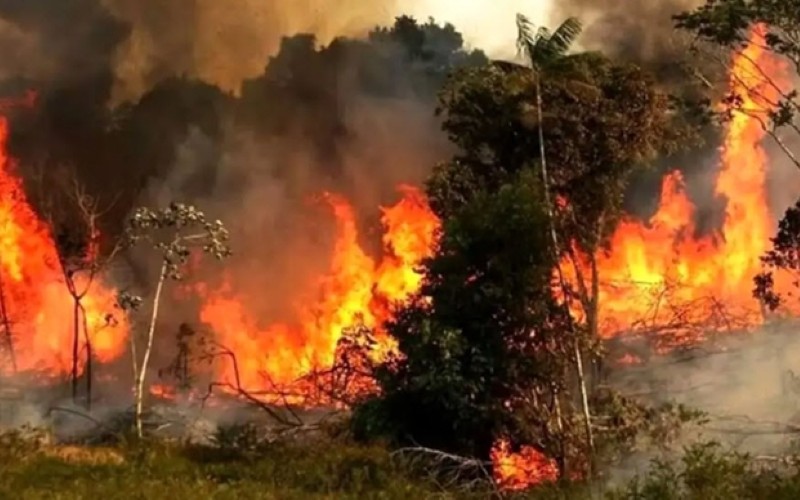

Weeks of uncontrolled wildfires reveal governmental neglect, lack of equipment, and attempts to downplay one of Iran’s worst environmental disasters
Experts across Iran continue to warn that the regime’s reckless environmental policies have paved the way for the catastrophic wildfires devastating the ancient Hyrcanian forests. Even state-affiliated media outlets are now forced to acknowledge parts of this destructive role, despite their long-standing attempts to minimize or obscure the regime’s responsibility.
The state-run daily Arman admitted that decades of official negligence have created the conditions for today’s disaster. It wrote that sustained indifference to environmental threats has already contributed to crises such as water scarcity, the drying of Lake Urmia, the degradation of the Caspian Sea, and the collapse of wetlands like Shadegan and Anzali. The ongoing fires in the Hyrcanian forests, which began on November 1, are now the latest and most dramatic manifestation of this neglect. Reports indicate that flames have spread from the Elit region of Chalous to forests near Nur, expanding the scale of the destruction.
Officials themselves have begun acknowledging the human causes behind the disaster. Aflatouni, the regime-appointed head of Iran’s Forestry Organization, stated that the Elit fire was “very likely” caused by human activity and that investigations have begun into potential land-grabbing operations linked to the outbreak. This admission has only deepened public anger, especially as suspicions grow that the fires may serve interests seeking to exploit or privatize forest land.
Controversy escalated further when Mohammad Jafar Qaempanah, deputy to the regime’s President Masoud Pezeshkian, attempted to trivialize the disaster by referring to the burning forests as mere grasslands. His remarks triggered widespread backlash on social media, prompting state television to reluctantly rebuke him and acknowledge the absurdity of his claim. Broadcasters conceded that the fire had engulfed forests with more than forty million years of ecological history—an irreplaceable natural heritage that cannot be reduced to “grassland.” This rare on-air correction underscored the widening disconnect between regime officials and public sentiment.
Meanwhile, local authorities in Mazandaran confirmed ongoing fires in the Karmozd region of Savadkuh, with eight hectares of protected forest burned and pockets of fire still active. Bahar News reported that the Elit blaze, which has been burning since early November, continues to advance due to the absence of effective action in the initial days. The Environmental Protection Organization admitted that if the fire had been extinguished properly at the outset, it would not have spread into nearby valleys.
Environmental activist Mahtab Shahi emphasized that the crisis cannot be blamed solely on natural causes. She warned that Iran’s firefighting infrastructure is catastrophically inadequate, noting that a country with vast forested terrain possesses fewer than five specialized firefighting helicopters. This shortage makes rapid response nearly impossible. Shahi explained that in many countries, vulnerable regions are identified in advance based on climate conditions and vegetation risk, with pre-emptive alerts that allow for early containment. In Iran, however, warnings typically come only after fires have already spread across multiple fronts.
Years of budget cuts targeting forestry and environmental agencies have left personnel with limited equipment, outdated tools, and insufficient funding. As a result, even when fires are detected early, teams struggle to act quickly or effectively. The combination of poor planning, chronic underinvestment, and administrative paralysis has allowed the current disaster to escalate far beyond what experts say was preventable.
No official has yet provided an estimate of the financial or ecological damage from the Elit fire. Authorities have postponed any assessment until the flames are fully contained, acknowledging indirectly that the destruction is likely far greater than the public realizes. With vast stretches of ancient forest lost and no meaningful reforms underway, the Hyrcanian wildfire crisis stands as another damning indictment of a regime unable—or unwilling—to protect the country’s most vital natural resources.