


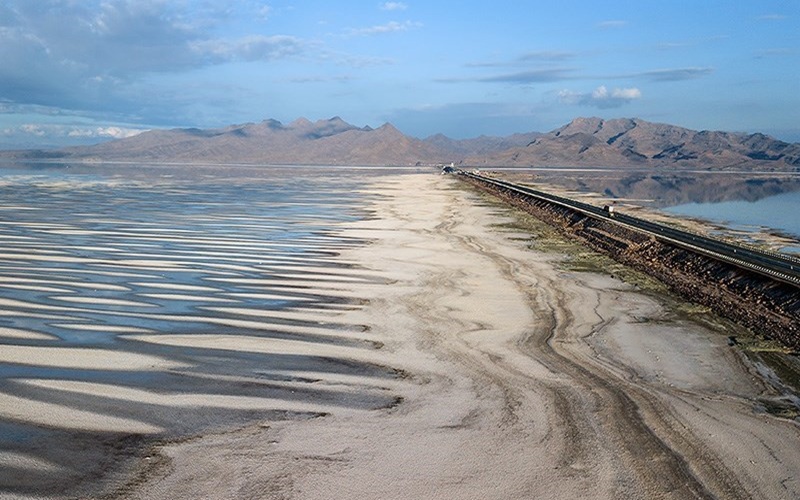

The catastrophic drying of Lake Urmia reveals the regime’s systemic corruption, environmental destruction, and indifference to the lives and health of millions.
Once a Jewel, Now a Desert of Salt
Lake Urmia, once the largest saltwater lake in the Middle East and celebrated as the “Turquoise Jewel of Iran,” has now become a barren wasteland covered in salt. This environmental catastrophe stems from decades of systemic corruption and exploitative policies under the rule of the mullahs’ regime, which has plundered Iran’s natural resources to serve the narrow interests of its ruling elite.
The Regime’s Negligence and Corruption
The death of Lake Urmia’s ecosystem was neither sudden nor unforeseen. For decades, environmental experts warned of its decline. Dr. Fariborz Nateghi-Elahi, a member of Iran’s International Institute of Earthquake Engineering and Seismology, stated in an interview with Bahaar News (September 28, 2025), “The cruelty and neglect toward the lake over the years are beyond imagination.”
He noted that nearly all government projects aimed at reviving the lake had failed or were left incomplete. “Either the projects were never finished, or the allocated budgets were misused,” he said, exposing how large sums meant for environmental restoration vanished into a network of corruption and profiteering.
The regime’s power structure—dominated by the IRGC and unaccountable foundations—has diverted public funds toward ideological or personal ventures while ignoring expert warnings. Nateghi-Elahi added: “When research leads to serious warnings, authorities must act. Their indifference to scientific findings has directly produced this tragedy.”
Plundering Policies and Anti-Iranian Governance
Reza Haji-Karim, head of the Federation of Iran’s Water Industry, confirmed that even comprehensive studies during Rouhani’s administration were ignored. “We had some of the most complete studies ever conducted on reviving Lake Urmia,” he said (Bahaar News, September 29, 2025). “But none of them were implemented.”
These unimplemented measures included reforming irrigation methods, stopping illegal water extraction, and releasing the lake’s ecological water rights from surrounding dams. Instead, the regime prioritized profit-driven projects such as sugar beet factories and water-intensive agriculture, all benefiting regime-affiliated networks.
Under the rule of the mullahs, the lands surrounding the lake have been exploited by regime insiders, while the lake’s vital water supply has been cut off—sacrificing the ecosystem to feed corruption and greed.
Human and Environmental Consequences
The drying of Lake Urmia has caused devastating social and health crises. Nateghi-Elahi warned that “dust storms from the lakebed are spreading across vast regions,” potentially leading to “unusual cancers, respiratory diseases, and the collapse of remaining agriculture.”
He added that salt and mineral dust storms now affect nearby cities daily, as satellite images show expanding salt plains and toxic air pollution spreading across northwestern Iran.
Evidence of Deliberate Destruction
In a shocking statement, Nateghi-Elahi suggested that the lake “may have been deliberately dried up for specific purposes.” This points to a disturbing possibility: that the regime might be exploiting mineral deposits beneath the lake for private financial gain.
The once-living turquoise heart of northwestern Iran has turned into a lifeless, poisonous expanse—a direct consequence of systemic corruption, environmental mismanagement, and ideological indifference.
Conclusion: The Regime’s Environmental Crimes
The tragedy of Lake Urmia is not an isolated failure but a reflection of the entire structure of the clerical regime. A system that silences experts, steals public funds, and destroys ecosystems for personal enrichment cannot be expected to protect Iran’s environment or its people.
Until this corrupt regime is dismantled, the devastation of Lake Urmia will remain a symbol of how the rule of the mullahs has poisoned not only Iran’s air, water, and soil—but also its future.