Hidden rationing, empty reservoirs, unrealistic megaprojects, and rising fears of an uninhabitable central Iran expose the regime’s deepening water crisis.
A Season of Drought, Not Rain
Autumn 2025 in Tehran is not a season of falling leaves—it is a season of water anxiety. Hidden rationing, sudden shutoffs, and constant warnings have created a disturbing new reality for a metropolis of more than 14 million people. Even in a season that should stabilize water supply, the capital is experiencing scarcity and instability reminiscent of the peak summer crisis.
Residents across multiple neighborhoods say water pressure is dropping daily and shutoffs now occur even during cold months. Many families fill bottles and containers at night, unsure whether water will still be available the next morning.
Experts warn that Iran’s mega-drought has reached a point where the country’s central plateau could, if current trends continue, become uninhabitable.
Reservoirs Across Iran Are Running Dry
The signs are visible.
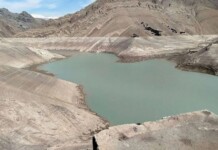
– The bottom of Latian Dam is now exposed.
– In Alborz Province, officials confirm that more than 90% of the Karaj Dam reservoir has disappeared, leaving only 7% of its capacity.
– Mashhad’s water authorities report that the city’s reservoirs are down to “less than three percent.”
These dramatic declines show that Iran’s water crisis is no longer seasonal—it is structural.
Warnings of Imminent Rationing and Even Evacuation
The head of the Federation of Iran’s Water Industry recently warned of the “near certainty of water rationing in the capital.”
He referenced statements by regime president Masoud Pezeshkian, who said:
“If it does not rain by Azar, we will have to evacuate Tehran.”
According to the water industry chief, the reality is “as alarming—or worse—than what Pezeshkian described.”
Official Responses: From Prayer Rituals to Grandiose Promises
While technical experts call for urgent structural reform, Tehran City Council chairman Mehdi Chamran has proposed a spiritual response:
“We must perform rain-prayer rituals, as the ancients did.”
Meanwhile, the Minister of Energy claims the government is developing “over two billion cubic meters” of seawater desalination capacity—an assertion far beyond the country’s existing capabilities.
Today, Iran’s total desalination output is only 750,000 cubic meters per day, a tiny fraction of the scale the government is promising. Achieving the minister’s claim would require:
– enormous energy supplies (electricity and fuel)
– advanced and unavailable technology
– massive capital investment
– intensive environmental safeguards
– infrastructure Iran has never been able to build
Experts call such targets “highly unrealistic and technically unfeasible in the coming years.”
Environmental Dangers the Regime Ignores
Large-scale desalination projects come with serious risks—particularly in the Persian Gulf, where water exchange is limited. Discharging concentrated brine dramatically increases salinity and temperature, threatening fragile marine ecosystems, fish stocks, and biodiversity.
In Iran, environmental impact assessments are routinely ignored.
The so-called “water mafia”—a powerful network benefiting from dam construction, inter-basin transfers, and mega-projects—exerts outsized influence. The Department of Environment often lacks the authority to resist these interests and at times acts as a facilitator rather than a regulator.
A History of Failure and Public Distrust
The Ministry of Energy’s record, especially in dam management and water-transfer schemes, is marked by:
– inflated costs
– failed restoration efforts (notably Lake Urmia)
– lack of transparency
– inability to implement sustainable policies
This track record fuels widespread public distrust of new promises. Many Iranians view the ministry and the environmental agency not as guardians of national resources but as extensions of the water-industry lobby.
Better Solutions Exist—But Are Ignored
Experts argue that effective alternatives are far more affordable and sustainable than national-scale desalination:
– reducing urban and agricultural water loss
– reforming irrigation systems
– adopting responsible cropping patterns
– implementing water-justice and environmental policies
– prioritizing wastewater treatment and reuse
Desalination, they note, is appropriate only for limited coastal areas—not as a nationwide solution for a country facing systemic water depletion.
The Gulf Seawater Plan: A Costly Symbol, Not a Solution
Reports indicate the government has already transported desalinated Persian Gulf water nearly 1,000 kilometers to Tehran at a cost of about $6 per cubic meter.
This raises pressing questions:
Why are deprived and peripheral regions not benefiting from such expensive projects?
Why does the regime prioritize symbolic pipelines to the capital instead of investing in wastewater treatment and local solutions?
Experts argue that far more sustainable options exist—yet they offer fewer benefits to entrenched economic interests dominating Iran’s water sector.
A Crisis the Regime Cannot Solve
Iran faces interconnected water catastrophes:
– collapsing groundwater tables
– land subsidence
– vanishing wetlands
– shrinking vegetation cover
– urban unavailability of potable water
Seawater desalination alone cannot reverse these trends. The process is energy-intensive, environmentally damaging, and financially unsustainable. It also requires technologies and international cooperation the Islamic Republic currently lacks due to political isolation.
A Capital at the Edge
For now, the reality is stark:
Tehran, one of the largest metropolitan areas in the Middle East, is confronting a water emergency with no credible plan from the government.
Empty dams, hidden rationing, unrealistic promises, and contradictory official statements reveal a regime trapped in its own failed water policies—unable to offer solutions beyond costly megaprojects and ritualistic appeals for rain.