


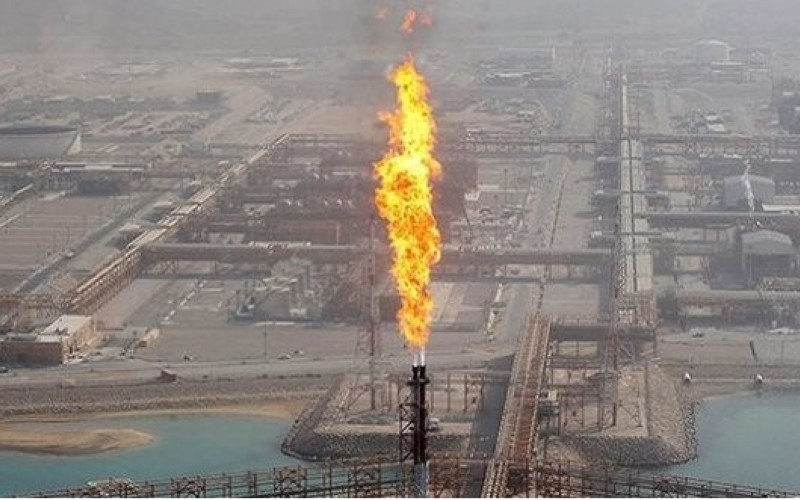

As poisonous gas clouds suffocate southern Iran, the regime’s decades of corruption and neglect have left citizens struggling to breathe.
In Khuzestan — a province where the land beneath people’s feet overflows with oil — breathing has become a daily struggle. Air quality in Ahvaz and surrounding areas, including the villages near Gheyzaniyeh, has reached the “very unhealthy” and “purple” levels on the pollution index, the most dangerous category.
All elementary and secondary schools in the province have been closed until the end of the month. Hospitals are crowded with patients suffering from respiratory illnesses, while local officials promise that oil flares will be extinguished “within two years” — a hollow pledge that residents, long accustomed to the choking fumes, have heard for decades.
The recent admission by Khuzestan’s governor, Mohammadreza Mavallizadeh, that one of the oil flares near Ahvaz emits toxic hydrogen sulfide (H₂S) — a poisonous gas known as “sour gas” — has sparked widespread panic among residents of Gheyzaniyeh and Ahvaz.
“This gas is acidic and must be shut down immediately,” he said, without explaining why his administration has allowed the flare to continue operating, spewing sulfurous smoke across the region.
Experts estimate that between 6 and 15 million cubic meters of sour gas are burned daily in Khuzestan’s oil fields. Due to incomplete combustion, this process releases hydrogen sulfide and fine particulate matter — compounds lethal to humans and animals.
According to Asr Iran, exposure to these gases causes hair loss, skin discoloration in wildlife, and rising rates of respiratory, cardiac, hormonal, and kidney diseases in humans. A resident told reporters: “My children can’t sleep without inhalers. Doctors say their lungs are burned.”
Jafar Mojdami, head of the Gheyzaniyeh District Council, added: “Since the discovery of oil, people have watched these flares burn day and night. They waste national wealth and destroy our environment.”
The so-called “28 Reservoirs Project”, signed in 2020 to eliminate gas flaring, has yielded no results. Local communities say not a single flare has been shut down.
Meanwhile, Khuzestan continues to choke under layers of toxic smoke and dust storms. The provincial environmental department reports that 13 cities are experiencing severe air pollution, with the Air Quality Index in Ahvaz, Karun, Hoveyzeh, and Shadegan ranging from 202 to 231 — levels that endanger even healthy children and the elderly. Fires in the Iraqi section of the Hour al-Azim Wetland have further worsened conditions.
But this is not an isolated disaster. From Tehran to Tabriz, from Ahvaz to Bandar Mahshahr, nearly every major Iranian city now faces air quality levels above the danger threshold during autumn and winter. The regime’s Health Ministry reported that in 2024, 58,975 deaths in Iran were attributed to air pollution — meaning every seven hours, 100 Iranians died from inhaling toxic air. The estimated economic cost of this crisis exceeds $17 billion annually.
Compounding the catastrophe, the government’s failure to produce enough natural gas has forced power plants to burn mazut, a heavy fuel oil with ten times more sulfur than gasoline. Combined with the continuous burning of oil flares, this has turned southern Iran into a toxic basin of pollution.
Hossein Afshin, a senior advisor to the regime’s President Masoud Pezeshkian, warned that Isfahan now has the highest rates of cancer and multiple sclerosis in the country, largely due to severe air contamination.
Governor Mavallizadeh has promised that by the end of 2026, “no flares will remain active.” Yet, in a province plagued for decades by water shortages, destroyed wetlands, and deadly air pollution, trust in such regime promises has vanished. A resident of Koreyt Camp said, “Every governor says the flares will be turned off, but every night the sky still burns like daylight.”
The continuous burning of these gases not only exacts a devastating human and environmental toll but also wastes billions of dollars in potential revenue. Natural gas that could be converted into fuel or petrochemical products is instead being burned into sulfur and acid — a symbol of the regime’s chronic mismanagement and disregard for human life.
Khuzestan’s poisoned air is not a natural disaster — it is the direct consequence of decades of corruption, neglect, and environmental destruction by the ruling regime. As citizens struggle to breathe beneath the smoke of burning wealth, the promises of reform ring hollow amid the flames that never die.