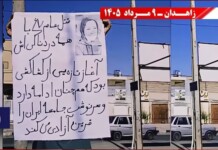
April 15, 2025 – In a powerful display of unity and resistance, the “No to Execution Tuesdays” campaign enters its 64th week with renewed momentum. Two more prisons—Zahedan Women’s Ward and Azbaram Lahijan—have joined the movement, bringing the total number of participating facilities to 40. Today, prisoners across the country are staging a collective hunger strike to protest the Islamic Republic’s continued and escalating use of the death penalty.
Launched as a grassroots response to Iran’s institutionalized violence and repression, the campaign has grown week by week. Now spanning prisons from the northwest to the southeast, its message is resolute: no to executions, no to silence, and no to impunity.
Executions Surge Amid Crisis
In recent weeks, Iran’s clerical regime—facing deepening internal unrest and international scrutiny—has turned again to executions as a means of control. On April 8 and 9, state authorities executed 29 people, a chilling spike in state violence.
Among those killed were five political and ideological prisoners—Malek Ali Fadaei Nasab, Farhad Shakeri, Taj-Mohammad Khormali, Abdolrahman Gorgij, and Abdolhakim Azim Gorgij—who were hanged in Mashhad’s Vakilabad Prison after ten years of imprisonment and torture.
On April 14, the regime executed Ali Dahani, a 22-year-old Baluch protester arrested during the November 2022 uprising following the Bloody Friday massacre in Zahedan and Khash. Accused of killing four government agents, Dahani was denied a fair trial, legal representation, and due process.
Another harrowing case involved the execution of Behzad, a juvenile who was under the legal age at the time of the alleged crime. His execution in Gonbad-e Kavus Prison stands in direct violation of international law.
In total, over 18 Baluch prisoners were executed between April 8 and 14 alone, illustrating the regime’s targeted violence against ethnic minorities and dissidents.
A Nationwide Hunger Strike Across 40 Prisons
This week, prisoners from 40 different facilities are participating in a coordinated hunger strike. Their resistance—often under severe and life-threatening conditions—forms a powerful collective stance against the death penalty and the political use of executions.
The campaign’s expansion to new regions highlights its growing reach and determination. Below is a breakdown of the participating prisons by region:
Tehran & Alborz Province (Central Command Centers of Protest)
-
Evin Prison (Women’s Ward, Wards 4 & 8)
-
Greater Tehran Prison
-
Qezel-Hesar Prison (Units 3 & 4)
-
Karaj Central Prison
-
Khorin Varamin Prison
Isfahan & Qazvin
-
Asadabad Isfahan Prison
-
Dastgerd Isfahan Prison
-
Choubindar Qazvin Prison
Khuzestan (Southwest Epicenter of Resistance)
-
Sheyban Ahvaz Prison
-
Sepidar Ahvaz Prison (Men’s & Women’s Wards)
-
Ramhormoz Prison
Fars Province
-
Shiraz Nezam Prison
-
Adelabad Shiraz Prison (Men’s & Women’s Wards)
Sistan & Baluchestan (Stronghold of Protest and Brutality)
-
Zahedan Prison (Women’s Ward)
-
Bam Prison
-
Kahnooj Prison
Khorasan Province
-
Vakilabad Mashhad Prison
-
Tabas Prison
Northern Iran & Caspian Region
-
Qaemshahr Prison
-
Rasht Prison (Men’s & Women’s Wards)
-
Rudsar Prison
-
Haviq Talesh Prison
-
Azbaram Lahijan Prison
-
Gonbad-e Kavus Prison
Western & Northwestern Iran (Kurdish and Azeri Regions)
-
Saqqez Prison
-
Baneh Prison
-
Marivan Prison
-
Kamyaran Prison
-
Urmia Prison
-
Salmas Prison
-
Khoy Prison
-
Naqadeh Prison
-
Miandoab Prison
-
Ardabil Prison
-
Tabriz Prison
Other Central and Regional Prisons
-
Arak Prison
-
Khorramabad Prison
-
Borazjan Prison
-
Jovin Prison
-
Dizelabad Kermanshah Prison
These prisons—housing political prisoners, ethnic minorities, women, juveniles, and many victims of flawed trials—are not just correctional facilities. They are now frontlines in a battle for human dignity and justice.
An Urgent Call to the World
The campaign’s weekly actions aim not only to protest state violence, but also to call upon the international community to respond. Civil society organizations, human rights groups, and global political actors are urged to amplify the voices of Iran’s imprisoned and hold the regime accountable for its crimes.
Dozens of political and ideological prisoners, along with thousands convicted under vague or fabricated charges, remain on death row—most without fair trials. The cost of global silence is measured in lives lost.
As the “No to Execution Tuesdays” movement enters its 64th week, its resolve has never been clearer. Despite isolation, repression, and the risk of retaliation, Iran’s prisoners are standing up—for each other, and for us all.
#NoToExecutionTuesdays
Week 64 – April 15, 2025