


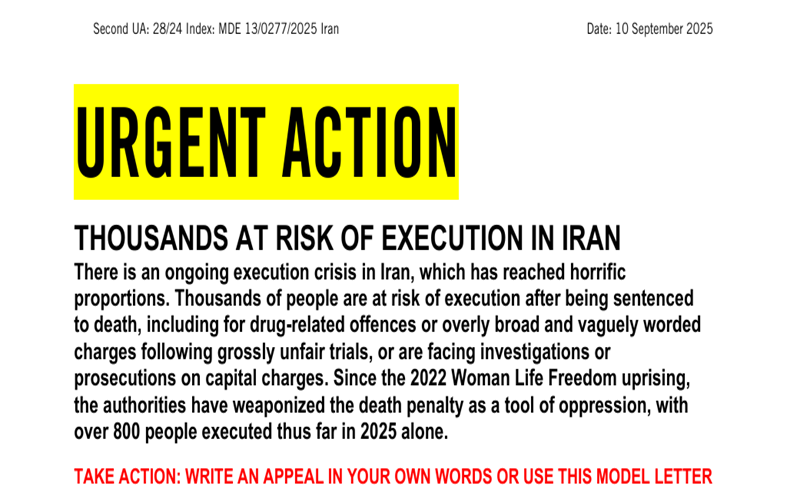

With more than 800 executions already in 2025, Amnesty International says thousands face death after unfair trials, drug-related charges, or politically motivated accusations.
Amnesty: Thousands at Risk of Execution
Amnesty International has issued a stark warning about the ongoing “execution crisis” in Iran, describing it as having reached horrific proportions. In its urgent action appeal released on September 10, Amnesty stated:
“Thousands of people are at risk of execution after being sentenced to death, including for drug-related offences or overly broad and vaguely worded charges following grossly unfair trials, or are facing investigations or prosecutions on capital charges”.
Since the 2022 protests, Iranian regime authorities have “weaponized the death penalty as a tool of oppression,” with more than 800 people executed so far in 2025 alone.
“The Iranian authorities weaponized the death penalty to instil fear among the population and tighten their grip on power,” Amnesty further added.
A Sharp Rise in Executions
The UN Office for Human Rights has confirmed that between January and late August 2025, at least 841 executions were carried out. Amnesty noted this represented “a steep increase in the authorities’ use of the death penalty since 2024, when the number of people executed between January and August 2024 was at least 429”.
According to Amnesty, “judicial officials have called for expedited trials and heavy punishments, including the death penalty, for those accused of ‘supporting’ or ‘collaborating’ with Israel” following the June 2025 armed conflict between Iran and Israel.
And “state-affiliated media outlets have advocated for the repetition of 1988 prison massacres, including Fars News article, claiming that ‘the mercenary elements… deserve 1988-style executions.”
Political Prisoners and Minority Communities at Risk
The report lists scores of individuals under sentence of death, including women activists and well-known detainees. Amnesty highlighted that trials before Revolutionary Courts “lack independence and impose harsh sentences following grossly unfair trials. Individuals tried before such courts are systematically denied their fair trial rights.”
Amnesty also warned of the disproportionate impact on minorities: “Iranian authorities’ use of the death penalty also further disproportionately impacts Iran’s oppressed minorities, particularly those belonging to the Afghan, Baluchi, and Kurdish communities”
Calls for International Action
Reiterating its stance, Amnesty declared:
“The death penalty is a violation of the right to life as proclaimed in the Universal Declaration of Human Rights and it is the ultimate cruel, inhuman and degrading punishment”
The organization called on Tehran to “immediately halt all planned executions, quash all death sentences and establish an official moratorium on all executions with a view to fully abolishing the death penalty”
A Regime of Fear
Amnesty’s findings highlight how the death penalty has become one of the Iranian regime’s primary tools of repression, used to instill fear and suppress dissent. With thousands at risk, the report warns that the Iranian authorities are perpetuating a cycle of fear, injustice, and violence that further alienates the people from the ruling system.