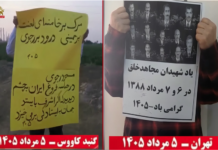
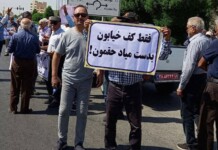
As protesters demand basic rights on the streets, the regime retaliates through secret executions, violent prison raids, and punitive transfers of political prisoners.
While angry protesters across Iran chanted “Water, electricity, life — our fundamental rights,” another scene unfolded behind the concrete walls of Iran’s notorious prisons — the scene of vengeance and silent execution. On Sunday, the Iranian regime executed two political prisoners, Mehdi Hassani and Behrouz Ehsani-Eslamlou, both supporters of the People’s Mojahedin Organization of Iran (PMOI/MEK). Denied access to fair trials, legal representation, and even a final visit, their deaths were carried out in the shadows — swift, silent, and brutal.
This act of state violence appears to be part of a broader campaign of retaliation by a regime that can no longer contain public anger in the streets. Powerless to meet the basic demands of its citizens, the Iranian leadership instead targets the most vulnerable: political prisoners who are already behind bars, defenseless, and at the mercy of a violent security apparatus.
A Coordinated Assault Inside Ghezel Hesar Prison
According to eyewitness reports, the executions were preceded by a large-scale, coordinated assault on the political ward of Ghezel Hesar Prison in Karaj, where both men were held. On Saturday, July 26 — just one day before the executions — over 100 armed forces from the prison’s special guard unit, along with agents from the Ministry of Intelligence, stormed Ward 4, Unit for Political Prisoners, under direct orders from senior prison officials.
Those involved in the raid reportedly included:
- Allahkaram Azizi, Head of Ghezel Hesar Prison
- Hassan Ghobadi, Deputy Prison Chief
- Esmaeil Farajnejad, high-ranking officer
- Hossein Kamarei, Head of Prison Security
- Rahim Feyzi, Ahmad Shirazi, Mohammad Sabzeh-Makan, and a ward guard known as Fallah
Witnesses described brutal beatings of the political prisoners, who were then taken away with handcuffs, leg irons, and black hoods over their heads. The unit was completely dismantled during this violent operation. Since Friday evening, none of the prisoners from this ward have been allowed to contact their families, and all communication has been cut off.
According to informed sources, the entire group has been transferred to an undisclosed location, sparking grave concerns about their safety and well-being. Human rights observers fear that this may signal the regime’s intent to escalate repression within its prison system.
The Punitive Exile of Saeed Massouri
In parallel with these events, reports emerged that longtime political prisoner Saeed Massouri, who has spent more than 25 years in Iranian prisons, was suddenly transferred to Zahedan Central Prison — one of Iran’s most deprived and dangerous facilities. The regime has offered no explanation for the move.
Massouri’s family issued a statement denouncing the transfer as a punitive measure aimed at inflicting additional psychological and physical harm. They emphasized that exile to Zahedan not only drastically limits access to medical care and family visits but also puts his life in serious danger.
In their statement, the family declared:
“The transfer to Zahedan — one of the most deprived and high-risk prisons in the country — is a clear move to escalate pressure and inflict mental and physical torment on this political prisoner and his family.”
They urged the international community to respond decisively:
“We call on human rights organizations, free media, and the global public not to remain silent in the face of this injustice and to demand the immediate return of Saeed Massouri to his previous place of detention.”
A Warning Sign of Worsening Repression
The complete communication blackout, the coordinated beatings, mass transfers, and sudden executions paint a dark picture of the Iranian regime’s internal state of fear and desperation. Unable to suppress protests through public policy or reform, it is doubling down on coercion behind closed doors.
This latest cycle of violence — executions of dissidents, raids on political wards, and punitive exile — suggests that the Iranian regime is not merely maintaining control, but actively retaliating against the growing voices of dissent, both on the streets and behind bars.
As the world watches the public face of Iran’s crisis unfold, what happens in its prisons may hold the key to understanding the regime’s true character — and its brutal response to being challenged.