



By Thomas Lutze*
Germany Trip Exposes the Collapse of Reza Pahlavi’s “Ready-Made Alternative” Narrativ
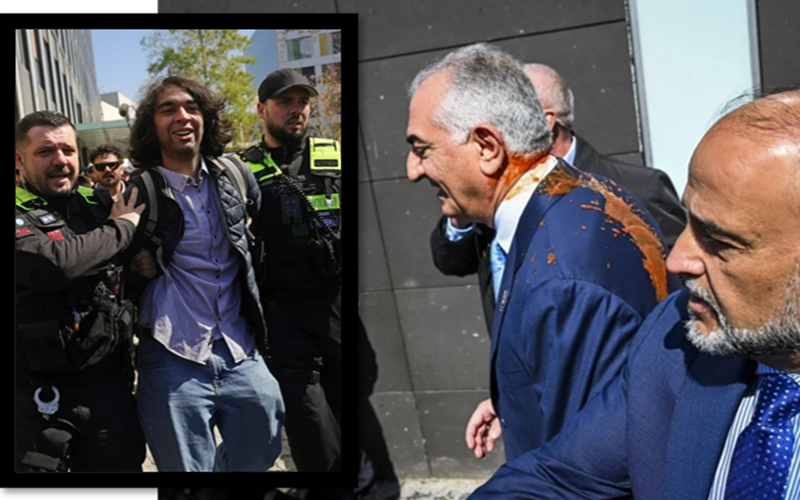
Reza Pahlavi’s trip to Germany at the end of April, following two contentious stops in Sweden and Italy, was less a demonstration of political strength than a stage upon which a political decline became increasingly visible — a decline that began with the failure of a broader strategy and culminated in Berlin with a clear political and media message: the bubble of the so-called “ready-made alternative” has burst.
In recent months, Pahlavi sought to position himself, amid war, repression, and the deadlock of the Iranian regime, as the central figure of a future transition and as a “ready alternative.” Yet in doing so, he relied not on social forces inside Iran, but on foreign war, external pressure, and media promotion. This strategy proved counterproductive. Support for an external war was perceived by large segments of Iranians, both inside and outside the country, not as determination, but as a detachment from the suffering of people living under bombardment.
The decline first became visible among Iranians abroad. In Sweden, protests by exiled Iranians, intellectuals, and activists confronted Pahlavi with questions about his family’s past — a past marked by “bloody dictatorship” and one-party rule. His response was telling: rather than distancing himself from that history, he described it as “a source of pride.” In Italy as well, political protests and media reactions disrupted efforts to stage a smooth and carefully managed visit. The culmination of this trend, however, came in Germany.
In Berlin, Pahlavi’s political weight was effectively diminished. The Frankfurter Rundschau emphasized that Pahlavi was dividing “not only the Iranian diaspora, but also German politics.” Berlin’s Senator for Justice, Felor Badenberg (CDU), stated plainly: “The Pahlavi family represents an authoritarian system prior to 1979. His father persecuted, tortured, and murdered political opponents.”
Distance was also evident at the federal level. Federal Minister Thorsten Frei stated on the program Maybrit Illner that regime change could “never be organized from outside, but must emerge from the population itself.” Asked whether he would meet with Pahlavi, Frei added that while Germany does speak with opposition figures, this was “certainly not the first address at this moment.”
The statement amounted to a clear political rebuff. A figure attempting to portray himself as the central address of the opposition was explicitly denied that status by a leading government representative.
Media assessments were equally critical. The newspaper Taz wrote that Pahlavi had “failed miserably” in his attempt to present himself as a statesman. According to the paper, he spent “the majority of his speaking time” lecturing journalists while failing to answer key questions. Its conclusion was scathing: the “prince who wants to become king” appeared instead as a “court jester” — “one who no longer even has a court willing to summon him.”
What emerges, therefore, is not merely a crisis of public perception, but a strategic crisis. The attempt to capitalize politically on an external war generated growing mistrust. Efforts to gain international legitimacy through political meetings remained limited, informal, or private. The image of a unifying figure gave way instead to that of a polarizing actor.
The Germany trip thus marked not merely the end of a tour, but the collapse of a political illusion: the belief that a family name, external pressure, media campaigns, and selective political contacts could constitute a viable alternative for Iran’s future. Berlin made clear that, for many, the issue is not a choice between “Shah” and “Sheikh,” but the rejection of both authoritarian models and the search for a third path: a democratic republic grounded in the free will of the people.
At the same time, another organized alternative gained greater international visibility. Maryam Rajavi, the President-elect of the National Council of Resistance of Iran, declared before the European Parliament, in response to a new wave of political executions, that Europe’s silence “not only encourages the regime to carry out more executions, but is also a sign of weakness.”
She also stressed that these executions were not a sign of the regime’s strength, but rather of its fear of a genuine alternative. The solution to Iran’s crisis, she argued, lies neither in appeasement nor in external war, but in the “organized uprising of the people and the Resistance.”
This points to a different approach altogether: a transition toward a democratic republic based on the will of the people, driven by internal social dynamics and an organized political structure.
* Thomas Lutze (SPD) served as a member of the German Bundestag from 2009 to 2025.