


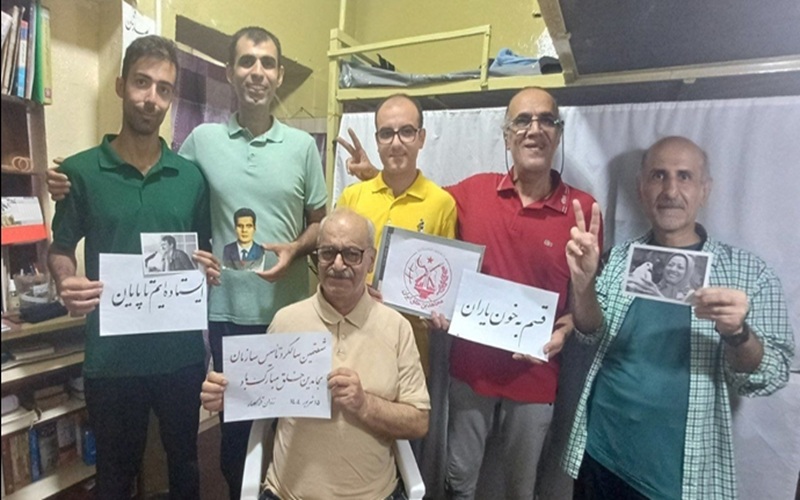

The killing of PMOI supporters, intended to instill fear and restore regime control, has instead triggered global outrage and exposed the fragility of Iran’s ruling system.
In a moment of acute vulnerability, Iran’s regime sought to exploit the cover of external conflict to suppress a growing internal threat. Fearful of the expansion of organized resistance networks and the potential for renewed uprisings, the regime turned to one of its most familiar tools: execution.
The objective was clear — intimidate a restless population, particularly the youth, and reinvigorate its increasingly demoralized security apparatus. Yet this strategy has not only failed; it has rebounded against the regime itself.
The executions of Mohammad Taghavi and Akbar Daneshvar Kar at dawn on March 30, 2026, followed by Babak Alipour and Pouya Ghobadi on March 31, and finally the executions of Abolhassan Montazer and Vahid Bani Amerian on April 4, were carried out under charges of “membership in the People’s Mojahedin Organization of Iran (PMOI/MEK)” and “armed rebellion.” These charges, long used by the regime as a legal façade, reflect a broader pattern of criminalizing dissent rather than addressing its root causes.
Rather than instilling fear, these executions ignited a wave of international condemnation. Volker Türk, the United Nations High Commissioner for Human Rights, described the killings as “cruel” and called for an immediate halt to all executions, emphasizing that the human rights of the Iranian people must be treated as a priority.
Human rights organizations reacted with equal urgency. Amnesty International strongly condemned the arbitrary executions, while the Nordic Committee of Friends of a Free Iran and the Friends of a Free Iran group in the Netherlands warned that at least 16 more PMOI supporters face imminent execution. Their statements underscored the need for concrete measures, not merely rhetorical denunciations.
Political institutions and advocacy groups echoed these concerns. The British Committee for Iran Freedom stressed the necessity of condemning the executions and ensuring accountability mechanisms to prevent further mass killings of pro-democracy activists. Similarly, the Norwegian Committee of Friends of a Free Iran Against Fundamentalism denounced the executions and reiterated warnings about the imminent danger facing additional detainees.
Beyond institutions, a broad spectrum of international political figures voiced strong opposition. Among them were Milan Zver, co-chair of the Friends of a Free Iran group in the European Parliament; Liam Fox, former UK Secretary of State for Defence; Newt Gingrich, former Speaker of the U.S. House of Representatives; Jim Shannon, Member of the UK Parliament; Keith Self and Laura Friedman, members of the U.S. Congress; Rudy Giuliani; Alejo Vidal-Quadras; Sam Brownback; Brad Sherman; and Mike Pompeo. Through public statements and posts on X, they collectively condemned the executions in unequivocal terms.
This broad-based backlash—from human rights bodies to senior political figures—conveys a clear message: the regime’s attempt to project strength has instead revealed weakness. Far from restoring morale within its ranks, these executions have highlighted the regime’s deepening isolation and structural fragility.
The implications extend beyond immediate diplomatic fallout. Each act of repression amplifies the regime’s legitimacy crisis, both domestically and internationally. At a time when Iranian society is already marked by widespread dissatisfaction and a readiness for change, such actions only intensify the underlying tensions.
The international community now faces a decisive test. Expressions of concern, while important, are insufficient in isolation. Translating condemnation into tangible pressure—through diplomatic, legal, and political mechanisms—is essential. Support for the Iranian people’s right to resist repression must move from principle to policy.
The blood of these six executed men may ultimately mark more than a moment of tragedy. It may signal the beginning of a new phase—one defined by the regime’s accelerating global isolation and the growing legitimacy of organized resistance movements and their networks inside Iran.