


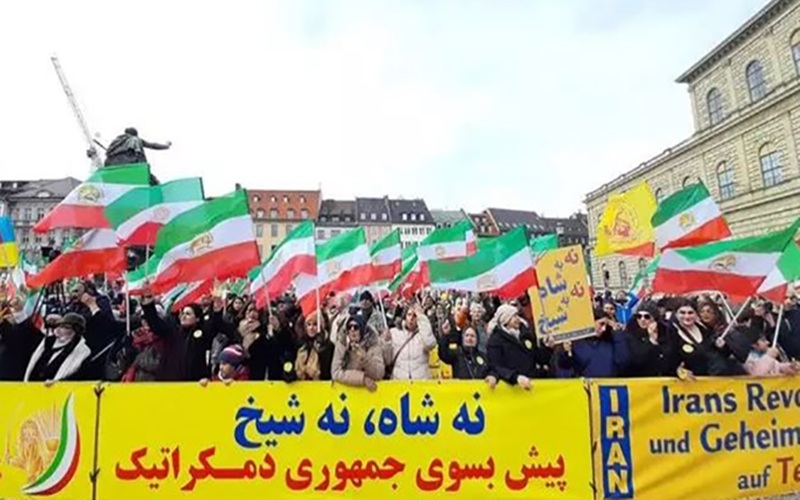

As Iranians and supporters of freedom prepare to gather in Paris on June 20, the event serves not only as a commemoration of past sacrifices but also as a declaration that neither religious dictatorship nor hereditary rule represents Iran’s future.
The history of a nation is not measured by ordinary dates on a calendar. It is defined by the decisive moments that alter the course of a people’s future. For many Iranians, June 20, 1981, remains one of those defining moments—a day when the newly established clerical regime openly revealed its intolerance of dissent and responded to peaceful demonstrations with bullets, arrests, and executions.
The events that followed left a lasting mark on Iran’s modern history. Hundreds were killed, thousands were imprisoned, and countless young men and women faced torture and execution for refusing to surrender their beliefs. The crackdown marked the beginning of a systematic campaign to eliminate political freedoms and suppress democratic aspirations that had emerged after the fall of the Pahlavi monarchy.
A Historic Choice Between Submission and Resistance
The significance of June 20 extends far beyond its historical context. It symbolizes a choice that continues to confront Iranian society today: submission to authoritarianism or resistance in defense of freedom and human dignity.
For decades, the Iranian Resistance has argued that the ruling establishment was not merely another political faction born from the 1979 revolution but a system fundamentally incompatible with democratic governance. From this perspective, silence in the face of repression has never been a neutral position. Every concession to tyranny has strengthened the machinery of oppression, while every act of resistance has preserved the possibility of a democratic future.
The anniversary therefore serves as a reminder that political change has always depended on those willing to challenge dictatorship rather than accommodate it.
Rejecting Both Monarchy and Theocracy
The debate over Iran’s future increasingly revolves around competing visions of governance. While the clerical establishment continues to maintain power through repression, some seek answers in the restoration of a hereditary monarchy.
Yet many Iranians reject both models.
The slogan “No to Shah, No to Mullahs” reflects a growing conviction that Iran’s future cannot be built by returning to systems that concentrate power in the hands of either a ruling dynasty or a religious authority. The demand is not for a different form of authoritarianism, but for a democratic republic based on the sovereignty of the people.
This vision argues that genuine political change cannot emerge from foreign military intervention, diplomatic accommodation with the regime, or nostalgic appeals to the past. Instead, it depends on the organized efforts of the Iranian people and the forces committed to democratic transformation.
Paris: More Than a Commemoration
Against this backdrop, the June 20 gathering in Paris carries significance far beyond a memorial event.
Marking the forty-fifth anniversary of the June 20 uprising, the gathering is expected to bring together Iranians from across Europe and supporters of democratic change from around the world. It represents an opportunity to honor those who lost their lives in the struggle for freedom while reaffirming a commitment to the future.
The event also highlights support for the democratic alternative presented by Maryam Rajavi and her Ten-Point Plan, which advocates principles including:
- Separation of religion and state
- Equal rights and opportunities for women and men
- Abolition of the death penalty and prohibition of torture
- A pluralistic republic founded on free elections and popular sovereignty
- Respect for fundamental human rights and political freedoms
For supporters of the Resistance, these principles provide a framework for a democratic transition and a vision of an Iran that breaks with both religious dictatorship and monarchical rule.
A Call for Unity
The June 20 gathering is ultimately a call for solidarity. It seeks to remind the international community that the struggle for freedom in Iran did not begin with recent protests and has not ended despite decades of repression.
At a time when competing narratives seek to redefine Iran’s future, participation in the Paris rally represents a statement that the aspirations of the Iranian people remain centered on democracy, human rights, and self-determination.
History has repeatedly shown that authoritarian systems rely on fear, silence, and forgetfulness. Democratic movements endure through memory, organization, and collective action.
As thousands prepare to gather in Paris, the message is clear: Iran’s future belongs neither to theocracy nor to monarchy, but to its people. The struggle for a democratic republic continues, sustained by generations who have refused to abandon the hope of freedom.
On June 20, Paris will become a meeting place not only for remembrance, but for a shared vision of a free and democratic Iran.