


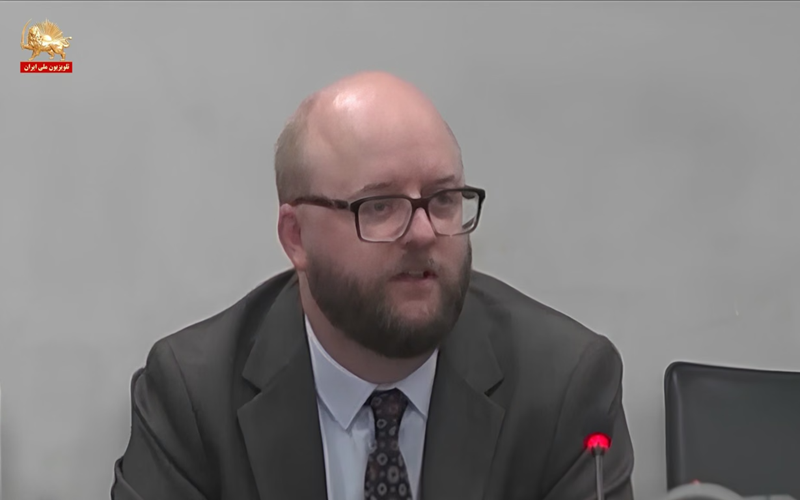

Political scientist Henrik Hermansson warns that increasingly restrictive laws and expanding repression are making it ever more dangerous for Iranians to expose human-rights violations and communicate with international organizations.
At a conference held at the European headquarters of the United Nations in Geneva, political scientist Dr. Henrik Hermansson warned that Iran’s already restricted civil society is facing an accelerating crackdown, while the use of executions and other forms of repression is expanding.
Addressing an audience of political figures, legal experts, and human-rights advocates, Hermansson focused on the increasingly dangerous consequences faced by Iranians who attempt to communicate information about human-rights violations to the outside world.
Sharing Human-Rights Information Can Carry Severe Punishment
Hermansson pointed to the dangers faced by Iranian citizens who communicate with foreign journalists, nongovernmental organizations, or United Nations-affiliated bodies.
Under Iran’s existing laws, he noted, an Iranian citizen who communicates with a foreign journalist or an international organization and shares information considered sensitive—including information concerning human-rights violations—can face severe punishment, potentially including the death penalty.
He also referred to a legislative initiative known as the “Bill to Counter Foreign Infiltration.” According to Hermansson, the proposed legislation would require Iranians to obtain prior authorization from the Ministry of Intelligence before communicating with NGOs, UN special mandate holders, or international organizations.
Failure to obtain such authorization could reportedly expose individuals to prison sentences of up to 30 years.
Such measures would further restrict an already narrow space for independent civil activity and make cooperation between Iranian citizens and international human-rights institutions increasingly difficult.
Civil Society Under Growing Pressure
Hermansson argued that the concept of civil society in Iran has already been severely constrained and is now shrinking at an accelerating pace.
Against this backdrop, he emphasized the importance of providing a venue where Iranian human-rights concerns can be raised openly.
The ability to discuss these issues at the United Nations, he said, is particularly valuable because those attempting to raise similar concerns inside Iran face increasingly serious risks.
The restrictions extend beyond political activists. Lawyers, trade-union members, journalists, medical professionals, and other civil-rights defenders have increasingly come under pressure, according to Hermansson.
The result, he warned, is an environment in which critical and dissenting voices are becoming progressively harder to hear.
Political Executions and Broader Repression
Hermansson also highlighted the rapid increase in political executions alongside Iran’s broader execution figures, which he described as approaching historic highs.
He warned that the targeting of people who defend civil and political rights is part of a wider effort to suppress independent voices.
The pressure on lawyers, journalists, labor representatives, healthcare workers, and human-rights defenders has a particularly significant impact because these groups play a central role in documenting abuses and communicating the concerns of ordinary citizens.
When these channels are suppressed, violations become harder to document and victims have fewer avenues through which to seek international attention.
Hermansson further noted that the recent war in the region has intensified and accelerated the domestic crackdown, adding another layer of pressure to an already restrictive environment.
A Greater Responsibility for the International Community
The speech placed particular emphasis on the role of the international community as domestic repression becomes more severe.
As expressing dissent inside Iran becomes increasingly dangerous, Hermansson argued that international institutions, governments, legal experts, and human-rights organizations have a greater responsibility to ensure that the voices of Iranian citizens are not silenced.
The challenge is not limited to documenting executions after they occur. It also involves preserving channels through which information can reach the outside world, protecting those who expose abuses, and ensuring that restrictions on civil society do not prevent international bodies from understanding conditions inside Iran.
The Geneva conference therefore underscored a central concern: as the space for peaceful dissent and independent civil activity contracts inside Iran, international attention becomes increasingly important.
With political executions continuing and restrictions on communication with international organizations expanding, the ability of the international community to hear and amplify the voices of Iranian citizens is becoming an increasingly critical component of efforts to defend fundamental rights.