


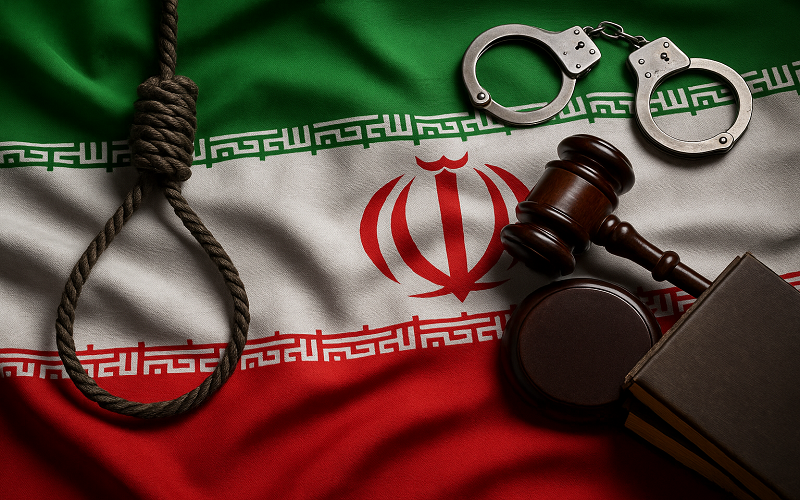

As the regime returns to mass death sentences and show trials, the world must respond before another 1988-style atrocity unfolds.
A chilling escalation of political repression is unfolding in Iran’s prisons, exposing the regime’s calculated use of terror to preserve its grip on power. This systematic crackdown—marked by a surge in death sentences and torture—sends a clear message: dissent will be silenced by any means necessary.
In recent weeks, at least 15 political prisoners have been sentenced to death, accused of affiliation with the opposition group, the People’s Mojahedin Organization of Iran (PMOI/MEK). Many face imminent execution. These sentences follow prolonged solitary confinement, extensive torture, and grossly unfair trials in the notorious Branch 1 of the Ahvaz Revolutionary Court. Charges such as “enmity against God,” “membership in the MEK,” and “propaganda against the regime”—often fabricated—form the basis of these convictions.
Among the starkest examples are Masoud Jamei, Alireza Merdasi, and Farshad Etemadifar, each condemned to two executions and one year in prison. Two others, Saman and Davoud Hormatnejad, received 12 and 15 years respectively. These rulings reveal the regime’s routine use of extreme punishment to crush any form of political opposition.
Such actions are a direct assault on fundamental human rights—including the right to life and the right to a fair trial—enshrined in international covenants such as the Universal Declaration of Human Rights and the International Covenant on Civil and Political Rights. Yet for the Iranian regime, these protections are little more than obstacles to its long-standing practice of political elimination.
The timing of this crackdown is no accident. It comes as nuclear negotiations remain active—a pattern that has repeated itself time and again. When facing internal discontent and external scrutiny, Tehran engages in a dual strategy: presenting a façade of diplomacy abroad, while intensifying repression at home. This contrast—of handshakes overseas and executions behind prison walls—has become a defining tactic of the regime.
This duality is not new. It is deeply rooted in the post-1979 history of the Iranian regime. The use of executions to eliminate political dissenters culminated in the 1988 massacre of an estimated 30,000 prisoners—most of them MEK supporters. The current wave of death sentences carries disturbing echoes of that tragedy. The world failed to stop the 1988 massacre. It cannot afford to repeat that mistake.
This moment demands more than concern. It requires concrete action—especially from those engaged in diplomacy with Tehran. Democratic governments, human rights organizations, and particularly the parties involved in nuclear negotiations must publicly condemn the regime’s recent actions. Silence now will be interpreted in Tehran as license for further brutality.
The principle is simple: human rights must not be sacrificed at the altar of nuclear diplomacy. Any political or economic engagement with Iran should be explicitly tied to measurable human rights benchmarks. That is not idealism—it is a necessity grounded in democratic values and moral responsibility.
The European Union, as a central actor in nuclear talks, holds unique leverage. It must be prepared to use diplomatic and economic tools to pressure Tehran. Targeted sanctions on human rights violators, suspension of negotiations in response to executions, and material support for human rights defenders are essential steps. Meanwhile, international bodies such as the United Nations must strengthen oversight, publish independent reports, and demand access to Iran’s prisons.
The regime’s renewed campaign of repression, including orchestrated trials and politically motivated death sentences, represents a grave challenge to the global human rights framework. The international community must place human rights at the heart of its policy toward Iran—not as an afterthought, but as the core of its engagement.
Because the cost of inaction is not theoretical—it is measured in lives.