


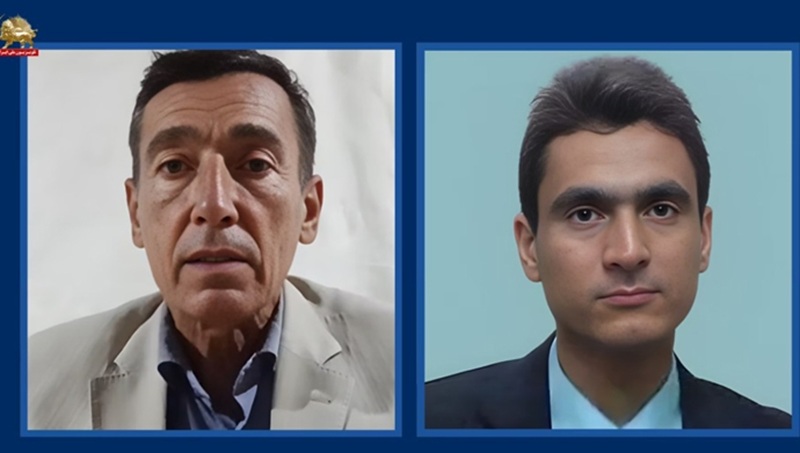

Messages from Evin and Yazd prisons condemn repression after nationwide uprising and reaffirm commitment to freedom against both Shah and clerical dictatorship
Two Iranian political prisoners have sent powerful messages from behind bars, denouncing escalating repression following the recent nationwide uprising and reaffirming their unwavering commitment to organized resistance against the ruling clerical dictatorship.
The statements, delivered from Evin Prison and Yazd Central Prison, underscore growing tensions inside Iran’s prisons amid intensified crackdowns on dissent.
“I Am Not and Never Will Be Remorseful”
Shahin Zoghi-Tabar, a political prisoner held in Evin Prison, described increased pressure on detainees following the uprising and the terrorist designation of the Islamic Revolutionary Guard Corps (IRGC).
“After the recent uprising of the Iranian people and the designation of the IRGC as a terrorist organization, the clerical regime is mistakenly trying to increase pressure on prisoners, especially political prisoners,” he said in an audio message from prison.
Zoghi-Tabar detailed his interrogation by the Intelligence Ministry on February 2, where he was accused of “propaganda against the regime.” According to his account, officials questioned him about recorded voice messages and public statements.
“They asked if I had given a voice message. I said yes. They asked if I had issued a statement. I said yes. They asked if I would continue. I said yes. They asked if I was still standing by my position. I said yes. They asked if I was remorseful. I said no — I am not and never will be remorseful.”
He accused the Intelligence Ministry of fabricating new cases in an attempt to pressure Western governments to remove the IRGC from terrorist lists.
“The Ministry thinks that by opening many new cases it can remove the IRGC from the terrorist lists of Europe and America. But it does not understand the law and does not realize that it itself will be placed on Europe and America’s list after the IRGC.”
He added: “Certainly, the next stage is the placement of the notorious ministry of the mullahs on the blacklist of Europe and America.”
Zoghi-Tabar also called on European and American governments to recognize what he described as “the rebellious units in Iran and the legitimate armed struggle of the Iranian people.”
His message concluded with a request that his voice be broadcast by opposition-affiliated media.
“The Banner of Freedom Has Never Fallen”
In a separate message from Yazd Central Prison, political prisoner Mohammadreza Habiban framed the current struggle as part of a century-long resistance against dictatorship in Iran.
“For one hundred years, in the struggle against the dictatorship of the Shah and the dictatorship of the Sheikh, our people have never lowered the banner of freedom.”
Habiban paid tribute to what he called the “rebellious units” whose operations, in his words, “have shaken the body of dictatorship and whose victories have lit the light of hope in the depths of society and in the hearts of prisons.”
He referred to the January uprising and the heavy toll of repression, stating:
“The smell of the blood of thousands of teenagers and young people, as well as fathers and mothers who took to the streets for freedom, is still rising from the pavement of our cities.”
Habiban rejected both foreign military intervention and compromise with the ruling establishment as paths to change.
“I declare that neither foreign war nor appeasement and concessions will bring the people to freedom. With deep conviction, I state that the only path to liberation from the grip of the demons ruling our beloved Iran is reliance on organized and popular resistance manifested in the rebellious units.”
He also invoked historical repression under both monarchic and clerical rule, arguing that neither system succeeded in extinguishing the demand for liberty.
“Neither the Shah’s dictatorship nor the clerical dictatorship has been able, and cannot, prevent the people from achieving freedom and liberation.”
Habiban ended his message with a declaration of confidence in ultimate victory:
“Victory is ours. Tomorrow is ours.”
Escalating Pressure Inside Prisons
The messages reflect mounting pressure on political detainees in the aftermath of widespread anti-regime protests. Human rights organizations have repeatedly warned about intensified interrogations, new charges, and psychological pressure against prisoners accused of supporting or encouraging dissent.
Despite the risks, both prisoners emphasized that repression has not weakened their resolve. Instead, they portray the prison system itself as an extension of the broader confrontation between the Iranian people and the ruling establishment.
Their statements from behind bars signal that, even under heightened security and surveillance, voices of resistance continue to resonate from within Iran’s most notorious detention facilities.