


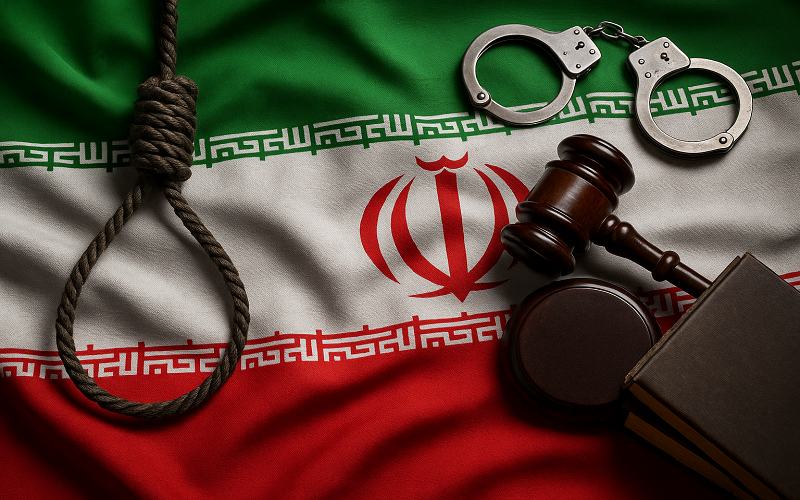

On the World Day Against the Death Penalty, Iran stands as a grim exception — turning execution into an instrument of political repression and survival.
A Global Day, a National Tragedy
October 10, the World Day Against the Death Penalty, serves as a reminder of one of humanity’s most urgent human rights challenges. While most nations have abandoned capital punishment, Iran continues to wield it as an instrument of state terror — a means to preserve the rule of a repressive regime.
As this global day approaches, Iran draws worldwide attention with an unprecedented surge in executions. According to Amnesty International, by the end of 2024, more than 145 countries had abolished or ceased the use of the death penalty. Yet, in the same year, Iran alone carried out over 60% of all recorded executions worldwide — a staggering reversal of global trends toward abolition.
While most of the world is moving toward life, Iran’s rulers have chosen the path of death, fear, and tyranny.
A Record-Breaking Year of Executions
In 2025, the situation has worsened dramatically. International human rights organizations report that over 1,000 people have been executed in Iran in the first nine months of this year, nearly double the total for all of 2024.
Sources close to the Iranian Resistance put the true number even higher: by October 6, 2025, at least 1,226 executions had taken place — an average of five to six per day. Since the appointment of Masoud Pezeshkian’s government in July 2024, more than 1,926 people have been executed.
September 2025 marked a horrific peak: at least 200 prisoners, including six women, were executed in a single month — the highest monthly figure in 36 years. By comparison, there were 84 executions in September 2024 and only 29 in 2023.
These numbers tell a chilling truth: the Iranian regime, facing social unrest and political paralysis, has turned the gallows into its last line of defense.
The Rope of Power
In Iran, executions have long ceased to be a judicial measure. They have become a political weapon — a display of power by a regime terrified of its own people.
Every time the regime’s survival is threatened, it turns to the noose. From the 1988 massacre of political prisoners to the execution waves following recent uprisings, the Islamic Republic has relied on death to silence dissent.
Today’s surge in executions is inseparable from the regime’s deepening crises: the death of Ebrahim Raisi in April 2024, the disarray within the Revolutionary Guards (IRGC), the collapse of proxy forces abroad, the activation of the UN snapback mechanism, and the worsening economic deadlock.
For Ali Khamenei, executions are not about enforcing law — they are about projecting strength. Each hanging sends a bloodstained message to a society that no longer fears him.
Political Executions on the Rise
In recent weeks, the regime has escalated its repression of political prisoners. On October 4, 2025, six Arab political prisoners were executed in Sepidar Prison, Ahvaz, after seven years of incarceration. That same day, Saman Mohammadi-Khiara was executed in Ghezel Hesar Prison after 12 years behind bars.
Meanwhile, Iran’s Supreme Court upheld the death sentence of Mohammad Javad Vafaei-Sani, a political prisoner and supporter of the People’s Mojahedin Organization of Iran (PMOI/MEK). Earlier this year, Hamed Validi and Nima Shahi were sentenced to death following brutal torture.
With these cases, the number of political prisoners on death row has exceeded 17 — a grim milestone that underscores the regime’s desperation.
Fear of a Restless Nation
The surge in executions is directly linked to the regime’s fear of a volatile society. The spread of young dissidents, rebellious women, and men inspired by past uprisings has shaken the regime to its core.
The expanding activities of PMOI Resistance Units across Iran have triggered panic in Khamenei’s inner circle. The regime’s reliance on executions reflects its growing isolation and decay.
For a dictatorship built on terror, the gallows have become both a weapon and a crutch — a tool to delay an inevitable downfall.
“We Do Not Bargain for Our Lives”
The courage of Iran’s political prisoners stands in stark contrast to the regime’s brutality. The “No to Execution Tuesdays” campaign, launched from a prison cell in Ghezel Hesar, has now reached 52 prisons across the country in its 89th consecutive week. It is one of the longest-running acts of organized resistance in Iran’s prison history.
Letters and statements from political prisoners show that the regime’s machinery of fear is failing. Inmates now chant against executions, turning the gallows into a symbol of defiance rather than submission.
Two MEK political prisoners, Behrouz Ehsani and Mehdi Hassani, executed on July 27, 2025, left behind a lasting message. Despite severe torture, they refused to denounce their ideals, declaring:
“We do not bargain for our lives.”
Their final words have since become a rallying cry — echoing through Iran’s prisons and resistance circles alike.
A Regime Sustained by Death Cannot Survive
The clerical regime has built its rule on executions. Yet history shows that the noose guarantees not survival, but collapse.
Iran today is not the Iran of the 1980s. Each execution now fuels greater anger — from universities to factories, from Kurdish towns to Khuzestan, from prisons to the streets. The cry against executions has become a cry for the overthrow of the entire theocratic system.
A government that depends on killing its citizens to rule is a government doomed to fall.
The Global Responsibility
The World Day Against the Death Penalty must serve as a moment of solidarity with the Iranian people. The world must recognize that in Iran, executions are not acts of justice but instruments of state terror.
The cries of Iran’s prisoners, the tears of victims’ families, and the defiance of those who refuse to bow to tyranny must echo across the globe.
The end of executions in Iran will come — and with it, the end of the dictatorship that has ruled through death. The people of Iran have already made their choice: life, freedom, and justice will prevail.