


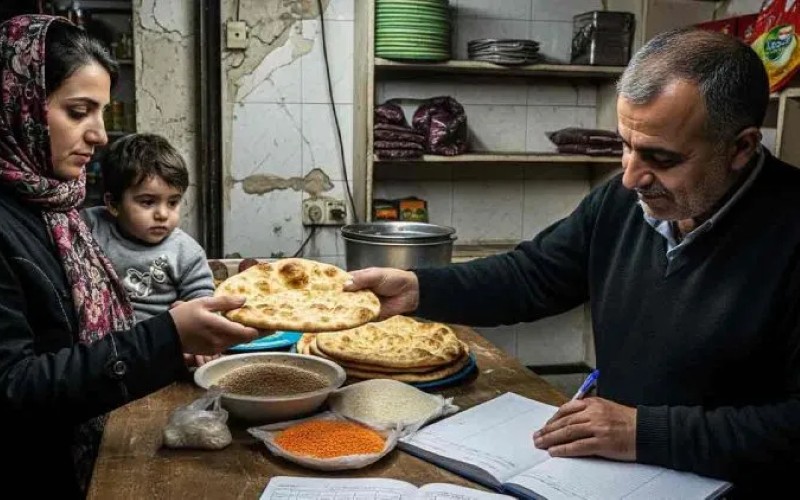

As Iran faces renewed UN sanctions and economic collapse, the regime’s war-driven policies push millions deeper into poverty — where even basic food like beans is now unaffordable.
A Nation Where Beans Cost More Than Wages
In today’s Iran, even the most ordinary meal has become a symbol of economic despair. What once served as a modest substitute for meat — beans and lentils — is now out of reach for most Iranian households.
At major retail chains in Tehran, a kilogram of pinto beans has soared to 660,000 tomans. For a family of four, a simple meal of beans each day would cost more than 19 million tomans per month — more than many workers’ entire salaries. Even if a laborer were to spend his full monthly income on beans alone, he still could not feed his family for a full month.
This is the new reality in Iran’s kitchen: a nation where the price of beans tells the story of national collapse.
Inflation Beyond Imagination
The rise in food prices has been staggering. In June 2024, pinto beans cost less than 150,000 tomans per kilo. By February 2025, they had nearly doubled to 280,000 tomans, and by September 2025, the price had jumped to over 660,000 tomans — a more than fourfold increase in just 15 months.
Similar inflation has hit all basic goods. Today, red meat sells for 1.2 to 1.5 million tomans per kilo, lentils for 200,000 tomans, mung beans for 190,000, white chickpeas for 210,000, and split peas for 250,000. Even rice — once the cornerstone of Iranian meals — costs about 300,000 tomans per kilo.
Meanwhile, dairy and everyday items have followed the same trajectory:
- 1 bottle of low-fat milk: 52,000 tomans
- 100g butter: 60,000 tomans
- 450g yogurt: 42,000 tomans
- 900ml cooking oil: 90,000 tomans
- 400g chicken breast: 145,000 tomans
- 1 small frozen village chicken: 240,000 tomans
In many households, meat and dairy have vanished entirely from the dinner table — replaced first by beans, and now, by nothing.
The Trigger: The Regime’s Policies and the Return of Sanctions
The latest wave of price hikes coincides with the activation of the UN snapback sanctions and the return of multilateral sanctions against Tehran. The Iranian currency has collapsed under pressure, with the U.S. dollar reaching an unprecedented 118,000 tomans in the Tehran market.
As the rial loses value, prices for nearly all goods — from food to medicine — continue to spiral upward. Yet the regime refuses to alter its policies. Instead, it pours billions into nuclear and military projects, and into funding proxy militias abroad, while Iranian citizens struggle to afford milk and rice.
The government’s priorities are clear: while families are forced to ration food, the regime spares no expense to sustain its foreign interventions and repressive apparatus.
A Widening Gap Between Wages and Survival
According to official data, the average monthly income for Iranian workers and employees ranges between 12 and 17 million tomans. Yet labor activists estimate that the poverty line for a three-person household now exceeds 56 million tomans per month.
That means even if a family pays no rent and cuts out meat, chicken, and dairy, their combined monthly wage would still not be enough to afford basic staples like rice and beans.
Beyond food, Iranians face rising costs for transportation, education, utilities, and healthcare — all of which compound the financial pressure on the working class.
The Human Cost of the Regime’s Mismanagement
More than 80% of Iran’s population now lives below the poverty line. In many homes, ordinary dishes like ash-e reshteh (a traditional bean and noodle soup) have disappeared. Families buy meat on installment, students drop out of school due to rising costs, and retirees struggle to afford medicine.
In just one year, prices of basic goods have increased by more than 100%, the cost of school supplies by 30%, and over one million children have been forced to abandon their education. Even healthcare has become a luxury, as under-the-table medical fees and the soaring cost of drugs push families into despair.
This humanitarian and economic catastrophe is not the result of sanctions alone, but of the regime’s war-driven, corruption-laden economic model. Billions of dollars are spent on regional militias and nuclear ambitions, while Iran’s citizens bear the full cost of these destructive policies.
The Outlook: A Crisis Without a Ceiling
With sanctions fully reinstated, oil revenues falling, and financial isolation deepening, Iran’s economy is heading toward a new phase of instability. Analysts warn that in the coming months, even domestically produced goods — once relatively affordable — will continue to rise in price, further eroding purchasing power.
The gap between minimum wage and the poverty line is turning into an abyss, leaving millions trapped in hunger and hopelessness.
For ordinary Iranians, the regime’s economic mismanagement has turned survival into a daily battle — one where the price of beans now stands as a national symbol of despair.