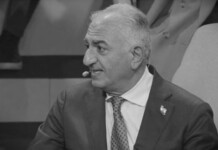
The death of former Iranian regime president Ebrahim Raisi, infamously dubbed the “Butcher of Tehran,” will undoubtedly lead to new developments within the regime. This article analyzes the regime’s behavior towards students during Raisi’s tenure.
In 2019, when Raisi headed the regime’s judiciary, the Iranian government violently cracked down on student protests, using tear gas, attacking university dorms, and later purging professors and expelling or arresting students involved in the demonstrations.
Dozens of protesters were killed by security forces during this period. During the Mahsa Amini protests that erupted in September 2022 after Mahsa Amini’s death at the hands of the regime’s morality police, reports indicate that at least 308 students were arrested.
The exact number of students killed remains unknown. Throughout the protests, police and Basij forces used tear gas, rubber and metal bullets, and live ammunition to disperse gatherings, killing hundreds of unarmed people.
According to the National Council of Resistance of Iran (NCRI), at least 750 people were killed. Under Raisi’s tenure, students faced more oppression than at any time since the 1980s.
Escalating Repression
In the first three months of the 2022 uprising alone, more than 5,000 students were summoned to university disciplinary committees, and 18 professors were banned from leaving the country.
Since then, the process of summoning, banning entry, suspending, and expelling students and professors from dormitories and universities has continued. At least 435 protesting students were deprived of their studies through heavy suspension and expulsion orders.
These pressures were not exclusive to student activists or major cities and universities; they extended to any student who participated in protests, even union-related ones.
In recent weeks, this intensified repression has even reached students’ simple virtual actions, such as participating in student groups or channels.
The launch of the morality patrol was related to the last few months of 2023. Now, the Islamic Revolutionary Guard Corps (IRGC), Basij, and plainclothes regime forces are allowed to enter universities and suppress students.
Contradictory Rhetoric
The regime’s “purification policy” has continued across all university fields, with the government stationing “hijab observers” on campuses. In some universities, the regime has ramped up repression and increased excessive use of CCTVs.
One of the tasks of university repression is filing cases against students under various pretexts. These cases often extend beyond the students’ study periods, jeopardizing their professional futures and employment prospects after graduation.
Remarkably, not long after pro-Palestinian student protests began in American and European universities, the Iranian regime’s authorities voiced support for these protests.
From the Supreme Leader to the Minister of Science and university presidents, in a completely contradictory approach to dealing with opposition within the country, concepts such as “human rights” and “student movement” were suddenly recognized.
Relying on these concepts, they supported protests they may perceive as opposition to ruling systems in Western democracies.
Supreme Leader Ali Khamenei expressed displeasure with how protesting students were treated in Western countries, seemingly forgetting or ignoring the oppression Iranian universities faced under his decades of leadership, especially during Raisi’s presidency.
Raisi, whose tenure saw the most intense security and repression on campuses, did not remain silent about student protests abroad.
He claimed that dealing with these protesting students broke the “respect” of students, universities, and freedom of speech.
However, during his term alone, more than 725 students were arrested, and over 2,843 students were punished by university disciplinary committees.