


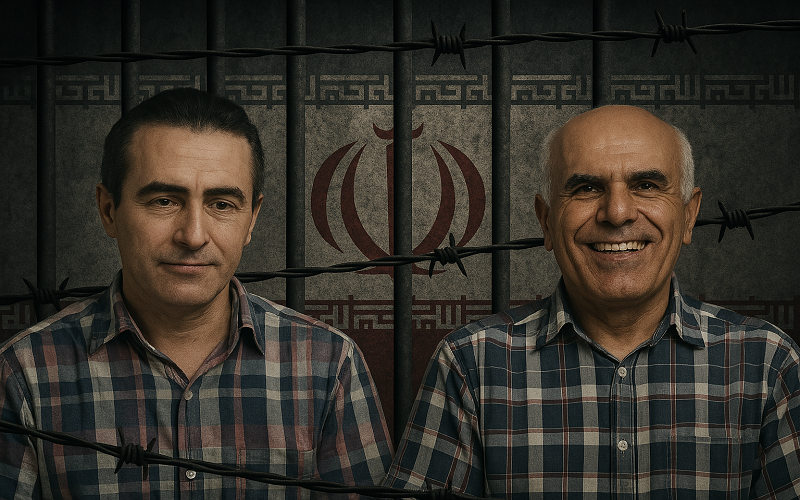

In yet another attempt to whitewash its crimes against political dissenters, the Iranian regime has issued a 12-page report to the UN High Commissioner for Human Rights in a futile bid to justify the death sentences of two political prisoners: Mehdi Hassani and Behrouz Ehsani. Cloaked in legal jargon, the report is nothing more than a desperate effort to legitimize state-sanctioned murder and suppress voices of resistance.
Both Hassani and Ehsani are political activists whose only “crime” is their unyielding commitment to freedom and justice. The charges against them—ranging from “membership in the People’s Mojahedin Organization of Iran (PMOI/MEK)” to “shouting anti-regime slogans” and “sending videos to opposition media”—read less like legitimate legal accusations and more like a paranoid regime’s checklist for silencing dissent.
The Iranian judiciary’s so-called High Council for Human Rights absurdly claims that protests since 2022, allegedly linked to the PMOI and its domestic networks, resulted in terrorist activities targeting security and judicial institutions. The report accuses Hassani and Ehsani of being the masterminds behind these acts and stacks a laundry list of sensationalist charges against them, including the destruction of public property, carrying firearms, and even building mortars.
But these charges, rather than indicating a fair and thorough investigation, reek of fabricated evidence and forced confessions—methods the regime has notoriously relied on to crush opposition. International human rights organizations have repeatedly documented the regime’s use of torture, long-term solitary confinement, and denial of legal rights to extract false confessions and secure predetermined verdicts.
Perhaps the most glaring irony in the report is the regime’s claim that all legal proceedings adhered to the principles of a fair trial and that the executions are consistent with international law. The regime boldly asserts that the accused were represented by lawyers at all stages—conveniently omitting the fact that in political and security cases, defendants are only allowed to choose from a list of lawyers pre-approved by the head of the judiciary, a central figure in orchestrating the regime’s repression.
Equally ludicrous is the regime’s citation of its own constitution, which formally prohibits torture—while its prisons overflow with evidence of inhumane treatment, and its courts rely heavily on confessions extracted under duress, often televised to serve as public warnings.
In yet another contradiction, the regime frequently insists on the international stage that the PMOI has no presence in Iran. Yet, in this very report, it elevates the actions of individuals allegedly linked to the PMOI as a grave threat to national security—an admission that the organized resistance is not only real, but growing in strength and influence.
This confused narrative only reveals the regime’s fear. It is not strength that drives these executions, but panic in the face of an increasingly emboldened and legitimate resistance movement. The Islamic Republic’s pattern of repression has already earned it condemnation in international forums at least 71 times for systematic human rights violations. This latest attempt to justify death sentences is not a legal defense—it is a propaganda campaign aimed at delaying the inevitable reckoning for decades of brutality.
The execution orders for Mehdi Hassani and Behrouz Ehsani are not isolated incidents—they are the latest entries in a vast and damning record of state violence. But no amount of coercion or state-sanctioned killing can extinguish the Iranian people’s hunger for freedom. On the contrary, each act of repression further isolates the regime, both politically and diplomatically, and adds fuel to the fire of a growing resistance that refuses to be silenced.
The world must not be deceived. These executions are not justice—they are crimes. And they must be condemned as such, with firm and immediate action by the international community.