



UNGA Resolution Marks First Global Recognition of Iran’s 1988 Massacre Amid Escalating Executions
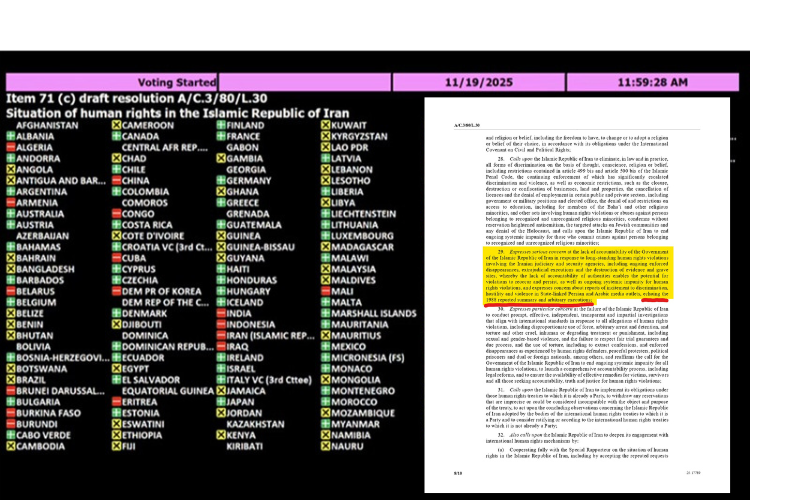
In a historic development, the Third Committee of the United Nations General Assembly adopted a resolution on November 19, 2025, that—for the first time—explicitly references the 1988 Massacre of political prisoners in Iran. This unprecedented recognition marks the first official acknowledgment by the global community of one of the Iranian regime’s most enduring crimes against humanity.
With the Iranian regime openly threatening to repeat that massacre amid escalating executions, human rights advocates argue that the world must finally move from condemnation to action.
A Landmark Resolution Exposing Systematic Crimes
The resolution, passed with 79 votes in favor and 28 against, is the 72nd UN resolution condemning Iran’s gross and systematic human rights violations. Yet this one stands apart: it names the regime’s decades-long atrocities with clarity and detail unprecedented in UN documents.
Among its most critical components are several paragraphs directly addressing the Iranian regime’s ongoing abuses:
1. Institutionalized Religious Discrimination
The resolution calls on Iran’s regime to abolish all forms of discrimination based on belief, including the repressive Articles 499 bis and 500 bis of the Islamic Penal Code. These laws have enabled violence, economic persecution, confiscation of property, denial of education, and widespread discrimination—particularly targeting Bahá’ís and other religious minorities.
It also condemns heightened antisemitism, state-backed attacks on Jewish communities, and any denial of the Holocaust.
2. Impunity for Enforced Disappearances and Extrajudicial Executions
The resolution expresses serious concern over Iran regime’s refusal to hold officials accountable for long-standing crimes involving the judiciary and security agencies. These include:
- ongoing enforced disappearances
- extrajudicial executions
- destruction of grave sites and evidence
- incitement to violence in state media that echoes the mass killings of 1988
This recognition represents the first time the United Nations draws a direct line between current regime crimes and the 1988 massacre.
3. Systematic Torture and Abuse of Protesters
The resolution condemns the regime’s failure to investigate torture, sexual violence, arbitrary detention, and the disproportionate use of force. It highlights ongoing abuses against:
- human rights defenders
- peaceful protesters
- political prisoners
- dual and foreign nationals
By linking these violations to institutional impunity, the UN underscores the regime’s deliberate use of repression as policy.
4. Non-Compliance With International Human Rights Treaties
The resolution urges Tehran to fulfill its treaty obligations, remove incompatible reservations, and cooperate fully with UN human rights mechanisms—including allowing visits from the Special Rapporteur on Iran, whom the regime has repeatedly denied entry.
Executions Surge—Regime Threatens to Repeat the 1988 Massacre
Alongside its references to the 1988 Massacre, the resolution strongly condemns the alarming rise in executions. Since the beginning of 2025, the regime has executed at least 1,700 prisoners, nearly double the number from the same period last year. Many executions are politically motivated and used as tools of intimidation, particularly against protesters from the uprisings of 2022 and earlier.
The UN specifically condemns death sentences used to silence dissent, including against minors and women.
Maryam Rajavi: The Regime’s Crimes Must Be Referred to the UN Security Council
Mrs. Maryam Rajavi, President-elect of the National Council of Resistance of Iran (NCRI), welcomed the resolution as “a reflection of only a fraction of the regime’s crimes.” She emphasized that:
“Following this explicit acknowledgment of the 1988 massacre and the surge in executions, the regime’s case must be immediately referred to the UN Security Council, and its leaders must be brought to justice.”
Seventy-second UN Resolution Condemns Grave Human Rights Violations in Iran
Mrs. Rajavi underscored that the impunity enjoyed by regime officials—including those directly involved in the 1988 killings—has enabled the repetition of atrocities for over four decades. She noted that in his July 2024 report, the UN Special Rapporteur determined that the 1988 massacre constituted crimes against humanity and genocide, with key perpetrators still occupying top government posts under Ali Khamenei.
She also stressed:
“The godfather of executions, terrorism, and warmongering does not represent the people of Iran. He must be expelled from the United Nations and all international forums.”
According to Mrs. Rajavi, such an action is not only the demand of the Iranian people but an international necessity for global peace and stability.
A Turning Point for International Accountability
By formally acknowledging the 1988 Massacre for the first time, the UN has taken a decisive step that aligns the international community with four decades of evidence, survivor testimonies, and investigative reporting. With Iran regime’s rulers now escalating executions and threatening to repeat past atrocities, this recognition carries immense urgency.
The resolution makes clear that the Iranian regime’s systematic impunity remains the engine of continued crimes—from the mass killings of 1988 to the suppression of nationwide protests in 2009, 2017, 2019, and 2022, and the record executions of 2025.
Whether the world turns this historic acknowledgment into meaningful action—particularly by referring the case to the UN Security Council—will determine whether justice is finally served for the thousands of victims, past and present.