


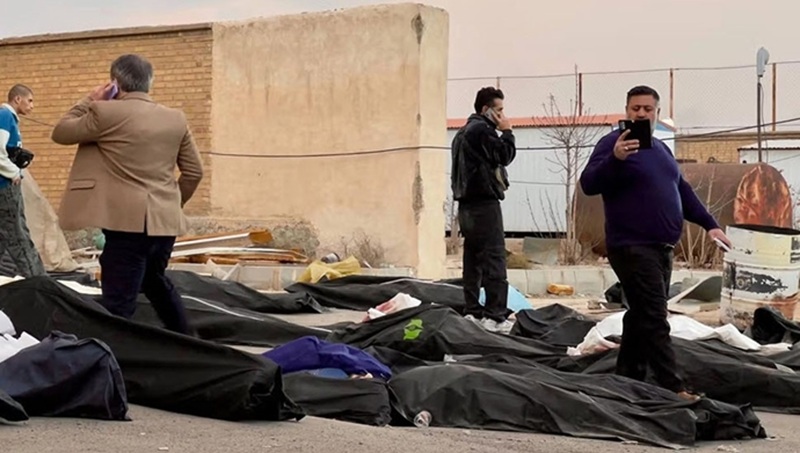

From early revolutionary violence to the January 8–9 killings, Iran’s “truth commissions” have consistently served power—not accountability.
Since 1979, there has not been a single political-security case in Iran for which the regime has formed an independent fact-finding body that led to genuine accountability. This is not an administrative oversight; it is a structural feature of a system that treats responsibility—accountability—as an existential threat.
Within such a framework, every major national tragedy becomes not an opportunity for truth-seeking, but a mechanism for producing fresh layers of obfuscation. From the early post-revolutionary vigilante violence backed by figures such as Mohammad Beheshti and Ruhollah Khomeini, to torture scandals, acid attacks, the chain murders of intellectuals, the bombing at the Imam Reza shrine in Mashhad, the killings of Christian pastors, the downing of Ukraine International Airlines Flight 752, the Shah Cheragh attack in Shiraz, the killing of Mahsa Amini, and the death of Armita Geravand—the pattern has been consistent.
In each case, instead of a transparent and independent investigation, the public has been presented with contradictory narratives, missing evidence, unnamed “foreign agents,” and cases left open and unresolved. Over four decades, this has hardened into a doctrine of plausible deniability.
The Function of “Truth” in an Unaccountable System
In democratic systems, fact-finding committees are typically composed of individuals institutionally independent from the executive branch, precisely to ensure that wrongdoing within the state apparatus can be exposed without interference.
But in Iran, the concept of a “truth commission” has repeatedly functioned as a public-relations instrument—designed to manage outrage, diffuse pressure, and buy time.
Either such committees are never meaningfully formed, or their findings are never published, or—if published—lack enforceability and consequence. The outcome is predictable: no senior official is held responsible, and the structural conditions that produced the tragedy remain intact.
Pezeshkian’s Promise and Structural Contradictions
Now, the regime’s President Masoud Pezeshkian has pledged to establish a fact-finding body to determine “the truth” about the events of January 8 and 9 (18 and 19 Dey). The announcement comes despite the widely acknowledged reality that ultimate authority over lethal force resides with Supreme Leader Ali Khamenei.
Yet no information has been released regarding the committee’s composition, mandate, independence, or subpoena powers. The absence of these basic criteria has fueled skepticism—even within establishment media.
On February 18, the Tehran-based newspaper Shargh questioned the silence surrounding the promised inquiry:
“What happened on January 8 and 9? The President promised that a fact-finding group has been formed to uncover the truth of those two days, but so far there is ‘no news at all.’ Everywhere in the world, the tradition of a fact-finding group is that it and its members must be independent of the governing apparatus so that if an error has occurred within that apparatus and there is reluctance to disclose it, they can uncover it and report to the nation.”
The paper further noted, drawing on 47 years of experience:
“A fact-finding group is formed because the governing apparatus, for whatever reason, does not want to or cannot or does not deem it expedient to report; especially since sometimes considerations may prevent the reporting of the truth.”
This is the structural knot at the heart of the issue. When the authority that forms the committee is itself a potential subject of investigation, impartiality becomes logically untenable.
Shargh described the events of those January nights as a “blind knot on the map of Iran,” urging:
“Mr. President! Lift the veil from the secret and do not let this question, like a blind knot on the map of Iran, swallow everything into itself.”
The metaphor captures a society saturated with unanswered questions—each new incident layering ambiguity upon ambiguity.
A Predictable Outcome
Based on four decades of precedent, there is little reason to expect a different trajectory for this latest committee. The institutional architecture of the Velayat-e Faqih system subordinates investigation to expediency. Truth is filtered through regime survival.
In such a structure, independent fact-finding is not merely unlikely—it is incompatible with the logic of governance itself.
For many Iranians, this accumulated experience has led to a stark conclusion: under the current system, truths about state violence will not emerge through internal mechanisms. They will surface only through fundamental political transformation.
That conviction, sharpened by repeated cycles of denial and impunity, continues to shape the determination visible in Iran’s streets in recent weeks and months.