


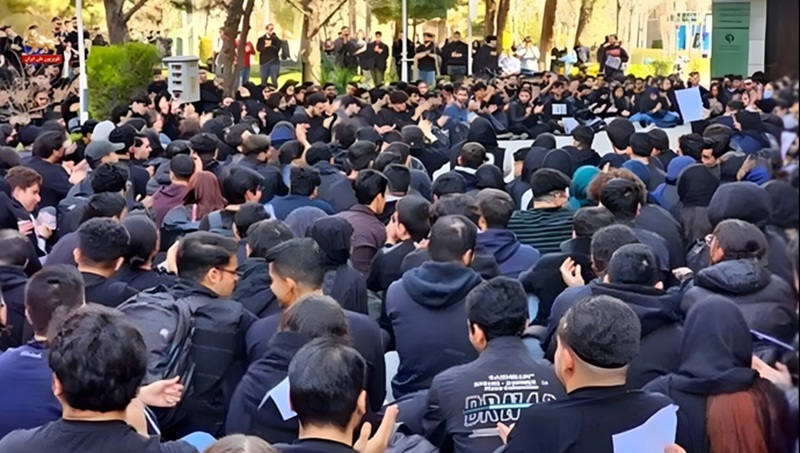

Regime-aligned media warn of inflation shocks, collapsing purchasing power, and unresolved January violence as public anger simmers beneath the surface
Iran’s crisis is no longer confined to the streets. It is visible in the price of bread, in empty Ramadan tables, and in the uneasy tone of the regime’s own media. When newspapers that operate within the system begin issuing warnings about “dangerous consequences,” the signal is unmistakable: the Iranian regime is navigating a period of acute vulnerability.
The debate over bread prices illustrates how combustible the situation has become. Shargh cautions bluntly that in conditions where inflation remains uncontrolled, “any shock measure of any kind can be dangerous.” The warning is not abstract. The paper describes a society in which “many people can no longer afford meat; chicken and eggs are also difficult to obtain, and the only item left on the table is bread.” If that final pillar of subsistence faces a price shock, it writes, “practically the last livelihood support of the lower deciles will be damaged, and such an action is not recommended.”
Bread is not just a commodity in Iran; it is a political barometer. When even regime-aligned outlets advise against tampering with bread subsidies for fear of unrest, they are acknowledging the fragility of social stability. The leadership understands that inflation is not merely an economic indicator—it is an accelerant.
The economic deterioration is starkly visible during Ramadan. Donya-e-Eqtesad reports that rising prices and shrinking purchasing power have made traditional family gatherings increasingly rare. Confectioners speak of collapsing sales of Zulbia and Bamieh. Foods such as ash and Halim appear to be disappearing from iftar tables. A date seller notes that last year customers would buy two cartons at a time and inventories would vanish within days; this year, the same product “hardly sells.” This is particularly alarming in a country where, according to the head of the national date association, 40 percent of annual date consumption normally occurs during Ramadan.
The dairy market offers an even clearer signal of distress. A shopkeeper reports that two-kilogram yogurt containers from certain brands now cost around 500,000 tomans, asking rhetorically: “Who can buy at such prices?” The paper adds that dairy goods have experienced even sharper price increases than other staples. These are not opposition talking points. They are admissions published within the country’s sanctioned press.
Economic erosion and political trauma are now intertwined. The state-run daily Tose’e Irani reminds readers that January 2026 was not “merely a calendar moment; it was a fresh wound on the collective memory of society.” The protests of January 8 and 9 quickly reached a critical point, accompanied by contradictory statistics and unanswered questions. What the paper calls a “slice of an accumulated condition” suggests that the uprising was the product of long-building pressure rather than a transient disturbance.
Today, the demand is no longer limited to economic relief. It is about truth and accountability. Former parliamentary national security commission head Heshmatollah Falahatpisheh publicly challenged the regime’s President Masoud Pezeshkian, writing: “As head of the Supreme National Security Council, announce the council’s resolution for January 8 and 9. Now that you are asking the people to help collect documents of the January crime, you must take the first step yourself.” The phrase “January crime” is politically loaded. Its appearance in domestic discourse reflects a significant shift.
The call for transparency, as the paper frames it, is “beyond a political quarrel.” It is a test of whether there exists “a real will to clarify all dimensions of the matter, even if it comes at political cost to some institutions.” That caveat exposes the regime’s internal tension: transparency risks implicating powerful actors, while opacity deepens public distrust.
Cleric and seminary lecturer Mohsen Gharavian offers another revealing observation. Society, he says, is exhausted by promises that remain unfulfilled and feels “worn out.” What people observe in their lived reality is a gradual worsening of economic conditions and declining purchasing power, leading a significant portion of society to “feel greater poverty.” When a religious figure articulates such grievances, it underscores how widespread and undeniable the hardship has become.
Selective publication of January reports, the paper warns, does not restore calm; it fuels speculation. Hardliners, who interpret any admission of error as retreat, may resist full disclosure. The essential question posed is whether the government is willing to “pay the cost of transparency.”
Taken together, these commentaries reveal a regime caught between economic necessity and political fear. Raising bread prices risks igniting unrest among already strained lower-income households. Publishing a full account of January risks exposing institutional culpability. Failing to act on either front risks compounding anger.
The January uprising has not faded into memory. It lingers in unresolved questions, in grieving families, in detained youth, and in empty supermarket baskets. Inflation has transformed daily life into a site of quiet confrontation. Ramadan tables reflect not only economic contraction but also the erosion of confidence in governance.
When the system’s own media warn that society is “injured and tired,” that despair can turn into anger, and that shock measures may have dangerous consequences, they are documenting more than hardship. They are documenting a legitimacy crisis.
Iran’s regime faces a narrowing corridor. Economic relief without structural reform is fiscally constrained. Repression without transparency deepens mistrust. Transparency without political reform threatens entrenched power centers. Each path carries risk.
The convergence of bread anxiety, Ramadan austerity, and demands for truth about January 2026 reveals a country still in a state of unresolved tension. Beneath the surface calm, the social contract is fraying. And when even regime-sanctioned voices sound the alarm, it suggests that the leadership understands how thin the margin for error has become.