


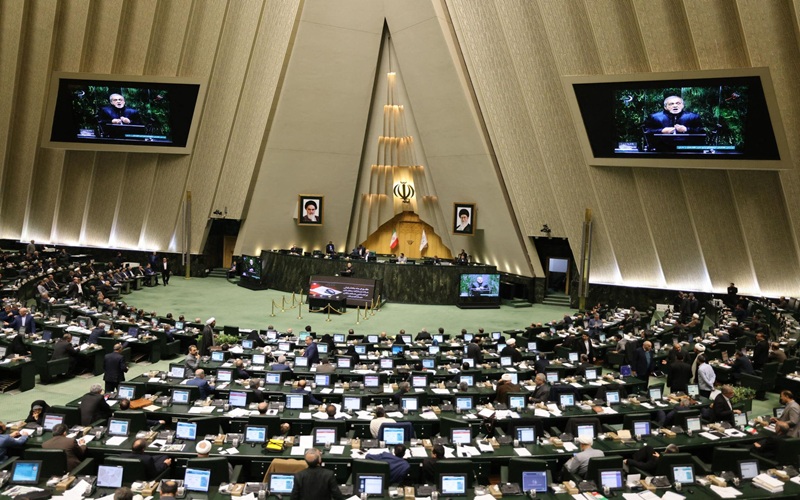

State media warnings about “collapse from within” and “national exhaustion” reveal a regime increasingly consumed by internal conflict and institutional decay.
Escalating tension, factional conflict, and institutional deadlock have become defining features of Iran’s regime under the doctrine of Velayat-e Faqih. What is unfolding today is no longer a routine political disagreement between competing elites. It is a deeper and more dangerous process: the gradual erosion of the regime’s ability to govern coherently.
The fractures are visible everywhere — in state media, parliament, government institutions, and the broader power structure. Competing centers of authority increasingly operate as rival camps rather than parts of a unified system. The result is a government that appears unable to impose discipline even within its own ranks.
A System Speaking Through Its Own Warnings
One of the clearest signs of this crisis is that the regime’s own newspapers have begun openly warning about the consequences of continued infighting. These are not opposition outlets; they are media tied to the establishment itself. Their language reflects growing anxiety about a situation that seems to have no clear mechanism for resolution.
In its June 6, 2026 issue, the state-affiliated newspaper Tose’e Irani offered a striking description of the current condition:
This statement exposes a long-standing reality inside the Iranian system: multiple power centers pursuing their own agendas while openly obstructing one another. The reference to the state broadcaster — Iran’s powerful state-controlled media apparatus — highlights how institutions nominally under the same regime can function as political adversaries.
The Internet Dispute as a Symptom of a Larger Crisis
The same newspaper pointed to the impeachment threats against the Minister of Communications after the government approved reconnecting parts of the international internet:
This episode is revealing because it shows that even implementing an official government policy can trigger confrontation between rival factions. Governance itself becomes hostage to internal power struggles.
The newspaper described this condition as “bone-burning” — a Persian expression conveying severe, exhausting, and corrosive turmoil.
“Collapse from Within”
Another establishment newspaper, Ettela’at, went even further in its June 7, 2026 issue by warning of a “catastrophic defeat from within.” It wrote:
The significance of this warning lies not only in its wording, but in the fact that such language is now appearing in official discourse. Terms like “defeat from within,” “divisiveness,” and “end of national resilience” indicate that concerns about internal fragmentation have become central even among regime insiders.
Mutual Delegitimization Among Factions
The newspaper Arman Melli highlighted another dimension of the crisis: the increasingly aggressive delegitimization of rival factions. It noted that state television and hardline nighttime gatherings were continuing to attack the government and its negotiating team.
The paper also cited a hardline parliamentarian who accused former President Hassan Rouhani and former Foreign Minister Mohammad Javad Zarif of being: “loudspeakers for the United States and Israel in Iran in many cases.”
Talk of Judicial Confrontation
The crisis is now so deep that some establishment figures are openly calling for judicial action against extremist loyalists within the system itself. Arman Melli quoted political figure Mohammad Atrianfar as saying:
This is an extraordinary statement in the context of the regime. It suggests that parts of the establishment now view certain hardline forces not merely as political rivals, but as threats to the state’s own survival.
A Regime Consumed by Its Own Contradictions
Taken together, these warnings and accusations paint a clear picture of the current situation in Iran: a ruling system trapped in exhausting and seemingly endless internal conflict. The repeated use of expressions such as “bone-burning crisis,” “collapse from within,” and “end of national resilience” reflects a regime increasingly aware of its own fragility.
Importantly, these warnings are emerging even while external factors such as regional conflict and international negotiations still provide the regime with a temporary pretext for unity. The deeper question is what happens when those external pressures recede and factional swords are drawn openly against one another.
The Broader Meaning for Iran’s Future
For ordinary Iranians, the central issue is not which faction prevails in these internal struggles. The broader reality is that the entire system has become structurally dependent on factional conflict as a means of preserving itself. Rival camps compete fiercely, yet all operate within a framework that excludes genuine democratic accountability and popular sovereignty.
The ongoing infighting therefore reveals more than political dysfunction. It exposes the limitations of a system in which multiple power centers compete for influence while the country’s economic, social, and political crises deepen unresolved.
What is emerging is not merely a dispute among elites. It is a crisis of governance itself — a regime increasingly at war with its own institutions, narratives, and factions, while Iranian society continues to bear the consequences.