


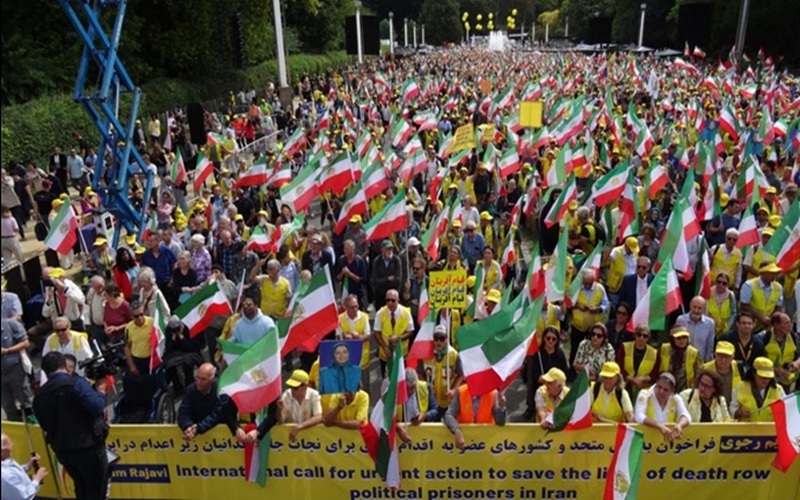

As Iran faces a historic turning point, the path forward is neither religious dictatorship nor hereditary rule, but a democratic transition led by the Iranian people themselves.
Iran stands at one of the most consequential crossroads in its modern history. The struggle unfolding across the country is not merely a political dispute between competing factions. It is a fundamental confrontation between two opposing visions of Iran’s future: on one side, a repressive system that relies on monopolized power and coercion to survive; on the other, a society that continues to demand freedom, democracy, and the right to determine its own destiny.
This confrontation has been building for decades, but it has now reached a critical stage. The traditional mechanisms used to preserve authoritarian rule are increasingly losing their effectiveness as the gap between the ruling establishment and society continues to widen.
Today, Iran’s ruling system finds itself in perhaps its most isolated and vulnerable position since its establishment. The causes that fueled nationwide protests and uprisings throughout the past decade have neither disappeared nor been resolved. Economic collapse, systemic corruption, political repression, and deepening social discrimination continue to intensify. Rather than addressing these crises, the authorities have allowed them to evolve into structural threats to the country’s stability.
The reality inside Iran demonstrates that the regime’s greatest challenge does not come from foreign armies or external pressure. The most significant threat originates from within Iranian society itself. The persistence of public dissatisfaction and the potential for renewed nationwide protests have become central concerns for the ruling establishment.
This fear is reflected in the growing use of intimidation, repression, and executions. The sharp increase in harsh punishments and state violence reveals a government acting from a position of insecurity rather than confidence. Such measures are intended to prevent the emergence of another nationwide uprising, yet they simultaneously expose the regime’s deep anxiety about its own future.
However, transforming public anger into democratic change requires more than spontaneous protests. Sustainable political transformation depends upon organization, discipline, and continuity. Under conditions of severe political repression, networks of civil resistance and grassroots activists inside the country have assumed a crucial role in maintaining momentum for change.
Many of these networks are driven by young people and courageous women who continue to challenge authoritarianism despite immense personal risks. By exposing human rights violations, breaking the climate of fear, and mobilizing different sectors of society, they help bridge the gap between public discontent and a coherent political vision for the future.
One of the most important questions facing both Iranians and the international community concerns the transition period that could follow the fall of the current system. How can democratic change be achieved while avoiding instability and political chaos?
The answer requires preparation, institutions, and a clear roadmap.
In this regard, the National Council of Resistance of Iran (NCRI) has presented a framework for a transitional period designed to transfer sovereignty to the people rather than to another authoritarian elite. The proposal envisions a temporary government with a limited mandate of six months, tasked with organizing free and transparent nationwide elections for a constituent assembly. The assembly would then be responsible for determining the country’s future political system through democratic processes.
The significance of such an approach lies in its rejection of monopolized power. Instead of replacing one form of authoritarianism with another, it seeks to establish a system based on popular sovereignty and democratic legitimacy.
Several core principles define this vision:
- Political pluralism and respect for diverse viewpoints
- Full gender equality and the rejection of all forms of discrimination
- The abolition of the death penalty and adherence to international human rights standards
- A non-nuclear Iran committed to peaceful international relations
Yet discussions about Iran’s future should not automatically confer legitimacy upon every opposition current. Not every alternative to the current regime represents a democratic alternative.
The experience of monarchist politics serves as an important example. Efforts to revive hereditary rule and rehabilitate authoritarian structures from Iran’s past have repeatedly failed to address the democratic aspirations of contemporary Iranian society. Moreover, the inconsistent political positions and controversial appeals made by Reza Pahlavi during critical moments have often provided the regime’s propaganda apparatus with opportunities to portray genuine domestic protests as externally orchestrated movements, thereby attempting to justify repression.
Beyond tactical political disagreements, concerns remain regarding the absence of a clear reckoning with the human rights abuses, censorship, and political repression associated with the Pahlavi era. Equally troubling are statements made by some monarchist figures and advisers suggesting the restoration or rehabilitation of institutions and practices associated with former security apparatuses such as SAVAK.
These concerns are not merely historical. Reports of intimidation campaigns, harassment of critics, and legal disputes involving monarchist activists abroad raise legitimate questions about the persistence of authoritarian political culture beyond the current regime. For many advocates of democracy, Iran’s future depends upon rejecting both religious absolutism and hereditary authoritarianism.
The aspiration of today’s Iranian society is neither the turban nor the crown. It is democratic self-government.
The international community must also move beyond outdated assumptions and false binaries. Western policy toward Iran should not be reduced to a choice between appeasement and military intervention. A third option exists: recognizing the Iranian people’s right to determine their own future, supporting democratic forces inside the country, and encouraging a peaceful and democratic transition.
Such an approach neither imposes change from abroad nor sustains authoritarianism through accommodation. Instead, it aligns international policy with the aspirations of millions of Iranians who seek democratic governance, accountability, and respect for fundamental rights.
Iran’s future will not belong to the current theocratic establishment. Nor will it be secured through the restoration of obsolete models of hereditary rule. The future belongs to a society that has repeatedly demonstrated its determination through protests, acts of resistance, and immense sacrifices made in prisons and on the streets.
The defining question of Iran’s next chapter is not whether change will come, but whether that change will ultimately serve the cause of democracy. For millions of Iranians, the answer lies in building a republic founded on freedom, pluralism, and the sovereignty of the people.