


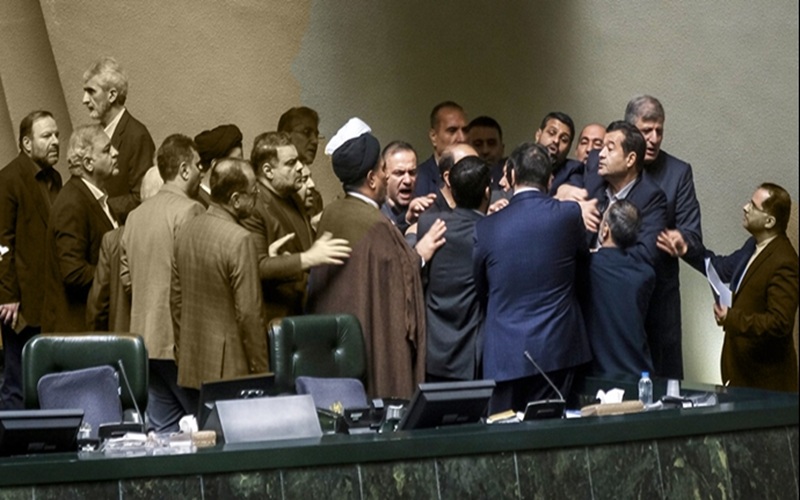

As public discontent grows and uncertainty over war, diplomacy, and succession intensifies, the regime’s competing factions are turning on one another in a struggle that reflects a deeper structural crisis.
Power Struggle Signals a System in Decline
For decades, the Iranian regime has relied on a carefully managed balance between competing power centers, with the Supreme Leader serving as the final arbiter capable of containing factional conflict. That model is now showing visible signs of breakdown.
Today, the convergence of several crises—the unresolved dilemma between confrontation and negotiations with the international community, the aftermath of military conflict, mounting economic hardship, and an increasingly alienated population—is pushing the regime into one of its most dangerous periods since its establishment. Rather than presenting a united front, its rival factions are openly accusing one another of betrayal, incompetence, and even conspiracy.
The result is a political system increasingly consumed by internal conflict at precisely the moment it faces unprecedented pressure from society.
The End of Absolute Authority
A defining feature of the current period is the weakening ability of the Supreme Leader to impose unquestioned authority across the regime’s competing factions.
Whether because of succession concerns, declining legitimacy, or growing institutional fragmentation, rival centers of power appear increasingly willing to challenge each other publicly rather than settling disputes behind closed doors. Political competition is no longer confined to differences over policy; it has become a struggle over control of the regime itself—and over the enormous political and economic privileges attached to it.
Even the symbolic management of Ali Khamenei’s public image and political legacy has become part of this contest. Different factions are attempting to appropriate the authority of the Supreme Leader to strengthen their own positions ahead of an uncertain future.
Public Accusations Replace Internal Discipline
Recent exchanges between regime insiders illustrate how dramatically political discourse has deteriorated.
Kamran Ghazanfari, a member of parliament associated with the hardline camp, publicly accused figures including President Masoud Pezeshkian and Parliament Speaker Mohammad Bagher Ghalibaf of participating in what he described as a “coup through negotiations.” He further alleged that they intended to suppress pro-regime street gatherings and accused them of betraying the Supreme Leader.
Such accusations would once have been confined to internal security meetings. Today they are made openly through public videos and media platforms.
The response from the hardline daily Javan, affiliated with the Islamic Revolutionary Guard Corps (IRGC), was equally remarkable. In an unusually harsh rebuttal, columnist Abdollah Ganji dismissed Ghazanfari’s statements as “disgusting,” “illogical,” “insulting,” and so detached from the regime’s political structure that he initially believed the video had been generated using artificial intelligence.
The exchange demonstrated not only disagreement but the collapse of the discipline that once prevented public warfare between regime loyalists.
Succession Anxiety Is Reshaping the Political Landscape
Perhaps even more revealing were comments made by Mohammad Jafar Ghaem-Panah, a senior aide to President Pezeshkian.
He questioned the purpose of institutions such as the government, parliament, and the Supreme National Security Council if every statement by the Supreme Leader must simply be implemented without debate.
Such remarks would have been politically unthinkable only a short time ago.
More importantly, they reveal growing resistance within parts of the political establishment that Mojtaba Khamenei could be a reliable replacement to his father’s political authority. While no senior official openly challenges the principle of Velayat-e Faqih, increasing numbers appear unwilling to accept hereditary leadership without question.
That represents a potentially profound shift inside the regime’s own power structure.
Divisions Extend Into the Religious Establishment
The fragmentation is no longer confined to politicians.
A recent discussion surrounding President Pezeshkian’s visit to Qom highlighted similar tensions within the clerical establishment itself.
According to Mohammadreza Yousefi of Qom’s Mofid University, an organized and influential minority inside the seminaries increasingly dominates public discourse while broader divisions continue to deepen. He warned of expanding social polarization that now extends into religious institutions.
This observation reinforces an important reality: the regime’s internal crisis is affecting virtually every pillar on which its authority has historically rested.
Society Remains the Regime’s Greatest Fear
Despite factional rivalries, the regime’s leadership shares one overriding concern: the Iranian people.
The primary force driving elite fragmentation is not simply disagreement over foreign policy or succession. It is the dramatic erosion of the regime’s social legitimacy.
Years of economic decline, corruption, political repression, executions, environmental crises, and repeated nationwide protests have steadily reduced the regime’s social base. As public support has diminished, competition among ruling factions has intensified because the political system no longer possesses the stability necessary to accommodate rival interests peacefully.
Even during periods of external military confrontation, the leadership has consistently treated domestic unrest as the greater existential threat. From its perspective, foreign conflict can often be managed through security institutions or diplomacy; a nationwide uprising cannot.
This explains why repression at home has remained a strategic priority even when the regime faces significant international challenges.
A System Moving Toward Fragmentation
The competing factions remain united in one respect: each depends on the survival of the regime for its own political and economic interests.
Yet that shared interest no longer prevents increasingly destructive competition.
As uncertainty surrounding Ali Khamenei’s eventual succession grows, today’s political infighting is likely to become even more intense. The current exchanges may represent only the opening phase of a broader struggle over the future distribution of power inside the regime.
Whether the system ultimately preserves its cohesion or enters a period of deeper fragmentation will depend not only on elite maneuvering but also on the continuing pressure exerted by Iranian society.
The regime’s greatest vulnerability is no longer found in foreign capitals or on regional battlefields. It lies in the widening gap between a population demanding fundamental change and a political establishment increasingly consumed by its own internal struggle for survival.
As those two dynamics reinforce one another, the regime’s long-standing mechanisms for managing internal rivalries appear to be approaching their limits. The more the regime loses legitimacy among its citizens, the more its ruling factions are likely to turn their energies inward—accelerating the very instability they seek to avoid.