


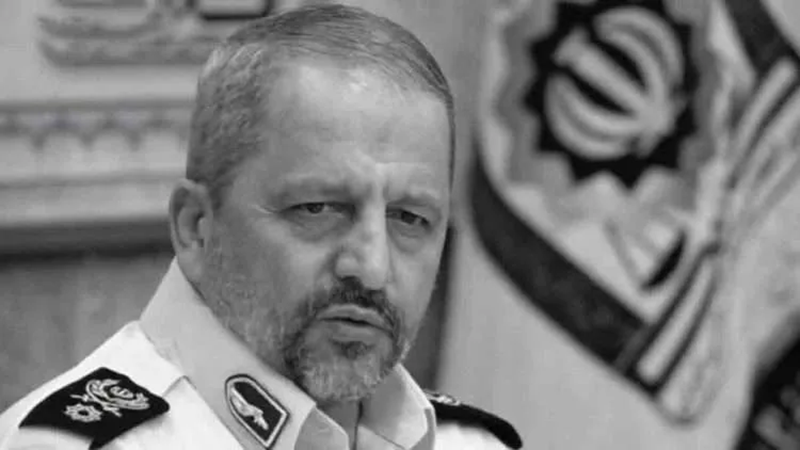

The inclusion of the former police commander—known for brutal crackdowns and corruption—reveals the regime’s security-centered approach even in diplomacy.
A Controversial Figure in the Regime’s Delegation
Following the latest round of talks between the Iran regime and U.S. officials in Islamabad, attention quickly turned to one controversial member of the Iranian delegation: Esmail Ahmadi-Moghaddam, the regime’s former police commander.
The trip, led by parliamentary speaker Mohammad-Bagher Ghalibaf, drew immediate public criticism—not for the talks themselves, but for who represented the regime. Ahmadi-Moghaddam’s long record of violent repression, systemic corruption, and loyalty to the regime’s most hardline institutions has made his inclusion a stark symbol of Tehran’s true face on the international stage.
Tied to Some of the Regime’s Darkest Crimes
Ahmadi-Moghaddam served as the regime’s police chief during the 2009 protests, overseeing one of the most violent state-led crackdowns in Iran’s modern history. Under his command, security forces opened fire on peaceful demonstrators, arrested thousands, and carried out brutal assaults across multiple cities.
One of the most infamous episodes during his tenure was the June 15, 2009 raid on Tehran University dormitories, where students were beaten and their belongings destroyed. Around the same time, the Kahrizak detention center, operated under police supervision, became synonymous with torture and death. At least three detainees were confirmed killed there—an atrocity for which Ahmadi-Moghaddam bore direct responsibility.
In 2012, after the murder of blogger Sattar Beheshti under police interrogation, Ahmadi-Moghaddam trivialized the incident by blaming “psychological stress.” His remarks provoked widespread anger among human rights defenders, who saw it as an appalling attempt to justify state torture.
Years later, after the death of Mahsa Amini in 2022 and the resulting nationwide uprising, he labeled the protests merely a “code name for riots,” once again echoing the regime’s trademark rhetoric that dismisses citizens’ demands for freedom as “foreign plots.”
Corruption within the Security Apparatus
Beyond his record of repression, Ahmadi-Moghaddam has long faced accusations of massive financial misconduct during his time at the helm of the regime’s police. Reports of fraud, embezzlement, and misuse of public funds emerged during his tenure, pointing to entrenched corruption within Iran’s law enforcement system.
Although the regime has never allowed transparent investigation or prosecution of such cases, the allegations have persisted, shaping his public image as a symbol of the regime’s corruption and impunity.
What His Presence Reveals about the Regime
Ahmadi-Moghaddam’s appointment to the Islamabad delegation was not coincidental. Analysts see it as a deliberate political statement—a reminder that the regime’s diplomacy, like its domestic rule, remains dominated by security and intelligence networks rather than professional diplomats.
His participation underscored a regime that remains defiant and unreformed, seeking to project power instead of legitimacy. Sending a figure with a history of brutality and corruption to represent the country in high-level negotiations sends a clear message: the regime’s nature has not changed, and its foreign policy continues to reflect the same authoritarian mindset that defines its internal repression.
By including Ahmadi-Moghaddam, the regime effectively turned what could have been a diplomatic gesture into a declaration of continuity—showing the world that Tehran’s politics, diplomacy, and security machine remain one and the same.