


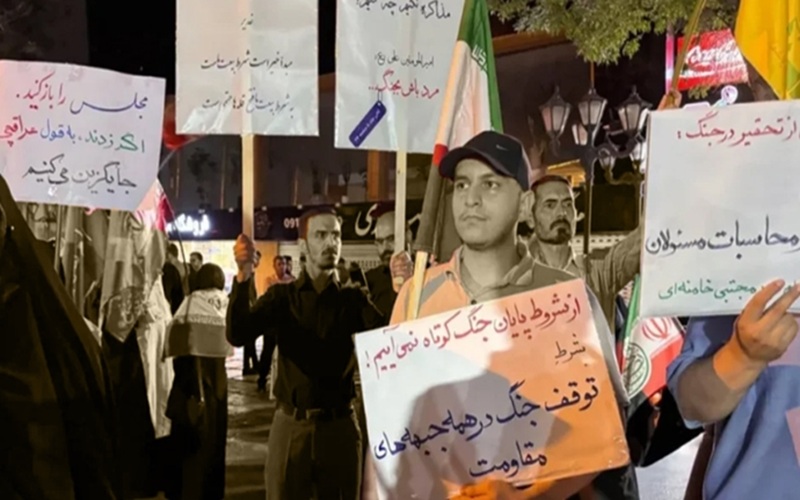

As internal divisions deepen after the collapse of Washington negotiations, rival factions increasingly rely on nuclear brinkmanship, terrorism, and regional intimidation to preserve a fragile grip on power.
The carefully orchestrated funeral spectacle for the regime’s slew Supreme Leader Ali Khamenei was intended to project unity and stability. Instead, as soon as the state ceremonies concluded—and even while they were underway—the Iranian regime’s long-suppressed internal conflicts resurfaced with renewed intensity.
At the center of this latest confrontation lies the collapse of the regime’s understanding with the United States. Rather than presenting a coherent strategy for navigating the mounting international pressure, competing factions within the ruling establishment have turned on one another, exposing deep disagreements over diplomacy, security, and the regime’s future direction.
What is emerging is not merely another factional dispute. It is a struggle over survival, with increasingly dangerous implications for regional stability and the international community.
Diplomacy Becomes the Latest Casualty
Hardline figures have launched an aggressive campaign against officials who supported negotiations with Washington, portraying any diplomatic engagement as a humiliating failure.
Cleric Hamid Rasaei publicly attacked Parliament Speaker Mohammad Bagher Ghalibaf for defending the agreement, demanding that the regime formally abandon the diplomatic process altogether. Similar attacks came from IRGC-affiliated figures, including Saeed Ghasemi, who dismissed the understanding as worthless from its inception and openly called for preparing for war rather than pursuing negotiations.
State-controlled media closely aligned with the security establishment have reinforced this narrative, arguing that the agreement was effectively “dead on arrival” because of alleged American violations and insisting that military confrontation—not diplomacy—should now define Tehran’s strategy.
The message is unmistakable: within influential circles of the regime, negotiation is increasingly portrayed as weakness, while confrontation is promoted as the only acceptable path.
The Hardliners’ Push Toward Escalation
The regime’s most radical voices are now attempting to institutionalize this strategic shift.
The newspaper Kayhan, widely regarded as the mouthpiece of the Supreme Leader’s office, urged the regime’s diplomatic apparatus to officially declare the negotiations finished so that “the Maydan (battlefield)” could determine the outcome instead.
Such rhetoric reflects more than ideological posturing. It demonstrates an effort by hardline factions to replace diplomacy with coercion as the central pillar of the regime’s foreign policy.
Unable to produce economic relief or political legitimacy, these factions increasingly portray military escalation as the only remaining instrument for preserving the regime’s authority.
Terrorist Threats Replace Political Strategy
Perhaps the most alarming development is the increasingly open embrace of violent threats.
State television personalities have publicly discussed assassinating foreign leaders, with one presenter declaring that as long as Donald Trump was within range, the regime’s supporters would not cease their resistance until “blood like Trump’s” was spilled.
At the same time, senior parliamentary figures broadened these threats beyond Western officials.
Ebrahim Rezaei, spokesman for the regime’s National Security Commission, warned Persian Gulf countries that supported American policies to “watch their oil and gas wells,” signaling that regional energy infrastructure could become targets if pressure on Tehran intensifies.
Such statements are not isolated outbursts. They reveal a growing reliance on intimidation and terrorism as instruments of state policy, particularly as the regime faces increasing diplomatic isolation.
Nuclear Blackmail Returns to the Forefront
Even more troubling is the renewed emphasis on the regime’s nuclear capabilities.
Hossein Shariatmadari, Khamenei’s representative at Kayhan, openly acknowledged that the regime already possesses the technical capability to manufacture nuclear weapons, arguing that the only remaining obstacle is political will rather than scientific capacity.
This message was quickly reinforced by members of parliament, who threatened that any future American military action could trigger a change in the regime’s nuclear doctrine.
Officials also floated the possibility of withdrawing from the Nuclear Non-Proliferation Treaty (NPT) while discussing broader military options, including disrupting strategic maritime routes.
These declarations represent an unmistakable return to nuclear coercion.
Rather than reassuring the international community, senior regime figures are deliberately using the prospect of nuclear weaponization as leverage—a strategy that reflects both desperation and growing internal weakness.
A Regime Cornered by Its Own Crises
Taken together, these developments paint the picture of a regime entering one of the most unstable periods in its history.
The collapse of diplomatic engagement has not produced consensus but intensified divisions among competing power centers. As economic deterioration, domestic unrest, and international isolation continue to deepen, the ruling establishment appears increasingly dependent on external confrontation to distract from internal failures.
The simultaneous escalation of terrorist rhetoric, threats against neighboring countries, calls for abandoning diplomatic channels, and renewed nuclear blackmail all point to a leadership struggling to maintain cohesion after Khamenei’s death.
Yet this strategy carries profound risks. Every step toward greater confrontation increases the danger of further isolation while doing nothing to address the underlying political and economic crises that continue to erode the regime’s foundations.
The Iranian regime now finds itself trapped between two equally perilous choices. Retreat from its confrontational posture risks exposing irreparable weakness before an increasingly dissatisfied population. Escalating further through military threats and nuclear brinkmanship, however, risks deepening international isolation and creating a far more dangerous regional crisis.
Rather than demonstrating strength, the regime’s increasingly aggressive rhetoric reveals a leadership that has fewer options than ever before—and is attempting to compensate for its internal fractures by projecting instability far beyond Iran’s borders.