


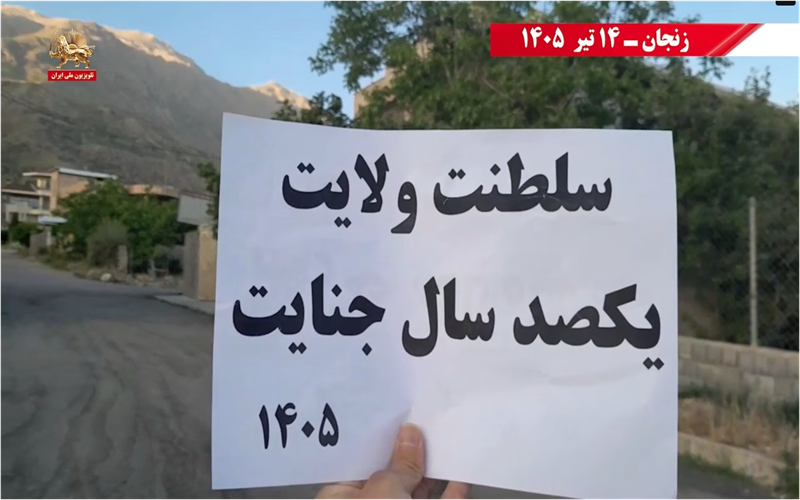

As the regime staged Ali Khamenei’s burial at the Imam Reza shrine to reinforce its religious legitimacy, Resistance Units launched coordinated anti-regime operations across dozens of Iranian cities.
While the Iranian regime sought to transform the funeral and burial of Ali Khamenei into a carefully choreographed display of religious legitimacy, Resistance Units responded with one of their broadest coordinated waves of anti-regime operations in recent months.
The regime buried Khamenei within the shrine of Imam Reza in Mashhad—a decision widely viewed by opponents as an attempt to associate the late Supreme Leader with one of Shiite Islam’s holiest figures and reinforce the regime’s religious narrative at a time of unprecedented political weakness.
Instead of projecting unity, however, the ceremony was met with acts of defiance across the country.
Despite an extensive security deployment, heightened surveillance, and the mobilization of intelligence and security forces, Resistance Units carried out dozens of operations targeting symbols of the regime, demonstrating that opposition activity continues even under the most restrictive conditions.
A Nationwide Response to the Regime’s Ceremony
According to reports released by the Resistance Units, at least 25 coordinated operations were conducted simultaneously with the funeral proceedings.
The activities stretched from Tehran and Mashhad to Isfahan, Karaj, Shiraz, Zahedan, Yazd, Kermanshah, Chabahar, Khorramabad, Arak, Saveh, Babol, Ardabil, Shahrekord, Birjand, Fasa, Dorud, Rezvanshahr, Azna, Aligudarz, Dehloran, Sanqar, and several other cities.
Many of the operations focused on burning large banners and billboards displaying images of Ali Khamenei, Ruhollah Khomeini, Mojtaba Khamenei, and other senior regime figures.
In several cities, Resistance Units also set fire to propaganda posters and public displays erected in connection with the funeral ceremonies.
These actions directly challenged the regime’s effort to portray the funeral as a demonstration of nationwide loyalty.
Targeting the Machinery of Repression
The operations extended beyond symbolic targets.
Resistance Units also struck facilities associated with the regime’s security apparatus, including Basij centers, intelligence offices, and government institutions.
Among the reported actions were attacks on:
- A Basij base affiliated with the Islamic Revolutionary Guard Corps (IRGC) in Karaj.
- Basij facilities in Yazd and Zahedan.
- Buildings associated with Basij intelligence activities in Khorramabad and Rezvanshahr.
- A Ministry of Intelligence office in Dorud.
- A municipal council building in Aligudarz.
- A police command center in Chabahar.
By targeting institutions viewed by many Iranians as instruments of repression, the operations conveyed that the Resistance Units intended not only to reject the regime’s political messaging but also to confront the security structures that enforce its rule.
Defying an Unprecedented Security Presence
The timing of the operations was particularly significant.
The funeral took place under extraordinary security conditions, with authorities reportedly deploying extensive surveillance systems, intelligence personnel, and security forces in anticipation of possible unrest.
Nevertheless, Resistance Units succeeded in carrying out operations across multiple provinces almost simultaneously.
Additional activities were reported in Mashhad itself, where banners bearing images of Khamenei, Khomeini, and Mojtaba Khamenei were set ablaze, along with IRGC symbols.
Resistance Units also reported broadcasting anti-regime slogans in public areas of Mashhad during the funeral procession. Recorded messages included chants condemning Khamenei while expressing support for the Iranian Resistance, bringing opposition voices into the heart of the city where the regime was attempting to stage its most symbolic event.
Challenging the Regime’s Narrative
The burial of Ali Khamenei at the Imam Reza shrine carried profound political symbolism.
For the ruling establishment, the location appeared intended to reinforce the image of continuity between the institution of Velayat-e Faqih and Shiite religious tradition by placing the late Supreme Leader in one of the faith’s most revered sites.
Opponents, however, viewed the move as an attempt to cloak political authority in religious symbolism and to compensate for the regime’s declining legitimacy through carefully orchestrated spectacle.
The Resistance Units’ coordinated response sought to undermine that narrative by demonstrating that widespread opposition persists despite the regime’s efforts to project strength and stability.
A Continuing Campaign of Resistance
The operations conducted during the funeral represent the latest chapter in an ongoing campaign of activities carried out by Resistance Units across Iran.
In recent months, the network has repeatedly targeted symbols of the ruling establishment, security institutions, propaganda centers, and public displays associated with the regime.
The breadth of the latest operations—spanning major cities and smaller provincial centers alike—illustrates both the geographic reach of these activities and the determination of participants to challenge the regime during one of its most politically sensitive moments.
Rather than allowing the funeral to become an uncontested display of authority, the coordinated actions transformed the day into another arena of confrontation between the ruling establishment and organized resistance.
For the regime, the funeral was intended to reinforce political continuity following the death of its longtime leader. For the Resistance Units, it became an opportunity to demonstrate that heightened security measures and public ceremonies cannot extinguish organized opposition or erase the profound political crisis confronting the ruling system.