


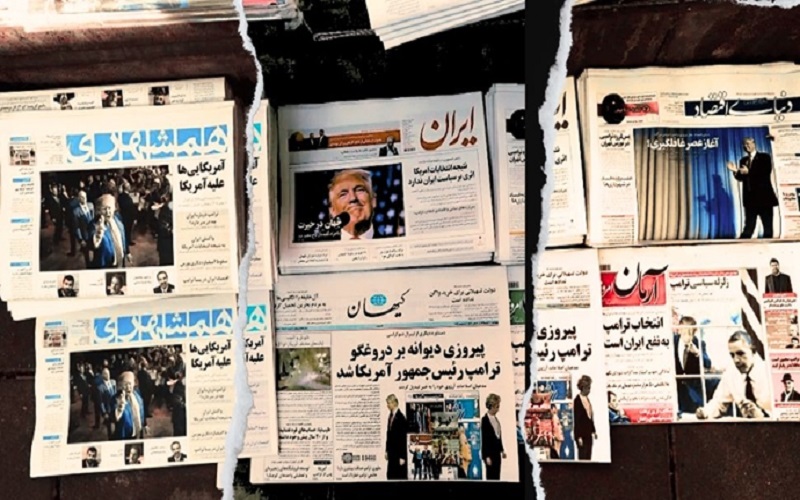

Following Donald Trump’s recent victory in the 2024 U.S. presidential election, the Iranian regime finds itself facing a renewed wave of uncertainty. Having spent years suppressing domestic calls for reform and stifling protests, the Iranian government now looks anxiously toward Washington, where a new chapter of American foreign policy is set to unfold.
Trump’s return has cast a shadow over Tehran’s political and economic strategies, as his previous term was marked by an aggressive “maximum pressure” campaign that isolated Iran and decimated its oil-based revenue. For Iranian leaders, Trump’s re-election amplifies an already fragile situation at home, where a population beset by economic hardship and political discontent sits on the verge of rebellion. Each political shift and international development is now scrutinized for its impact on public morale, as the regime braces for a potential explosion of unrest.
Although Supreme Leader Ali Khamenei and top officials attempt to downplay the influence of U.S. politics on Iran’s stability, their initial responses suggest otherwise. Prominent Iranian analyst Ahmad Zeidabadi captured this sentiment with a stark reflection on social media:
“Enduring another term with a narcissistic, deceitful, and unpredictable leader in the White House is severe punishment for those of us even thousands of miles away, let alone for half the American people who didn’t vote for him! We don’t yet know his plans for global crises, especially in the Middle East. Personally, I’ll have to reconsider my mental ‘chessboard’ to understand the implications of this new reality.”
Zeidabadi also foresees complications in dealing with Trump’s foreign policy machine, expressing particular discomfort at the potential return of hardliners like former Ambassador David Friedman, who played a significant role in escalating tensions with Iran.
In a prior interview, Zeidabadi voiced fears about the impact of a Trump-led administration that includes figures such as Jared Kushner and Mike Pompeo, envisioning scenarios where Iran could be forced into a corner: “If Trump is in power again, they might drive us into a humiliating position or reignite hostilities. Governments sometimes face choices between bad and much worse options. Continued conflict would lead to more strikes on Iran, escalating into a crisis that endangers Iran’s political stability and creates an existential threat.”
Another Iranian political observer, Sadegh al-Hosseini, recently echoed these concerns, noting that Tehran wasted valuable time under President Joe Biden by not pursuing substantial reforms to strengthen Iran’s standing before the potential return of Trump. In a Telegram post, he wrote, “Four years ago, I warned that Trumpism could return and urged our leaders to reform internally and assert a stronger regional and global presence. But these warnings went unheeded, and now we face the consequences.”
Al-Hosseini sees Trump’s renewed mandate as especially dangerous, predicting that the re-elected president will act swiftly to increase sanctions, further draining Iran’s oil revenue and weakening its influence in the region. He also anticipates that Trump’s firm support for Israel will embolden Prime Minister Benjamin Netanyahu, potentially sparking further escalation in Gaza and leaving Israel’s hands unrestrained in addressing perceived threats from Iran. Al-Hosseini believes these risks will intensify both economic pressures and strategic instability for Iran.
Reflecting on previous missteps, he added, “Will we be wise enough to avoid repeating mistakes? Or will we respond with erratic economic measures, like reimposing an unfavorable currency rate or enforcing broad export restrictions in retaliation for sanctions?”
For a regime reliant on Western appeasement policies while advancing regional ambitions, Trump’s return is a harsh wake-up call. The Iranian leadership now faces the daunting task of recalibrating its strategies, as a potentially more confrontational U.S. approach looms large. With the memory of the 2022 nationwide protests still fresh, the regime finds itself at a pivotal crossroads that may decide whether it secures its survival or ignites the very unrest it fears.