


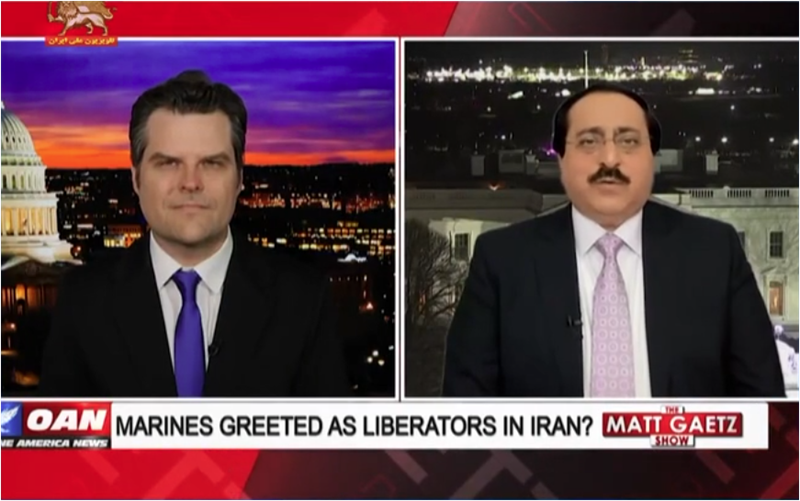

Alireza Jafarzadeh rejects foreign intervention and warns against repeating the mistakes of the 1953 coup
In a recent interview with One America News, Iranian opposition figure Alireza Jafarzadeh, deputy director of the U.S. office of the National Council of Resistance of Iran (NCRI), emphasized that the future of Iran will be determined not by foreign intervention, but by forces inside the country.
Military Action isn’t Enough
Deputy Director of the National Council of Resistance of Iran @A_Jafarzadeh joins @RileyLewis760 in explaining why military action alone won’t bring down Iran’s regime, emphasizing that lasting change has to come from the people inside the country on… pic.twitter.com/fDYbUosi6i
— One America News (@OANN) March 21, 2026
Jafarzadeh, a senior representative of the National Council of Resistance of Iran (NCRI) in Washington, outlined what he described as the “third option” for Iran—rejecting both foreign military intervention and continued appeasement of the ruling regime, while placing responsibility for change firmly in the hands of the Iranian people and organized resistance units.
He argued that although the regime has suffered growing military and political setbacks, the decisive factor in any change will be domestic forces. In his view, the ruling system is currently in one of its weakest positions, yet its fate will ultimately be decided by organized networks inside Iran rather than by external pressure. He stressed that meaningful change depends on the capacity, coordination, and persistence of internal opposition forces.
A central element of his remarks was the emphasis on the independence of the resistance movement. Jafarzadeh made clear that the Iranian opposition does not seek weapons, foreign troops, or intelligence assistance from any outside power. He presented this independence as a defining principle that sustains both the movement’s credibility and public trust in its vision for a democratic alternative.
He further cautioned that reliance on foreign actors would undermine the legitimacy of any political transition and weaken the foundation for a stable and representative system.
Jafarzadeh also pointed to historical precedent to warn against external interference. Referring to the 1953 Iranian coup d’état, he highlighted the lasting impact of foreign intervention on Iranian public opinion. He noted that this episode continues to shape a deep sensitivity toward sovereignty and national self-determination.
According to his analysis, any externally imposed solution risks repeating past mistakes and could open the door to renewed forms of authoritarian rule. He emphasized that Iranian society rejects both the current religious system and any return to monarchy, instead seeking a democratic system shaped by the will of the people.
In his concluding remarks, Jafarzadeh called on Western governments to adopt a policy of non-interference and respect for the Iranian people’s right to determine their own future. Rather than promoting alternatives or intervening directly, he urged the international community to recognize the legitimacy of the people’s struggle to replace the current system with a democratic republic based on the opposition’s proposed ten-point framework.
His message reflects a consistent position within the organized opposition: that durable political change in Iran must emerge internally, through collective action and public support, rather than through external imposition.