


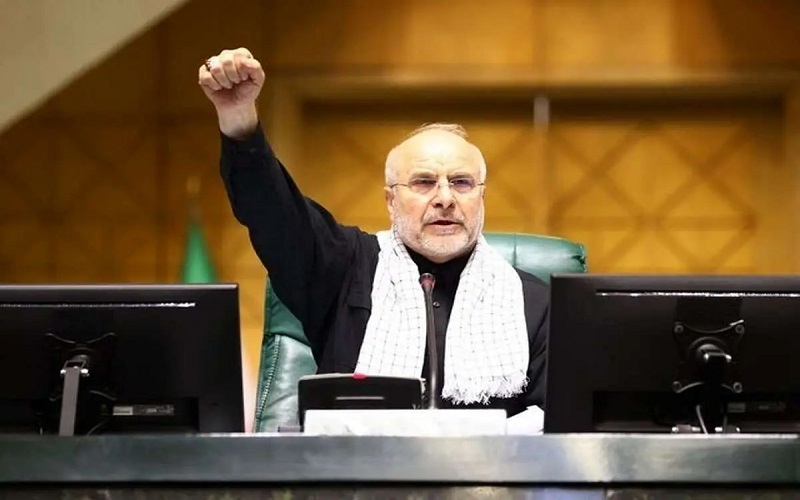

Ghalibaf acknowledges Israeli surprise attack targeted top commanders and exposed internal vulnerabilities as Khamenei remained absent from public view for over three weeks.
Iranian regime officials continue to grapple with the shockwaves of Israel’s devastating June 3 strikes, which marked the beginning of a 12-day war and led to the death of several of Iran regime’s most senior military and intelligence leaders. In a rare and unusually candid statement, Mohammad Bagher Ghalibaf, the Speaker of the Iranian regime’s parliament, admitted that the nature and precision of Israel’s operation caught the regime by surprise.
Speaking on state television on the evening of July 10, Ghalibaf said, “We were surprised by the way they operated… At the very first moment, they struck our commanders. They started their operation by targeting our commanders around 3:00 AM.”
Israel’s Decapitation Strike
Ghalibaf confirmed that the Israeli strikes at the onset of the war led to the deaths of numerous top officials, including the Chief of Staff of the Armed Forces, the Commander-in-Chief of the Islamic Revolutionary Guard Corps (IRGC), the head of the IRGC’s Khatam al-Anbiya Base, the commander of the IRGC Aerospace Force, and several nuclear scientists.
In the following days, Israel reportedly continued its operations, killing the head of the IRGC’s intelligence organization and his deputies. Ali Shadmani, who had been appointed just four days earlier as the new commander of the Khatam al-Anbiya Base, was also eliminated in a subsequent Israeli strike.
“The enemy targeted our brains—those who were developing our plans and were supposed to command them,” Ghalibaf admitted, emphasizing that the first wave of strikes aimed not only at leadership but also at defense radars and command infrastructure.
Israeli Operational Superiority
According to Ghalibaf, Israel employed a range of advanced military aircraft, including F-15, F-16, and F-35 fighter jets, as well as air-launched missiles. He noted that the attacks were guided by a combination of satellite data, hearsay, and “certainly from infiltrators they had” inside Iran. “This type of operation took us by surprise, and we must admit it came as a shock to everyone,” he said.
After the war, the Israeli military reported conducting 1,500 operational sorties over the 12-day campaign, with five types of fighter aircraft flying most of the combat missions.
Ghalibaf tried to downplay the depth of the regime’s vulnerability, claiming that while the method of attack was surprising, the regime had anticipated the “principle of war.” He insisted that IRGC commanders Hossein Salami and Amir Ali Hajizadeh were present in their command bunkers on the morning of June 3.
However, initial reports from regime and foreign sources contradict this claim. Salami was reported to have been killed in his home, while Hajizadeh died in a meeting with IRGC Aerospace officials—raising further questions about the regime’s operational preparedness.
Khamenei’s Absence Raises Questions
Ghalibaf also claimed that the regime’s Supreme Leader Ali Khamenei appointed replacement commanders in the early hours of the war and “personally justified them.” Yet no official reports or evidence have been published confirming Khamenei’s involvement in such meetings during or after the conflict.
In fact, Khamenei remained absent from public view for more than three weeks, fueling widespread speculation. Only three short videos were released during the war, and he reappeared publicly only on July 5, attending a religious ceremony on Ashura night.
His prolonged silence sparked intense discussion on social media and among commentators. Regime-affiliated media initially attempted to portray his absence as a calculated leadership tactic. After his appearance at the Ashura ceremony, they shifted the narrative, labeling his public return as an act of “courage.”
Heavy Toll and Broader Escalation
Iranian officials have claimed that over 1,000 people were killed during Israel’s 12-day aerial campaign. In contrast, Israel has reported 28 fatalities from Iranian missile strikes during the same period.
Adding to the escalation, on June 22—while Iranian and Israeli exchanges were ongoing—the United States launched bunker-busting strikes on Iran’s key nuclear sites at Fordow, Natanz, and Isfahan. U.S. President Donald Trump later declared that these facilities had been “completely destroyed.” Intelligence assessments regarding the full impact of those strikes on Iran’s nuclear program remain mixed.
A Regime Under Pressure
Ghalibaf’s televised remarks and Khamenei’s extended absence highlight the disarray within Iran’s leadership during the conflict. The regime’s admission of surprise, combined with the unprecedented elimination of its top military hierarchy, marks a major blow to its image of strength and strategic depth.
As Iran struggles to regroup, its internal fractures, vulnerability to infiltration, and delayed leadership response may reshape regional perceptions of the regime’s capabilities for years to come.