



For 45 years, Iran and the broader Middle East have suffered under the cancerous influence of the mullahs’ regime. This government has repeatedly driven the region to the brink of destruction.
When the Shah’s dictatorship fell, it was replaced by the more dangerous rule of the clerics. Initially, the Iranian people celebrated the fall of the Shah, unaware of the dark future awaiting Iran, the region, and the world. The 1979 establishment of the Velayat-e Faqih dictatorship quickly revealed its oppressive nature. Freedoms were stripped away, and warmongering became a tool to suppress dissent. Pursuing freedom was branded a crime, leading to the imprisonment, torture, and execution of thousands. To date, over 120,000 people have been massacred or subjected to torture, executions, and terrorism by the regime.
A hallmark of this regime is its manipulation of religion to maintain power. Khomeini, the regime’s founder, gained the trust of the Iranian people by positioning himself as a religious leader, a source of moral and political authority. By exploiting this trust, Khomeini and his successors infected human values with religious authoritarianism, dividing society between believers and non-believers. Those who opposed the regime, especially the Velayat-e Faqih, were labeled “mohareb” (enemies of God) and “corruptors on Earth,” often facing the death penalty.
The regime thrives on the blood of both Iranians and the wider region. This is why the people of Iran have repeatedly risen to overthrow the dictatorship. Having toppled the Shah’s regime, they now seek to end the religious dictatorship, determined not to settle for less than full liberation.
This regime’s survival depends on two pillars: repression and warmongering. Deception and dictatorship have been ingrained in its fabric since the beginning. Khomeini’s war with Iraq not only devastated the region but also justified the brutal suppression of freedom in Iran. Every voice of dissent was silenced under the guise of war.
On September 25, 2024, the regime’s Supreme Leader, Ali Khamenei, reiterated the importance of the Iran-Iraq war (referred to by the regime as “the sacred defense”) in a speech to Revolutionary Guards and military officers. He declared that the war was not just about defending the homeland but defending the regime itself. Earlier, Khamenei referred to the Iran-Iraq war as an “inexhaustible treasure,” and Khomeini had called it a “blessing.”
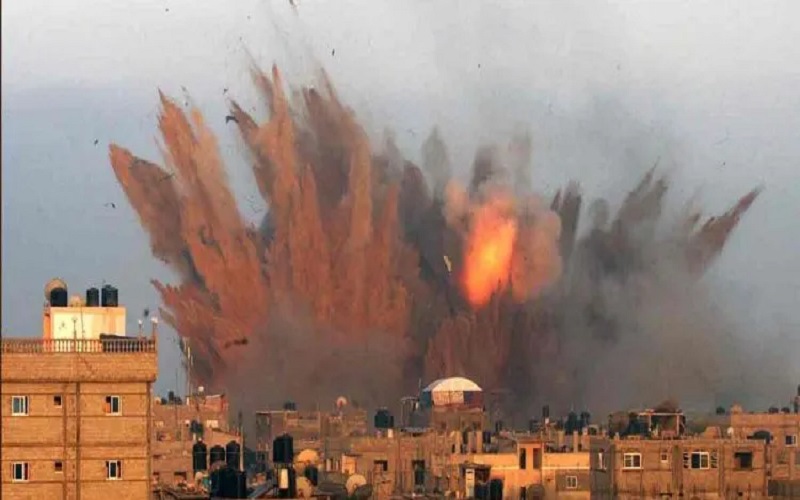
Khamenei then compared the ongoing conflicts in Gaza and Lebanon to the Iran-Iraq war, framing them as part of the regime’s sacred defense. Since its inception, the regime has never been at peace with Iraq and continues to use war as a tool to maintain its grip on power, placing itself on the side of the oppressed in every conflict. This is because the regime has never been able to stabilize internally, facing persistent resistance since the earliest signs of repression. The wars in Gaza and Lebanon are direct products of the regime’s ideology.
As the regime’s internal legitimacy eroded due to widespread repression and dissent, it increasingly turned to military strength and regional interventions as a way to project power and maintain control, both domestically and internationally. However, despite its claims of military deterrence, the regime’s capabilities have proven to be far weaker than its rhetoric suggests.
The elimination of key proxy leaders, who acted as the regime’s arms in various conflicts, has significantly weakened its military power. Attempts to use long-range missiles and drones to target Israel have further exposed the inefficiency of its offensive and defensive strategies. The regime’s military infrastructure, far from being the deterrent it claims, has become a vulnerable point.
Even the regime’s supporters acknowledge these weaknesses. Many believe Khamenei’s recent call to IRGC commanders for “strategic patience” reflects an understanding of the regime’s deteriorating military position. High-ranking security officials, including former intelligence ministers, have also pointed to serious issues of infiltration within Iran’s military and security structures. Cyberattacks, information theft, and repeated sabotage at sensitive sites demonstrate the critical vulnerabilities in the regime’s national security apparatus.
These military failures not only expose the regime’s fragility on the battlefield but also exacerbate its crumbling legitimacy at home. Unable to secure victories abroad, the regime’s internal weaknesses—such as public distrust and increasing dissent—become more pronounced. The nationwide protests in 2022, sparked by widespread discontent, stripped the regime of much of its public support, leaving it without the societal backing necessary for sustained military engagement.
The regime knows that any direct military confrontation with a foreign power would require public trust and widespread societal support, both of which it has largely lost. Without these elements, military action could lead to a sharp decline in its remaining legitimacy and pose an existential threat to the regime.
Caught in this dilemma, the regime now seeks to avoid direct confrontation while attempting to navigate the complex web of Western sanctions and domestic unrest. Trapped in this strategic deadlock, its future remains uncertain, with the risk of collapse looming if its military and domestic failures continue to mount.