

Deepening divisions over the “neither war nor peace” deadlock expose the regime’s inability to find an exit from mounting economic pressures, external isolation, and the threat of domestic unrest.
The contrast highlights a deeper crisis within the regime: its leadership recognizes the economic and political costs of maintaining the current situation but remains unable to agree on a viable way forward. More importantly, its security policies reveal that the regime sees the growing potential for domestic unrest as an immediate threat to its survival.
Throughout November, Pezeshkian repeatedly described the “neither war nor peace” situation as an unsustainable state of uncertainty. He even attributed the demand to resolve the situation directly to Mojtaba Khamenei. Ghalibaf likewise maintained that the deadlock could not continue indefinitely and had to be addressed.
Yet Mojtaba Khamenei’s message marking Basij Week made no reference to negotiations, the external confrontation, or the economic blockade. Instead, it emphasized strengthening the Basij paramilitary force, expanding street mobilization, and advancing the slogan “Every Iranian, one Basiji.”
This emphasis was reinforced by other regime officials. Ahmadreza Radan, the regime’s police chief, openly spoke of suppressing unrest before it even materializes. The Basij leadership also pointed to plans for expanding mobilization, including the use of schools and other institutions.
These measures indicate that the regime’s preparations are not simply about maintaining public order. They are part of an effort to expand its apparatus of repression and prevent potential protests from developing into a nationwide uprising.
The contradiction between calls for resolving the external deadlock and the simultaneous expansion of domestic security operations reflects the regime’s central fear: an increasingly volatile society that could turn its accumulated grievances into a challenge to the entire ruling system.
Economic collapse intensifies internal power struggles
The first major source of the regime’s deadlock is its inability to address the population’s most urgent economic and livelihood needs.
The economic figures reported by the regime’s own media paint a picture of rapidly deteriorating conditions. The dollar exchange rate has exceeded 290,000 tomans, while official and semi-official reports have cited inflation approaching 90 percent and negative economic growth of around 15 percent.
Other reported figures are even more alarming. Point-to-point inflation has reached 88.7 percent, food inflation stands at 113.4 percent, and inflation in oils and fats has surged to 255.7 percent.
These figures reflect the mounting pressure on household budgets and the widening gap between people’s incomes and the cost of basic necessities.
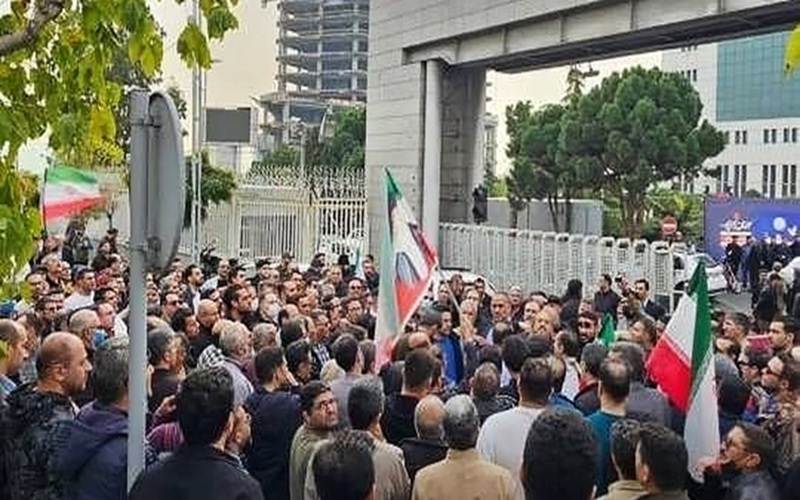
Pezeshkian himself has acknowledged the government’s financial predicament, pointing to its difficulties in selling oil and collecting taxes. His warnings about the prospect of protests further expose the leadership’s awareness that economic deterioration could translate into widespread public anger.
Even regime-affiliated media have acknowledged the political implications. The Jomhouri Eslami newspaper, for example, described the economic blockade as a pressure strategy intended to generate an internal explosion.
The economic crisis is therefore not merely a question of declining living standards. It has become a source of political instability, intensifying competition among rival factions over responsibility for the situation and the measures required to contain its consequences.
The growing calls in parliament to impeach eight or nine of Pezeshkian’s ministers, alongside disputes over whether to proceed with these efforts, are further manifestations of this internal paralysis. Rather than offering a coherent response to the crisis, the ruling establishment is increasingly consumed by factional confrontation.
External confrontation leaves the regime with no viable exit
The second source of the deadlock is the regime’s predicament over the external confrontation and economic blockade.
The leadership faces two seemingly incompatible options: make concessions to reduce external pressure or continue its confrontational policies despite their escalating costs.
Retreating and accepting concessions would expose the regime to serious political consequences. Given its fragile internal balance, any major reversal could intensify divisions among competing factions and undermine the authority of the leadership.
Yet continuing the confrontation is equally dangerous. The regime’s own officials have acknowledged that the existing situation cannot be sustained indefinitely. Restrictions on oil exports and mounting economic pressure have further narrowed its room for maneuver.
The disagreement is reflected in the competing approaches promoted by different factions. While Pezeshkian and Ghalibaf emphasize the need to resolve the deadlock, hardline voices insist that the answer lies in maintaining military pressure and strengthening the regime’s missile and drone capabilities rather than pursuing diplomacy.
This position, echoed by the hardline Kayhan newspaper, leaves little room for a political solution. Continuing along this path risks prolonging the economic blockade and increasing the danger of renewed confrontation.
Consequently, neither concession nor escalation offers a secure way out. Each option threatens to deepen the crisis and aggravate the divisions already undermining the ruling establishment.
Prolonging the status quo threatens social stability
There is also a third dimension to the regime’s predicament: the option of doing nothing and allowing the “neither war nor peace” situation to continue.
Maintaining the current uncertainty would mean prolonging economic pressure, further weakening investment and economic activity, and transferring the costs of the crisis directly onto ordinary households.
As living conditions deteriorate, public frustration is likely to intensify, adding to the social tensions that the regime is already preparing to suppress through expanded security mobilization.
This explains why the emphasis on the Basij, street deployments, and preventive repression has become so prominent even as senior officials speak about the need to resolve the external deadlock. The regime is attempting to prepare for the domestic consequences of a crisis it cannot politically or economically resolve.
The three dimensions of the deadlock—economic collapse, external confrontation, and the threat of popular unrest—are closely interconnected. Each reinforces the others, while the leadership’s inability to agree on a common strategy makes the situation increasingly difficult to manage.
Iran’s regime can neither advance along its current confrontational course, nor retreat without risking serious internal consequences, nor maintain the existing situation without worsening the economic and social crisis.
Its escalating internal disputes and expanding repressive preparations point to a ruling establishment increasingly preoccupied with its own survival. The central problem is no longer simply how to end the “neither war nor peace” situation, but how to prevent the accumulated crises from converging into a challenge to the regime’s continued existence.