


From Hamedan and Ardabil to Rasht, Isfahan, Lahijan, and Mashhad, Resistance Units campaign for political prisoners facing execution through photo actions, leaflets, and audio messages
Resistance Units carried out a series of coordinated activities across six Iranian cities and along the Haraz road, calling for the abolition of death sentences against political prisoners and demanding the release of those detained by the regime. The actions coincided with the ongoing No to Execution Tuesdays campaign and sought to mobilize public support for prisoners facing imminent execution.
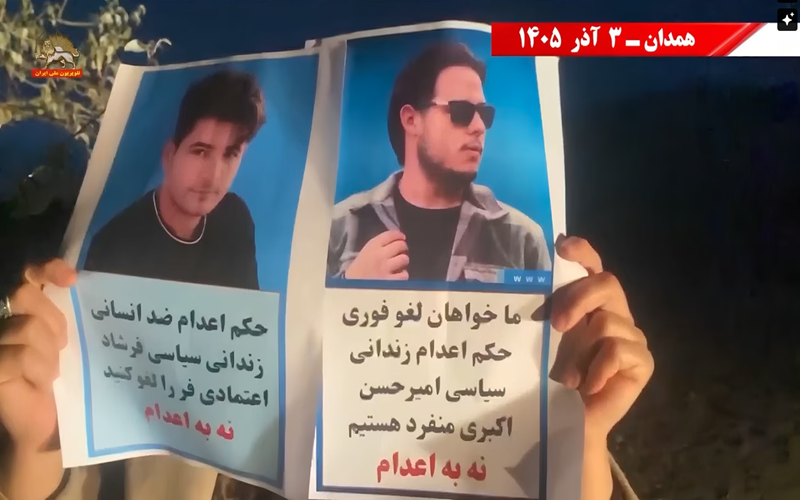
Through photo actions, leaflet distribution, and recorded audio messages, the activists highlighted the cases of political prisoners Farshad Etemadifar, Amirhossein Akbari Monfared, Ehsan Faridi, and Masoud Jamei, whose death sentences they demanded be revoked. They also called for the release of other political prisoners, emphasizing that executions and threats of execution would not break the Iranian people’s determination to resist repression.
Hamedan: Demanding an end to death sentences
In Hamedan, Resistance Units staged several photo actions carrying messages against executions and in support of political prisoners.
One banner declared, “Executioner, fear us. We are the generation of those who stand firm in the face of the gallows. No to execution.” Another warned, “Know this, executioner: the gallows cannot stop us.”
The activists specifically demanded the cancellation of Farshad Etemadifar’s death sentence and displayed the photograph of political prisoner Amirhossein Akbari Monfared, calling for the immediate revocation of his sentence.
Another message reflected the determination to continue the struggle: “Mourning is forbidden, bowing our heads is forbidden. We will return to the streets, this time stronger.”
Ardabil: Solidarity with political prisoners
In Ardabil, Resistance Units distributed leaflets demanding the cancellation of Ehsan Faridi’s death sentence.
They also displayed a message congratulating Mohammad Javad Vafaei Sani on receiving the 2026 Magnitsky Award, signed in solidarity by Shiva and Mehdi Vafaei. The recognition highlights the international dimension of efforts to draw attention to political prisoners and human rights violations in Iran.
Rasht: From Abdanan to Tehran, opposition to executions
In Rasht, activists carried out photo actions declaring that opposition to executions extended across the country.
One message read, “From Abdanan to Tehran, to every city in Iran, everyone against executions.” Another invoked the November uprising, declaring, “This is the message of Aban: fire is the answer to executions.”
Isfahan: Calls for freedom and resistance
In Isfahan, Resistance Units demanded the release of political prisoner Karim Khojasteh and the cancellation of Masoud Jamei’s death sentence.
Leaflets carried messages honoring those killed in the struggle and reaffirming continued resistance. One declared, “The message of our fallen comrades’ blood: Present, present on the battlefield.”
Another stated that the executioner’s gallows could no longer break the determination of the Iranian people, using Mount Damavand as a symbol of national resilience.
Lahijan: Demands for the release of political prisoners
In Lahijan, activists distributed leaflets and staged photo actions calling for the release of political prisoners Farshad Etemadifar, Masoud Jamei, Manouchehr Fallah, and Alireza Mardasi.
The messages emphasized that political prisoners must not be left to face the regime’s execution machinery in isolation, reiterating the demand: “Political prisoners must be freed.”
Haraz Road: Audio messages urge nationwide solidarity
Along the Haraz road, Resistance Units circulated two audio messages appealing directly to the Iranian public to stand with prisoners facing death sentences.
The first message stressed that the Iranian people’s aspiration for freedom could not be crushed by executions or death sentences. It described political prisoners facing execution as symbols of courage, perseverance, and resistance against oppression.
It called on people throughout Iran to break their silence, become the voices of political prisoners, and spread the slogan: “Political prisoners must be freed.”
The second message warned that the lives of political prisoners sentenced to death were in danger and that public solidarity was more urgently needed than ever. It urged people not to allow the regime’s gallows to take the lives of those who had raised their voices for the rights of the Iranian people.
The message concluded with a call for broader protests against executions and the declaration: “We are men and women of struggle; fight on until the struggle is won.”
Mashhad: A message in defense of human life
In Mashhad, Resistance Units staged a photo action carrying the straightforward message: “In the name of humanity, no to execution.”
A nationwide campaign against executions
These activities demonstrate the continued efforts of Resistance Units to bring the plight of political prisoners into public view and challenge the regime’s use of capital punishment as an instrument of repression.
By combining local actions with nationwide appeals for solidarity, the activists sought to connect the struggle for individual prisoners’ lives with the broader demand for an end to executions in Iran.
Their actions also reinforced the message of the No to Execution Tuesdays campaign: political prisoners must not be abandoned, death sentences must be revoked, and the Iranian public must continue to oppose executions.
The repeated calls for freedom across cities, from Hamedan and Ardabil to Mashhad and Lahijan, underline the activists’ determination to keep the issue of political executions at the center of public attention.