


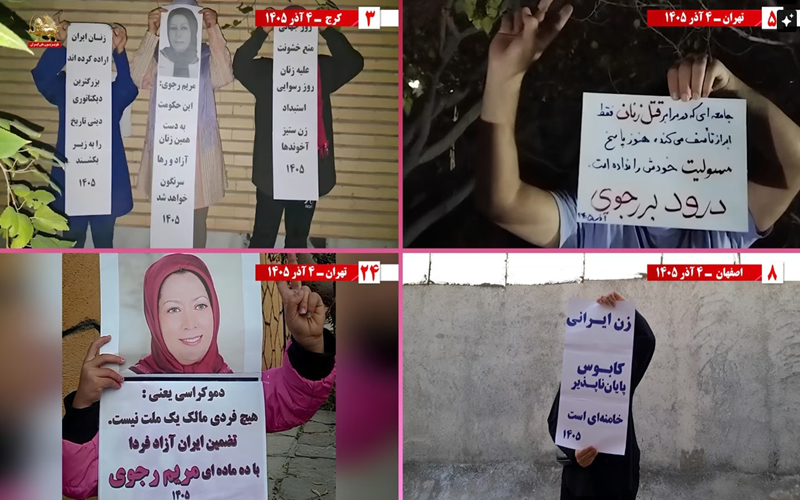

From Tehran and Karaj to Isfahan, Mashhad, Hamedan, Bandar Abbas, and Rasht, Resistance Units highlight women’s freedom, political equality, and the rejection of all forms of dictatorship
On November 25, the International Day for the Elimination of Violence Against Women, Resistance Units carried out a series of activities across several Iranian cities, challenging the regime’s restrictions on women and promoting a democratic alternative based on gender equality and individual freedoms.
Through slogans, wall writings, and public messages, the activists drew attention to violence against women, compulsory veiling, and the denial of women’s rights under the clerical regime. Their activities also highlighted the Ten-Point Plan of Maryam Rajavi, which advocates equal participation of women in political leadership, the separation of religion and state, and the establishment of a democratic republic.
The actions took place in Tehran, Karaj, Isfahan, Mashhad, Hamedan, Bandar Abbas, and Rasht, reflecting the activists’ efforts to connect the struggle against gender-based violence with the broader demand for political change in Iran.
Karaj: Women’s freedom and the end of religious dictatorship
In Karaj, Resistance Units marked November 25 with the message that the International Day for the Elimination of Violence Against Women was also an occasion to expose the system of clerical rule and its restrictions on women.
Messages highlighted Maryam Rajavi’s declaration that the regime would ultimately be overthrown by women who had achieved freedom and independence. They emphasized that Iranian women had resolved to bring down what Rajavi describes as the greatest religious dictatorship in history.
Other slogans expressed support for her Ten-Point Plan and declared the activists’ determination to overthrow the current regime.
Tehran: Equality, democracy, and accountability for violence against women
In Tehran, Resistance Units focused on women’s freedom as an essential measure of social justice and democracy.
One message declared: “Women’s freedom is not a threat. The real threat is an ideology that cannot tolerate their freedom.” It also called for a democratic republic and praised the principle of women’s equality.
Another message challenged society’s response to the killing of women, stating that a society that merely expresses regret after women are murdered has yet to fulfill its responsibility. It rejected the notion that women’s lives should be sacrificed to men’s possessive attitudes.
The activists also promoted Rajavi’s Ten-Point Plan as a framework for a free Iran, with slogans declaring:
- “No threats, no chains. Forward toward the Ten-Point Plan for Iran.”
- “Democracy means no individual owns a nation.”
- “The guarantee of a free Iran tomorrow is the implementation of Maryam Rajavi’s Ten-Point Plan.”
Other messages stressed that political change would not be delivered from abroad but would begin when people accepted responsibility and were prepared to act. They reaffirmed their commitment to continue the struggle alongside Rajavi.
The activities also carried messages rejecting compulsory veiling, compulsory religion, and compulsory government, while calling for a democratic republic.
Isfahan: Women’s participation as a guarantee of democracy
In Isfahan, Resistance Units highlighted the role of Iranian women in challenging the clerical establishment.
One slogan described Iranian women as the nightmare of Supreme Leader Ali Khamenei, reflecting the regime’s confrontation with a society in which women have repeatedly challenged restrictions imposed on their lives.
Other messages emphasized that women’s equal participation in political and social affairs was a guarantee of freedom and democracy.
The activists also repeated Rajavi’s three-part rejection of coercion: “No to compulsory hijab, no to compulsory religion, and no to compulsory government.”
Mashhad: Regime change as the demand of women and protesters
In Mashhad, Resistance Units publicized Rajavi’s message that the central demand of women and all those participating in uprisings in Iran was the overthrow of the regime and political change.
Another slogan reiterated the rejection of compulsory veiling, compulsory religion, and compulsory government, linking women’s freedom to the broader demand for individual and political rights.
Hamedan: Justice and accountability for violence
In Hamedan, the activists emphasized the need to hold perpetrators and those who order violence accountable.
One message called on people to do everything within their power to achieve justice, ensure accountability, and end impunity.
Other slogans promoted the vision of a future Iran based on justice and equality, while explicitly rejecting both monarchical and clerical dictatorship with the declaration: “Down with the oppressor, whether Shah or Supreme Leader.”
The activists also expressed support for Rajavi’s vision of a free Iran.
Bandar Abbas: Rejection of compulsory rule
In Bandar Abbas, Resistance Units circulated Rajavi’s message rejecting compulsory veiling, compulsory religion, and compulsory government.
The slogan presented freedom of choice and the separation of personal beliefs from state coercion as central principles of a democratic future.
Rasht: Commitment to continue the struggle
In Rasht, Resistance Units reaffirmed their determination to continue the struggle, declaring: “We have sworn by the blood of our comrades to stand firm until the end.”
Another message expressed confidence in reclaiming the country and rebuilding Iran, stating: “We will take Iran back and rebuild this beautiful homeland. We have sworn by the blood of our comrades to stand firm until the end.”
Wall writings in Hamedan carried the same anti-dictatorship message, declaring: “Down with the oppressor, whether Shah or Supreme Leader.”
Women’s freedom at the center of a democratic future
The November 25 activities brought together several interconnected demands: an end to violence against women, the rejection of compulsory veiling and religious coercion, equal participation in political leadership, and the establishment of a democratic republic.
By invoking Rajavi’s Ten-Point Plan, Resistance Units presented women’s equality not as a separate social issue but as a fundamental requirement of Iran’s political future.
The repeated rejection of both monarchical and clerical dictatorship also underscored their stated position that replacing one form of authoritarian rule with another would not fulfill the demand for democracy.
As Rajavi emphasized in her messages marking the occasion, society must not wait for another woman to become a victim before addressing women’s security and rights.
The nationwide actions on November 25 placed that demand alongside the broader struggle for freedom, justice, and an end to dictatorship in Iran.