



A national front, a clear program, and collective will—why Iran’s future depends on a democratic alternative beyond “Shah or Sheikh”
Iran stands at a decisive moment in its modern history—but its path forward will not be carved by missiles, bombs, or drones. The country’s passage through this critical juncture depends instead on the formation of a national front grounded in a clear political program and a unified national will capable of responding to today’s complex realities.
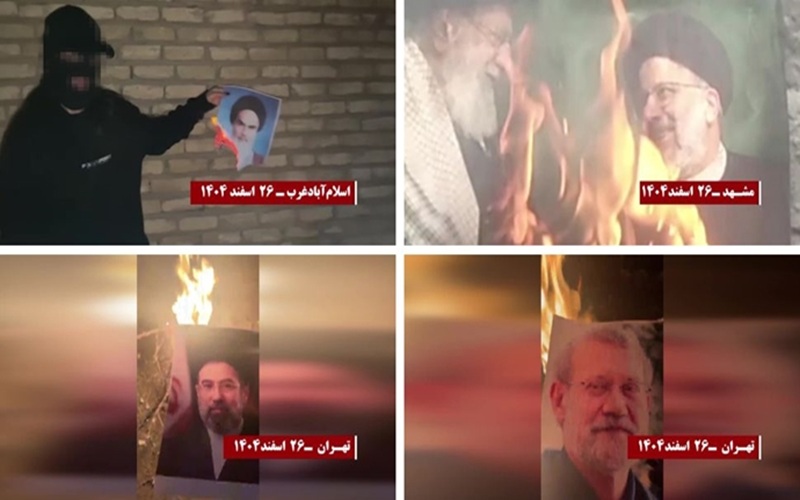
The stakes are shaped by decades of struggle. From June 20, 1981, to January 2026, successive waves of uprisings have defined the Iranian people’s demand for change. Preserving the aspirations and achievements of these movements requires more than resistance—it demands organization, clarity of purpose, and a coherent political alternative.
At its core, this moment is a call for vigilance. Iran’s current exceptional conditions underscore the necessity of a front that categorically rejects all forms of dictatorship and foreign dependency. Such a front must not only articulate national interests but also embody them through a viable and actionable alternative.
This raises a fundamental question: what distinguishes a genuine alternative from one that is artificial or imposed?
The answer lies in Iran’s modern historical trajectory. For at least 150 years, the country’s fate has oscillated between two poles: monarchy and clerical rule—“Shah and Mullah.” Despite their apparent differences, both have relied on authoritarianism and exclusion to maintain power. Together, they have functioned as a scissor, constraining Iran’s development through cycles of dependency, repression, and conflict.
One has fostered reliance on external powers; the other has pursued regional destabilization through ideological expansionism. Both have drawn on propaganda and public manipulation, reinforcing a closed political system that has repeatedly denied Iranians their right to self-determination.
The cumulative result of this historical cycle is visible today: a nation pushed toward crisis, including the danger of broader conflict.
Breaking out of this pattern requires an alternative that emerges from sustained resistance to both forms of dictatorship. Iran’s contemporary political landscape, shaped by decades of struggle, effectively reflects two opposing fronts: a coalition of authoritarian forces rooted in monarchy and clerical rule, and a countervailing front of pro-democracy forces.
A viable path forward lies in consolidating around the latter—an alternative grounded in what has been described as a “third option.” This approach rejects both appeasement of the current ruling system and reliance on foreign military intervention. Instead, it centers on democratic change driven by the Iranian people and their organized resistance.
At present, this perspective has found expression in the proposed provisional government framework put forward by the National Council of Resistance of Iran (NCRI). It presents itself as a political roadmap designed to navigate the country through this critical transition while safeguarding national sovereignty and democratic principles.
Decades of experience—from 1981 through early 2026—underscore the urgency of this moment. Iran’s future is not only a domestic question but increasingly part of a broader global equation. As such, the responsibility to shape that future rests on collective awareness and decisive action.
The central message is clear: Iran’s salvation lies in opening the path for a legitimate, independent, and democratic alternative—one defined by its rejection of all forms of dictatorship, its non-dependence, and its alignment with the national interests of the Iranian people.
For those committed to a future beyond both monarchy and clerical rule, the task ahead is strategic as much as political: to expand awareness, mobilize support, and bring this third option—from concept to reality—across Iran and within the global Iranian community.