


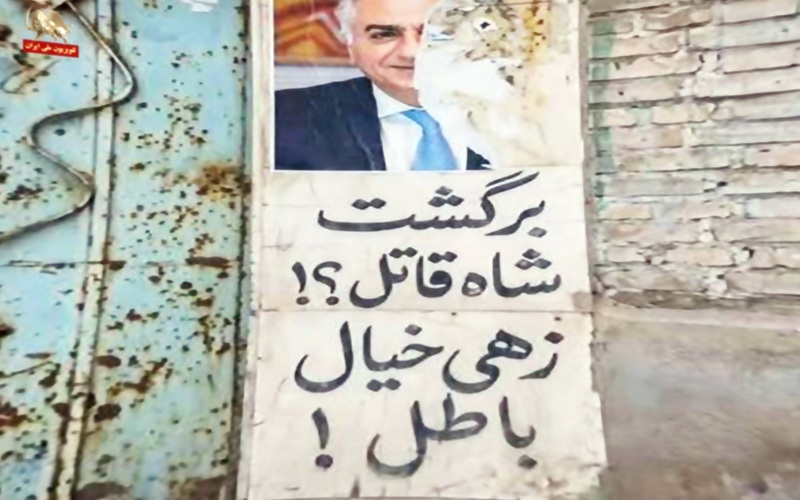

An analysis by the Italian weekly argues that Western efforts to portray the exiled crown prince as Iran’s future leader overlooked the country’s political realities and the absence of meaningful domestic legitimacy.
The Italian weekly Panorama has published an analysis arguing that the widespread narrative portraying Reza Pahlavi as the natural alternative to Iran’s ruling regime has failed to reflect the country’s political realities.
According to the publication, the rapid decline in international media attention surrounding Pahlavi demonstrates the risks of constructing political narratives around media visibility rather than developments inside Iran.
From Constant Media Attention to Sudden Silence
Panorama notes that for months Reza Pahlavi was presented through interviews, conferences, official meetings, and extensive media appearances as the figure expected to lead Iran following the fall of the current regime.
According to the publication, this created the impression that Iran’s political future had already been decided and that the son of the country’s last monarch was preparing to assume a leadership role.
Today, however, Panorama observes that Pahlavi has largely disappeared from international headlines. The magazine argues that this sudden silence should prompt a reassessment of the narrative that surrounded him from the outset.
According to the report, the political role attributed to Pahlavi was significantly greater than his actual political influence.
Media Visibility Is Not Political Leadership
One of the report’s central arguments is that many observers confused international media exposure with genuine political leadership.
Panorama argues that appearing frequently in international media, participating in conferences, and meeting foreign officials cannot substitute for the domestic legitimacy required to play a decisive political role inside Iran.
The publication further notes that political leadership cannot be created through communication strategies or international publicity alone.
Political Change Cannot Be Manufactured Abroad
The Italian weekly argues that, during recent regional developments, a growing narrative emerged in some Western political and media circles suggesting that the Iranian regime was nearing collapse and that all that remained was identifying a recognizable public figure for a post-regime transition.
According to Panorama, history demonstrates that political change is not created through international conferences or media campaigns. Rather, lasting political transformation requires support and legitimacy rooted inside the country.
The publication emphasizes that opposition to the Iranian regime should not automatically be interpreted as support for any single individual, warning that this distinction has often been overlooked in international discussions.
Media Hype Failed to Reflect Political Reality
According to Panorama, the image of Reza Pahlavi as the inevitable successor to the Iranian regime was driven largely by international media exposure rather than developments inside Iran. The publication argues that months of interviews, conferences, and official meetings created expectations that were ultimately overtaken by events.
The Italian weekly concludes that the attempt to present a single media personality as the ready-made alternative to the Iranian regime overlooked the realities on the ground. It notes that political change cannot be manufactured through publicity campaigns or international promotion alone, but must be rooted in developments inside Iran.
A Broader Lesson for International Observers
Concluding its analysis, Panorama argues that Iran’s political future cannot be understood through simplified narratives centered on individual personalities.
The publication states that the country’s complex political realities require more serious and nuanced analysis than efforts to identify a single figure as the solution to Iran’s long-standing political crisis.
According to the magazine, international politics should not be approached as though a complex national transformation can be achieved simply by promoting one highly visible personality. Instead, any assessment of Iran’s future should be grounded in the realities inside the country rather than expectations shaped by international media narratives.