
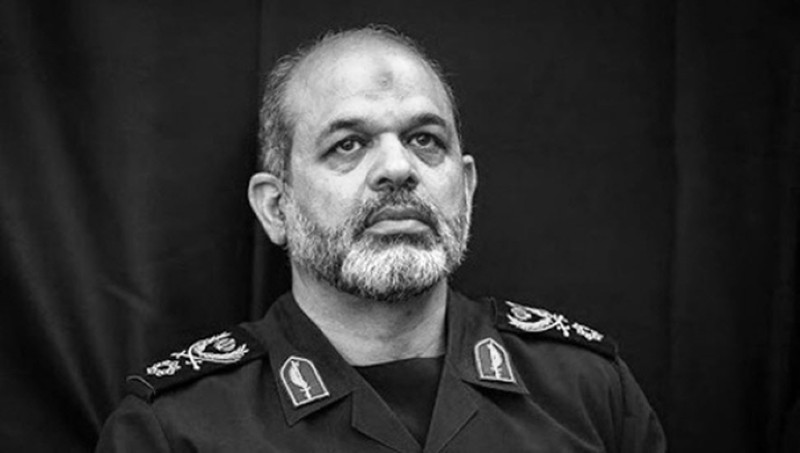

The regime’s leader selects a longtime IRGC commander accused of global terrorism and human rights abuses to strengthen military control.
Iran’s Supreme Leader Ali Khamenei has appointed Ahmad Vahidi, a senior Islamic Revolutionary Guard Corps (IRGC) commander and former head of the Quds Force, as deputy chief of the regime’s Armed Forces General Staff.
Vahidi, a veteran of the IRGC since 1980, has held several key posts under different administrations, including Minister of Defense under Mahmoud Ahmadinejad and Minister of Interior in Ebrahim Raisi’s cabinet. He also played a central role in establishing the regime’s Ministry of Intelligence during the early years after the 1979 revolution.
Vahidi is internationally wanted for his alleged involvement in major terrorist attacks. He was one of the key planners behind the 1994 AMIA bombing in Buenos Aires, which killed 85 people, and is also implicated in the 1996 Khobar Towers bombing in Saudi Arabia that targeted U.S. forces. Argentine prosecutor Alberto Nisman formally accused him of orchestrating the AMIA attack, and later died under suspicious circumstances a day before he was due to testify about Tehran’s secret dealings with Argentina’s former government.
In addition to being sanctioned by the United States, Vahidi has been linked to al-Qaeda operations in Afghanistan and Pakistan, according to a 2003 Washington Post investigation.
Before his latest appointment, Vahidi served as the head of the Supreme National Defense University, a major regime institution for military and strategic research.
Khamenei’s decision follows the death of Mohammad Bagheri, the previous chief of the Armed Forces, in June. The post was temporarily given to Abdulrahim Mousavi, a senior army commander. By assigning Vahidi as deputy chief, Khamenei effectively restores IRGC dominance over the military structure, positioning him alongside Mousavi to reinforce the regime’s control apparatus.
Vahidi’s long record in intelligence, terrorism, and military command highlights Khamenei’s strategy to consolidate internal repression and external aggression under the control of loyal IRGC veterans.